

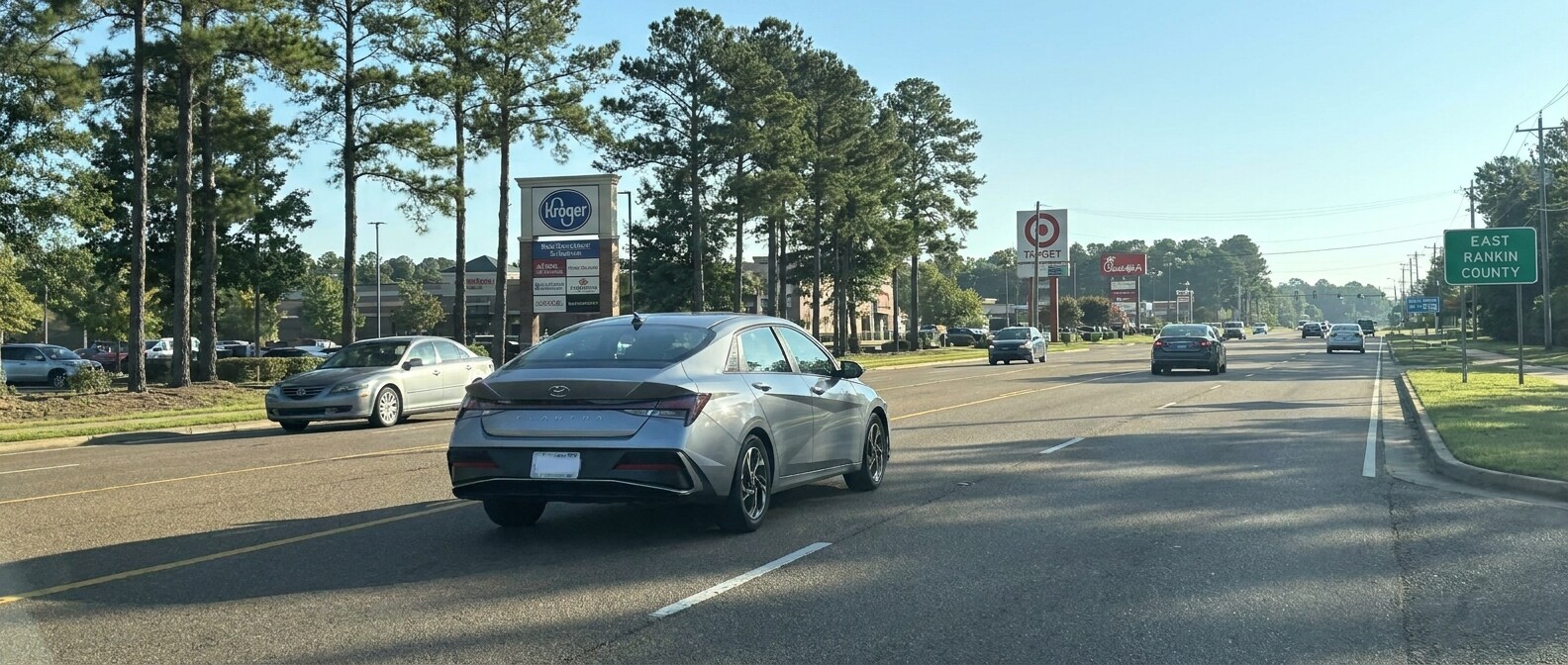
Plenty of Rankin County buyers walk onto our lot already decided that they need an SUV. The reasoning usually runs some version of "a sedan is too cramped," or "the hybrid isn't worth it on my commute," or "I need something tougher for Mississippi roads." We hear all three. On every one of those points, the verified numbers tell a different story than the assumption.
- Myth: A sedan is too small for a real commute. Reality: The 2026 Hyundai Elantra carries five adults and 14.2 cubic feet of trunk space; the Sonata stretches to 15.6.
- Myth: Hybrids only pay off on long highway runs. Reality: Hybrid regenerative braking recovers energy during deceleration, so stop-and-go on Lakeland Drive is exactly where the fuel savings concentrate most.
- Myth: The gas Elantra isn't efficient enough to matter. Reality: The EPA rates the 2026 Elantra SE at 35 mpg combined, which outpaces most compact crossovers in the same class.
- Myth: You'll regret not getting the SUV once you have passengers. Reality: The 2026 Sonata carries 46.1 inches of front legroom and a 15.6-cubic-foot trunk, more than enough for a Brandon school run or an airport drop-off.
- Myth: The hybrid upgrade isn't worth the extra cost for a short Rankin County commute. Reality: Stop-and-go is where the hybrid system earns back the most, not the least.
So which car actually makes sense in a town like this? Not the one that feels biggest on the lot, necessarily, because Flowood runs stop-and-go, the sort of place where you wait through the Airport Road light twice. The data points toward the sedans more often than buyers expect once they look.
Are Hyundai Sedans Actually Too Small for Rankin County Life?
The 2026 Hyundai Elantra sits in the compact class, so the worry about size is understandable, yet compact describes a category rather than a verdict, and the trunk holds 14.2 cubic feet of usable space for daily errands. For context, that handles a full grocery run from the Flowood Marketplace corridor or three carry-on bags for an airport drop-off on Airport Road. It loads flat without a step or a liftgate.
The Sonata enters the conversation when five adults and real cargo are the daily requirement. Its 15.6-cubic-foot trunk beats several small SUVs on paper, and 46.1 inches of front legroom is generous by any sedan standard. The rear seat measures 34.8 inches of legroom, and that number is the plain limitation of the class. For two adults running a daily Flowood-to-Jackson commute, though, the back seat rarely gets used anyway. Know your actual use case before the SUV aisle makes the decision for you.
| Myth | What's Actually True |
|---|---|
| "A sedan is too cramped for real use" | Elantra trunk: 14.2 cu ft; Sonata trunk: 15.6 cu ft; Sonata front legroom: 46.1 in (Hyundai published spec) |
| "Hybrids only pay off on highway miles" | Hybrid regenerative braking recovers energy during deceleration; EPA city rating for the 2026 Elantra Hybrid Blue is 51 mpg, its highest single figure |
| "The gas Elantra barely beats an SUV on efficiency" | The EPA rates the 2026 Elantra SE at 35 mpg combined, ahead of most compact crossovers in the same class |
| "You need SUV ground clearance for Mississippi roads" | Lakeland Drive is a paved commercial arterial; the Sonata's 5.3 in of ground clearance is fully adequate for every road on the standard Rankin County commute |
| "Sedans aren't safe enough in heavy commuter traffic" | Hyundai SmartSense driver assistance is standard on both the 2026 Elantra and the 2026 Sonata |
Stop-and-Go Is Where the Hybrid Equation Flips
A hybrid system does its best work in exactly the kind of stop-and-go driving this market delivers every morning, so the usual assumption about hybrids needing highway miles flips right here, because the Elantra Hybrid's regenerative braking converts the energy from slowing down into electricity and recharges the battery every time traffic stops. None of that is a marketing promise. The regen loop runs most efficiently when you're repeatedly decelerating and accelerating, which is precisely what happens between the Airport Road intersection and the retail strip on Lakeland Drive on any weekday morning.
The 2026 Elantra Hybrid Blue carries an EPA estimate of 51 city / 58 highway / 54 combined mpg. The SEL Sport and Limited hybrid trims come in at 49/52/50 combined. Those figures hold up in real mixed driving because city deceleration recharges the battery instead of wasting that energy as heat. The Elantra Hybrid's fair downside is power. It produces 139 horsepower, which is adequate for everyday driving (a hard highway merge is where you'd notice the ceiling), so if merging onto I-20 at speed is a frequent part of your day, that's worth weighing.
If you want a roomier midsize body with the same stop-and-go logic, the Sonata Hybrid Blue is EPA-rated at 47 city / 56 highway / 51 combined mpg, with 192 horsepower. More cabin, more power, and the same regenerative braking advantage on the same congested roads.
What Changes When You Know Your Actual Commute Numbers
The gas-versus-hybrid call comes down to your actual route, so run your own mileage against it before you decide, because a short surface-street loop and a long congested I-20 haul point toward different trims even though both sedans do the job well.
- Lakeland Drive from Pearl to Flowood runs roughly five miles. At 35 mpg combined on the gas Elantra SE (EPA-rated), the fuel cost per leg is a rounding error on a monthly budget.
- Extend the commute to a full Rankin-County-to-downtown-Jackson run on I-20, and the picture shifts. PM peak delays on I-20 between Clinton and Pearl run 25 to 38 additional minutes of stop-and-go, per MDOT traffic data. That added congestion is specifically the condition where the hybrid's city advantage compounds most.
- Add frequent airport runs on Airport Road, and even the gas Elantra's 40 highway mpg (EPA-rated, SE trim) is doing real work for you.
Put plainly, a pure-gas Elantra SE handles most Rankin County commutes without any efficiency apology, and the hybrid earns more of its premium the longer and more congested the route gets. None of that is a hedge. You can verify the pattern against your own daily mileage before you buy.
- Pure-gas Elantra SE: EPA-estimated 35 mpg combined, lightest entry point
- Elantra Hybrid Blue: EPA-estimated 54 mpg combined, strongest return on stop-and-go routes
- Gas Sonata SE: EPA-estimated 32 mpg combined, 191 horsepower, more cabin room
- Sonata Hybrid Blue: EPA-estimated 51 mpg combined, midsize space with near-compact efficiency
So Which Hyundai Sedan Actually Fits Your Jackson-Area Commute?
Which Hyundai sedan fits depends on how many people and how much congestion your week actually involves, and both answers hold up at the counter because our team drives this same corridor every day, right down to the Airport Road intersection that sees around 53,000 vehicles on an average day. We're at 4200 Lakeland Drive, so that number isn't abstract to us. It's the light you're already sitting at. Buyers who underestimate how much of their daily driving is stop-and-go errand and commute mileage are often surprised once they track it. The hybrid's city advantage ties directly to that documented traffic pattern rather than a best-case test loop.
The 2026 Sonata fits if your household regularly carries three or four people, if airport luggage runs are routine, or if you want midsize comfort on a longer I-20 stretch. The Sonata SE's 2.5-liter naturally aspirated four-cylinder delivers 191 horsepower and an EPA-rated 28 city / 38 highway / 32 combined mpg. That number trails the hybrid, though it still describes a genuinely capable daily driver in a package most Rankin County families find comfortable.
The Elantra is the right fit for solo and two-person commuters running Lakeland Drive and the commercial corridors daily. Its compact footprint means easier parking in the dense retail lots. At 35 combined on gas, it's already ahead of most crossovers, and at 54 combined on the Hybrid Blue, it's the most fuel-efficient sedan in its EPA class.
One fair tradeoff still stands with either sedan. Neither gives you the elevated seating position of an SUV, and both carry real rear-seat legroom limits if you're regularly hauling tall adults. We say that plainly because pretending otherwise doesn't help you choose the right car. See what's currently on our lot and find the trim that fits your actual commute.
Frequently Asked Questions
Does the Elantra Hybrid really save fuel on a short city commute?
Yes, and short stop-and-go commutes are specifically where the savings concentrate. The 2026 Elantra Hybrid Blue's regenerative braking recovers energy during every deceleration and uses it to recharge the battery. The EPA rates it at 51 mpg in city driving, which reflects repeated slow-and-go cycles directly. A longer uninterrupted highway run still returns the EPA highway figure of 58 mpg, but the strong city number shows that short urban routes aren't a disadvantage for the hybrid system. They're its strongest setting.
Is the Sonata or the Elantra better for a Flowood-to-Jackson daily commute?
It depends on your household size and how much of your route involves congested surface roads versus open highway. For a solo commuter or a couple, the 2026 Elantra Hybrid Blue's EPA-estimated 54 mpg combined makes it the efficiency leader in a compact footprint that's easier to park in Flowood's commercial corridors. If you regularly carry passengers or airport luggage, the Sonata's 15.6-cubic-foot trunk and 46.1 inches of front legroom give more practical daily comfort. Drivers whose I-20 route involves meaningful peak-hour delay would find the Sonata Hybrid's 51 mpg combined and 192 horsepower the balanced choice between space, efficiency, and power.


