

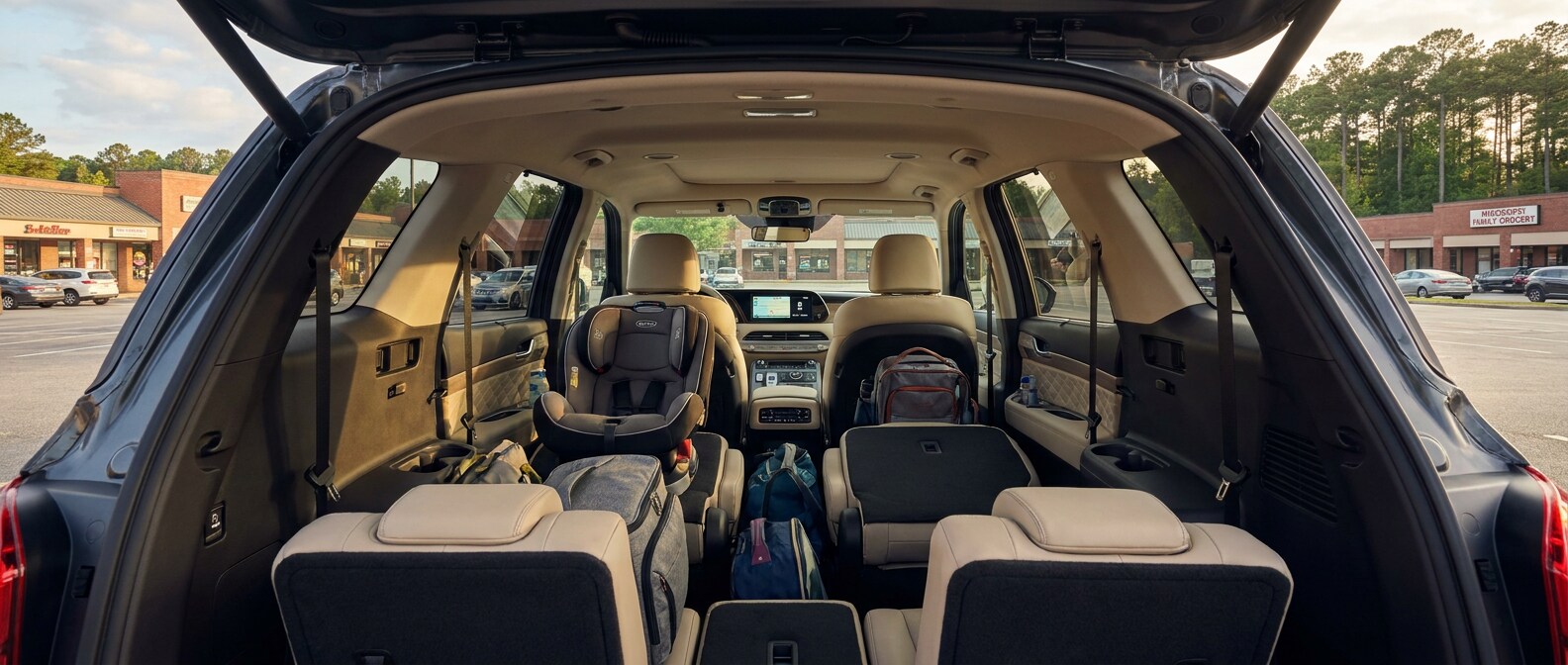
If your household is adding a seat at the dinner table and subtracting trunk space at the same time, you've probably already narrowed it down to two Hyundai SUVs. The 2026 Santa Fe and the 2026 Palisade are both three-row family haulers on our lot, and the right one comes down to a question that's easy to skip until you're standing at the cargo hatch, namely how full your third row is and how often.
The 2026 Santa Fe is the smarter pick for households that need a third row on standby but spend most miles running two rows and cargo. The 2026 Palisade earns its keep when three rows are filled day in and day out and you still need meaningful luggage room behind the last seat.
- The Santa Fe seats seven, starts with more hybrid efficiency (EPA-estimated 36 mpg combined, FWD), and fits households that use the third row occasionally.
- The Palisade seats seven or eight, hauls 19.1 cubic feet behind its third row (vs. 14.6 in the Santa Fe), and tows up to 5,000 lbs with the V6.
- For stop-and-go on Lakeland Drive, the Santa Fe Hybrid's fuel economy advantage is real and measurable.
- For a household that packs all three rows on every Brandon school run or airport pickup, the Palisade's extra cargo clearance behind the third row is the deciding number.
- The Palisade Hybrid splits the difference: three-row space plus an EPA-estimated 34 mpg combined (FWD SEL/SEL Premium).
What's the Real Difference Between These Two SUVs?
Both ride on the same three-row Hyundai idea, but the similarities thin out fast where it counts, since the Santa Fe is the more compact of the two with a turbocharged 2.5-liter four-cylinder making 277 horsepower while the Palisade runs a larger 3.5-liter V6 rated at 287 horsepower. Neither figure is what moves families to one or the other. The cargo math is.
| Spec | 2026 Santa Fe | 2026 Palisade |
|---|---|---|
| Seating capacity | 6 or 7 | 7 or 8 |
| Cargo behind 3rd row | 14.6 cu ft | 19.1 cu ft |
| Cargo behind 2nd row | 40.5 cu ft | 46.3 cu ft |
| Max cargo (all rows flat) | 79.6 cu ft | 86.7 cu ft |
| Gas engine EPA combined | 24 mpg FWD / 23 mpg AWD | 21 mpg FWD / 20 mpg AWD |
| Hybrid EPA combined | 36 mpg FWD / 34 mpg AWD | 34 mpg FWD / 29 mpg AWD |
| Max towing (gas) | 3,500 lbs | 5,000 lbs |
| Max towing (hybrid) | 2,000 lbs | 4,000 lbs |
Behind the third row, the cargo gap works out to 4.5 cubic feet. It doesn't sound dramatic until you're fitting luggage around a stroller frame, a backpack mountain, and a swim bag with all seven seats taken. At 14.6 cubic feet, the Santa Fe's third-row hold fits a few duffel bags. The Palisade's 19.1 cubic feet fits those same bags plus a couple of roller suitcases.
Does Third-Row Legroom Actually Matter for Your Kids?
Third-row legroom is the Santa Fe's clearest limitation against the Palisade, since the Santa Fe gives 30.0 inches back there (fine for kids, tight for adults past a quick errand) and the Palisade answers with 32.1 inches, enough for shorter adults on a longer drive. Those 2.1 inches read small on paper. On a two-hour drive they don't.
The Santa Fe Hybrid carries the same 14.6 cubic feet behind the third row as the gas Santa Fe. No cargo penalty for the powertrain swap, which is worth knowing. You're still working within the same tighter footprint, though.
For a Rankin County family doing airport pickups at Jackson-Medgar Wiley Evers International Airport with luggage and three rows occupied, that 4.5-cubic-foot difference shows up right away. The I-20 run from Flowood to the terminal is short. The cargo scramble at the curb is not.
Step up to the Palisade Hybrid and the efficiency story joins the larger platform, earning an EPA-estimated 34 mpg combined with FWD on the SEL and SEL Premium trims and dropping to 29 mpg combined with AWD. That's a meaningful upgrade from the gas Palisade's 21 mpg combined (FWD).
Which Model Actually Wins on Practicality?
Practicality tilts toward the Palisade once you fold the third row flat, though the Santa Fe stays genuinely useful, since row three down opens the Santa Fe to 40.5 cubic feet of cargo while the Palisade opens to 46.3 cubic feet in the same setup. That Santa Fe space is cube-shaped and real, good for hauling gear to Flowood's soccer fields or loading up for a Brandon weekend. Both are roomy. Both swallow a loaded Costco run. The Palisade just handles it with the third row up too.
Towing matters for a subset of Rankin County families. The gas Palisade pulls up to 5,000 lbs when properly equipped, which covers a small boat, a jet ski trailer, or an enclosed utility trailer comfortably.
The Santa Fe's gas tow rating tops out at 3,500 lbs, and the Santa Fe Hybrid drops further to 2,000 lbs. If there's a trailer in your driveway or in your near-future plans, the Palisade V6 is the clear answer.
Seating configuration is the other practical axis. The Palisade offers a second-row bench on some trims for eight-passenger capacity, or captain's chairs on others for seven with easier third-row access. The Santa Fe maxes at seven. For a household running carpools on the Brandon school route, that eighth seat earns its spot.
So Which Should You Pick?
Pick the Santa Fe if your third row sits empty more than it's full, and pick the Palisade if it's full more than it's empty, which is the short version of a decision that otherwise drags on for weeks at the cargo hatch.
Pick the Santa Fe (gas or hybrid) if: Your third row is a rotation spot for one or two kids on most days, you fold it flat for cargo the other days, and you want the Santa Fe Hybrid's EPA-estimated 36 mpg combined (FWD) working for the Lakeland Drive commute. You get a sharp, well-equipped three-row SUV for a household not quite outgrowing a two-row life.
Pick the Palisade (gas V6) if: Three rows fill up most days, you need the 5,000-lb tow rating, and cargo space behind the last seat matters as much as the seat itself. The V6 runs 21 mpg combined (FWD), so the efficiency trade-off is real, but the platform is built for full-household use.
Pick the Palisade Hybrid if: You want the Palisade's space with meaningfully better fuel economy. The EPA estimates 34 mpg combined (FWD, SEL/SEL Premium trim) against 21 mpg for the gas Palisade, and that difference stacks up over a year of Rankin County driving. Towing drops to 4,000 lbs, which still covers most trailer needs.
The plain version comes down to math on passengers. A household of four with one or two car seats can buy the Santa Fe Hybrid right now and revisit in two years. A household already at five or six regular riders should buy the Palisade today and stop wondering.
Browse our current Hyundai inventory in Flowood
Frequently Asked Questions
Is the 2026 Hyundai Santa Fe's third row big enough for everyday family use?
The 2026 Santa Fe's third row offers 30.0 inches of legroom, which suits children comfortably for regular use and works for adults on short trips, then gets cramped for adults on longer drives. Cargo behind the occupied third row is 14.6 cubic feet, enough for a few bags but tight when the whole family is loaded up. Families who plan to seat adults back there on the regular, or who need meaningful luggage room behind it, should look at the Palisade instead.
Does the 2026 Palisade Hybrid lose much efficiency compared to the Santa Fe Hybrid?
Yes, and the trade-off runs both directions. The 2026 Santa Fe Hybrid earns an EPA-estimated 36 mpg combined with FWD, while the Palisade Hybrid SEL and SEL Premium with FWD reach an EPA-estimated 34 mpg combined, a real gap over a year of daily driving on routes like Lakeland Drive. The Palisade Hybrid AWD drops further to 29 mpg combined. What you're paying for in that efficiency trade is the Palisade's larger cargo platform, its 4,000-lb hybrid tow rating, and up to eight seats. For a household that actually needs those things, the two-mpg difference is worth it.


