

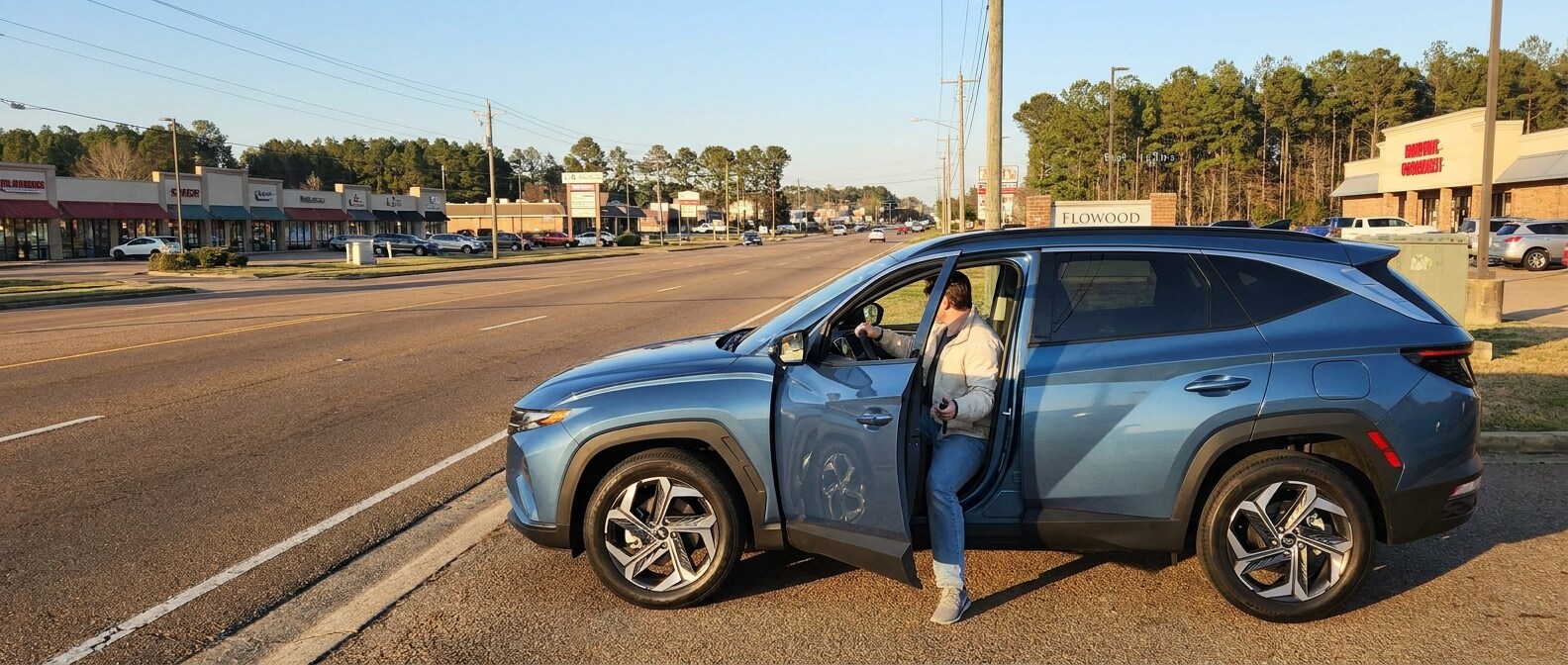
A quick lap around our lot won't tell you much. You'll learn the seat adjusts and the radio works, and that's about it. What you really want to know is whether this vehicle handles the Lakeland Drive stop-and-go you do five days a week, whether the I-20 on-ramp merge feels confident, and whether the safety features you're paying for actually show up in real traffic. A focused 25-to-30-minute drive across three road types answers all of that.
Bring your phone, bring whoever rides with you most, and ask us for a route that hits all three segments. We build it on purpose, and it isn't the fastest loop back to the lot.
The 2026 Hyundai Tucson is usually the first model we run through this sequence, though every check below applies just as well to any vehicle on our lot.
What to Do (and Skip) on the Drive
The seat and the stereo are worth about 90 seconds in the parking lot and no more, so hand the rest of the test drive to the things you can only judge in motion, because that's where a vehicle shows whether it fits the Lakeland Drive grind or just the showroom. Those two take almost no time standing still. Everything else waits for the road.
| Check | Do | Don't |
|---|---|---|
| Forward Collision-Avoidance Assist | Approach a red light on Lakeland Drive and feel whether the system modulates your following distance smoothly in clustered stop-and-go | Turn it off "to feel the real car." You will own it turned on. |
| Smart Cruise Control with Stop and Go | Engage it once you are on I-20 and let it hold the gap; notice whether the resumption after a full stop feels natural or abrupt | Assume adaptive cruise and Highway Driving Assist are the same system. They are not. |
| Blind-Spot Collision Warning | Signal a lane change on I-20 with a car in your blind spot; confirm the mirror icon fires and note whether steering correction is perceptible | Test it at 25 mph in an empty parking lot where there is nothing to detect. |
| Driver Attention Warning | Drive 15 minutes in your normal style and watch whether a fatigue prompt appears; a commute-length segment is exactly the scenario it monitors | Write it off before you have driven 90 minutes to the coast with it active. |
| Infotainment and phone pairing | Pair your phone before you roll one foot | Spend the first red light fumbling with Bluetooth at 45 mph. |
| Rear seat and cargo | Have your most frequent passenger sit in back during the drive, not after | Accept a walk-around substitute for an occupied rear seat. |
| Climate system | Set it to max cold on a warm afternoon and confirm the cabin cools before the I-20 segment ends | Test A/C on a cool November morning and assume it performs the same in a Mississippi August. |
The One Technique That Changes Everything
The one technique that changes a test drive is to drive the way you actually drive on an ordinary Tuesday, with the normal distractions and the normal pace, instead of easing around on your best behavior while a salesperson rides along. Drive it cautiously and you'll get an accurate read on a car you'll never really drive that way. Walk through the sequence below in order.
- Start on Lakeland Drive in real traffic. The stop-and-go from Flowood Drive toward the I-20 interchange mirrors a standard east-metro Rankin County commute segment. Lakeland Drive runs east to west through Flowood. Feel whether Forward Collision-Avoidance Assist modulates smoothly or grabs the brakes abruptly. Whatever it does there is what you'll live with every morning.
- Merge onto I-20 at a realistic pace. Don't creep up the ramp. The on-ramp is your one shot to feel genuine throttle response and whether the powertrain delivers when you ask for it. A Tucson Hybrid or Santa Fe Hybrid will feel noticeably different from a gas model here on acceleration, and that difference is worth feeling before you commit.
- Hold a highway lane for three to five minutes. If your trim includes Highway Driving Assist, engage it here. It rolls adaptive cruise and lane-centering into one system. Hyundai confirms it arrives at specific higher trims rather than across the full lineup, so ask us which trim you're in before you leave the lot. Once you've felt a trim that has it against one that goes without, the gap is obvious.
- Return and do one slow parking maneuver. Back into a space and use the rearview camera. If you're shopping a larger three-row, this step matters a great deal. The 2026 Palisade is an all-new model for this year, and on higher trims its camera-based monitoring displays a live feed from the adjacent lane directly in the gauge cluster the moment you signal. You'll want to see that in person before you decide.
- Sit still for two minutes after you park. Ask yourself whether the seat is still comfortable. That answer tells you more than how it felt in the first 30 seconds.
One Last Check When You Hand Back the Keys
When you hand back the keys, run through what the drive actually told you rather than what you hoped it would, because the honest read sits in the details you noticed without trying. If the I-20 merge felt underpowered, that's real data. If the Lakeland Drive stop-and-go felt effortless, that's real data too. If you're still torn between a sedan and a crossover for a daily Rankin County commute, the Elantra and the Kona are worth running back-to-back on the same route. One visit, two answers.
The 2026 Hyundai lineup is a 2026 model year across the board. What you drive today is what's on sale now.
If you're ready to move forward, knowing your current vehicle's trade value is the most useful thing to have in hand before you sit at the desk.
By the Hallmark Hyundai Flowood Team | November 2026


