

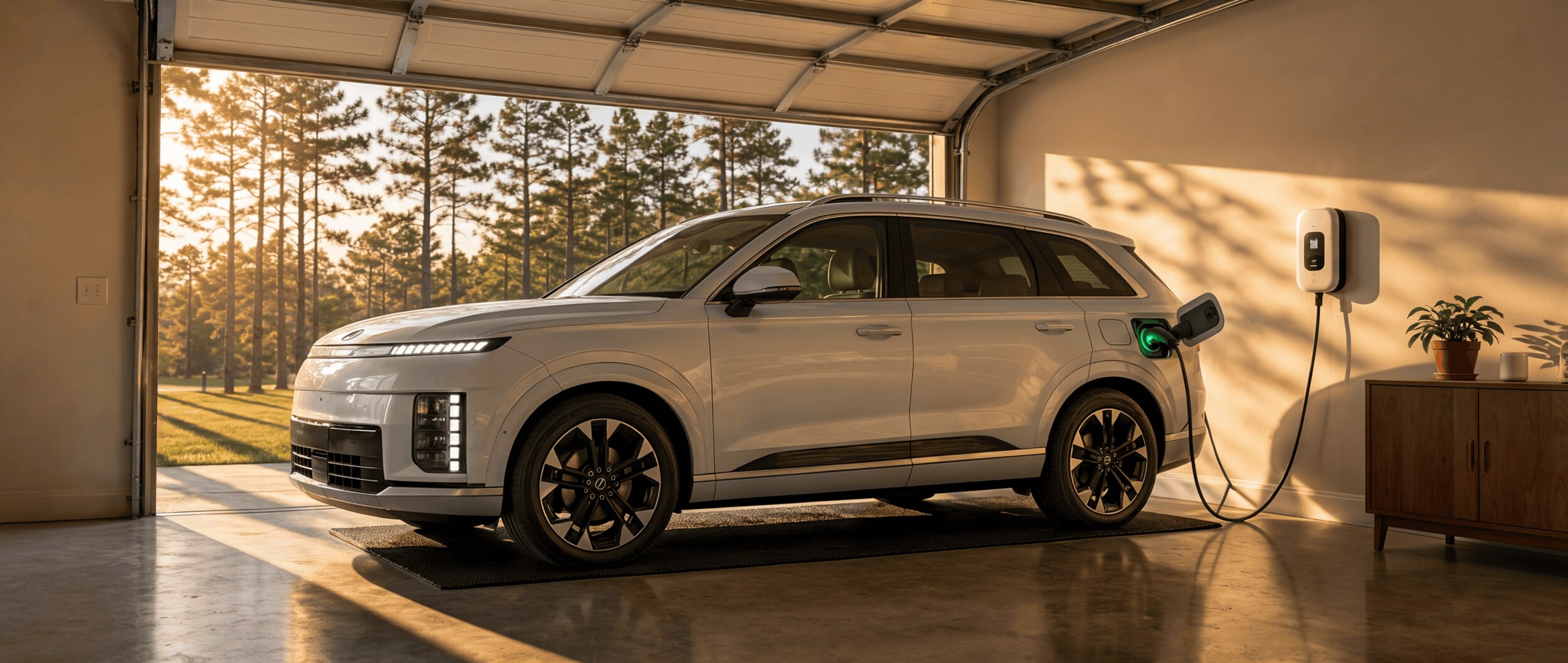
Most buyers in Flowood and Brandon can be fully set up for home charging before their EV ever leaves our lot, but only if they ask the right questions in advance. The electrical work takes days, not hours. Get the answers below sorted before you take delivery, and you'll plug in that first night instead of waiting a week for an electrician.
Browse our IONIQ 9 inventory and use this checklist alongside it.
What Goes on the Checklist?
Work through each item on this list before your delivery date, because the questions that matter here are about your house rather than about which charger brand to buy, and sorting them early is what lets you plug in on day one instead of waiting on an electrician. None of it's complicated.
Your Home EV Charging Prep Checklist
- [ ] Know your panel capacity. Find your main breaker and check its amperage rating. 100A, 150A, or 200A. A Level 2 home charger needs a dedicated 240V circuit, and that circuit has to fit alongside everything else already running. A 100A panel that's nearly full may need to be evaluated before install.
- [ ] Confirm you can run a dedicated circuit. Level 2 charging counts as a continuous load under electrical code, so the circuit has to be sized at 125% of the charger's draw. For the IONIQ 9's 11 kW onboard ceiling, that works out to about a 60A circuit breaker.
- [ ] Know your car's onboard charger ceiling. The IONIQ 9 accepts up to 11 kW on Level 2, which is around 46 amps at 240V. A 48A EVSE is the right match. A bigger charger won't speed things up, since the ceiling is set by the car rather than the wall unit.
- [ ] Check the connector type. The IONIQ 9 uses a NACS port rather than J1772. You can use a NACS-native wall charger directly, or any J1772 unit with a NACS adapter. Know which you're buying before the electrician visits.
- [ ] Schedule the electrician before delivery day. Permits, inspection scheduling, and installation usually take several days to coordinate, so getting on the calendar now avoids the gap.
- [ ] Decide: hardwired or plug-in EVSE? A hardwired unit draws slightly faster and skips the receptacle entirely. A plug-in unit (NEMA 14-50 outlet) is portable if you move. Either works for the IONIQ 9 at its 11 kW ceiling.
- [ ] Plan the charger location. It needs to be within reach of the charge port when the car is parked. Measure from your planned parking spot to the wall, then add cord length. Garage corners eat more cable than they look.
- [ ] Check for a permit requirement. In Mississippi, Level 2 EVSE installations on new circuits generally require an electrical permit and inspection. Skipping it can create complications at home sale.
- [ ] Consider off-peak charging schedules. Most wall chargers and the Hyundai Bluelink app let you schedule charging for overnight hours. Entergy Mississippi's rate structure rewards off-peak use. Check your current rate tier before you assume all hours cost the same.
Why These Items Matter Most
A lot of generic EV-charging guides stop at get a Level 2, and that's fine as far as it goes, but it skips two details that come up again and again when buyers at our store prep for a first home install. Both matter before you order.
The onboard charger ceiling is the number that actually governs your setup.
The IONIQ 9 has an 11 kW onboard AC charger, the hardware inside the vehicle that converts wall power to battery power. It caps at roughly 46 amps at 240V. See current IONIQ 9 availability and notice that every trim. S, SEL, Limited, Calligraphy. Carries that same 11 kW ceiling. So if your electrician sizes a 60A circuit and you buy a 48A EVSE, you're right at the car's limit. A 64A charger on a 80A circuit costs more and charges the IONIQ 9 at the same speed. Spending more on a bigger unit buys you nothing at the IONIQ 9's ceiling.
On Level 2, the IONIQ 9 charges from 10% to 100% in 9 hours and 40 minutes, and that's the full 110.3 kWh battery. For a typical day of errand driving and commuting on the Lakeland Drive corridor, you rarely run the battery to empty overnight, so a few hours of charging covers what you used, most nights.
The NACS connector question catches people off guard.
The IONIQ 9 uses a NACS port (the same connector standard Tesla pioneered), which helps with access to public charging networks. At home, it means a J1772 wall charger won't plug in directly. You've got two clean options. Buy a NACS-native Level 2 charger, or buy a J1772 unit and run a NACS adapter. Both work. The trap is ordering a J1772 wall unit, having it installed, and then discovering the cable doesn't mate with the car's port.
Our finance team can walk you through EV purchase timing, including whether to book the charger install before or after you finalize the vehicle.
| Item | Why It Matters |
|---|---|
| Panel amperage (100A / 150A / 200A) | Determines whether you can add a 60A dedicated circuit without an upgrade |
| Onboard charger ceiling (11 kW for IONIQ 9) | Sets the EVSE amperage you actually need. No benefit buying above 48A |
| NACS vs J1772 connector | IONIQ 9 uses NACS natively. Wrong connector = wrong charger |
| Dedicated circuit requirement | NEC continuous-load rule means breaker must be sized at 125% of charger draw |
| Permit and inspection | Required in most Mississippi jurisdictions for new 240V circuits |
| Hardwired vs plug-in EVSE | Hardwired is marginally faster; plug-in is portable and reversible |
| Charge scheduling via app | Off-peak scheduling reduces electricity cost with no hardware change |
The Honest Tradeoff on Level 1
For a small number of buyers, Level 2 isn't strictly necessary, and if you drive under about 30 miles a day with your car sitting at home for 10 or more hours overnight, the included Level 1 cable on a standard 120V outlet can add around 30 to 50 miles of range per overnight session, which may cover your daily use.
The tradeoff is that Level 1 leaves almost no buffer. Take a longer day, run the battery lower than usual, need an early start, and you haven't recovered enough charge. Here in Rankin County, where a lot of daily driving is a mix of Lakeland Drive stop-and-go and quick runs between Brandon retail corridors, those variable days are common. Level 2 charges several times faster and gives you a full battery every morning regardless of how much you used the night before. For most buyers with the IONIQ 9's 110.3 kWh pack, Level 2's the right call, and Level 1 stays a reasonable backup. Keep it as the backup.
Print-and-Go: Your Pre-Delivery Recap
You don't need to do all of this in one afternoon, and most of it can spread comfortably across a week or two, so long as you begin with the electrical panel check and wrap everything up before your delivery day arrives. The order below works.
- Check your electrical panel this week. Find the main breaker rating and look at how many open slots remain.
- Call a licensed electrician for a panel assessment. Ask specifically whether a new 60A, 240V dedicated circuit is feasible without a panel upgrade.
- Choose NACS or J1772 + adapter for the wall unit. For the IONIQ 9, NACS-native is cleaner. Order the EVSE only after the electrician confirms your circuit plan.
- Pull the permit before work starts. In Mississippi, an electrical permit is required for new service circuits. Your electrician handles this, but confirm it's in the plan.
- Schedule installation at least a week before your expected delivery date. Inspection scheduling varies by jurisdiction. Rankin County inspectors are generally efficient, but buffer time prevents the gap.
- Set up charge scheduling in Bluelink before or during delivery. It takes five minutes and shifts your charging to overnight hours automatically.
Our service team is also available for EV ownership questions after delivery.
By the Hallmark Hyundai Flowood Team | November 2026
Frequently Asked Questions
Does the IONIQ 9 work with any Level 2 home charger?
Not directly with every unit. The IONIQ 9 uses a NACS charge port, so a NACS-native Level 2 wall charger plugs in directly. If you have or buy a J1772 Level 2 charger, you'll need a NACS adapter to connect it to the vehicle. Both configurations work, just confirm the connector type before you buy the wall unit.
How long does it take to charge the IONIQ 9 at home overnight?
On a Level 2, 240V, 11 kW home charger, the IONIQ 9 charges from 10% to 100% in 9 hours and 40 minutes. For typical daily driving in Flowood and the surrounding Rankin County area, you're rarely starting from near-empty, a few hours of overnight charging usually restores everything used during the day.


