


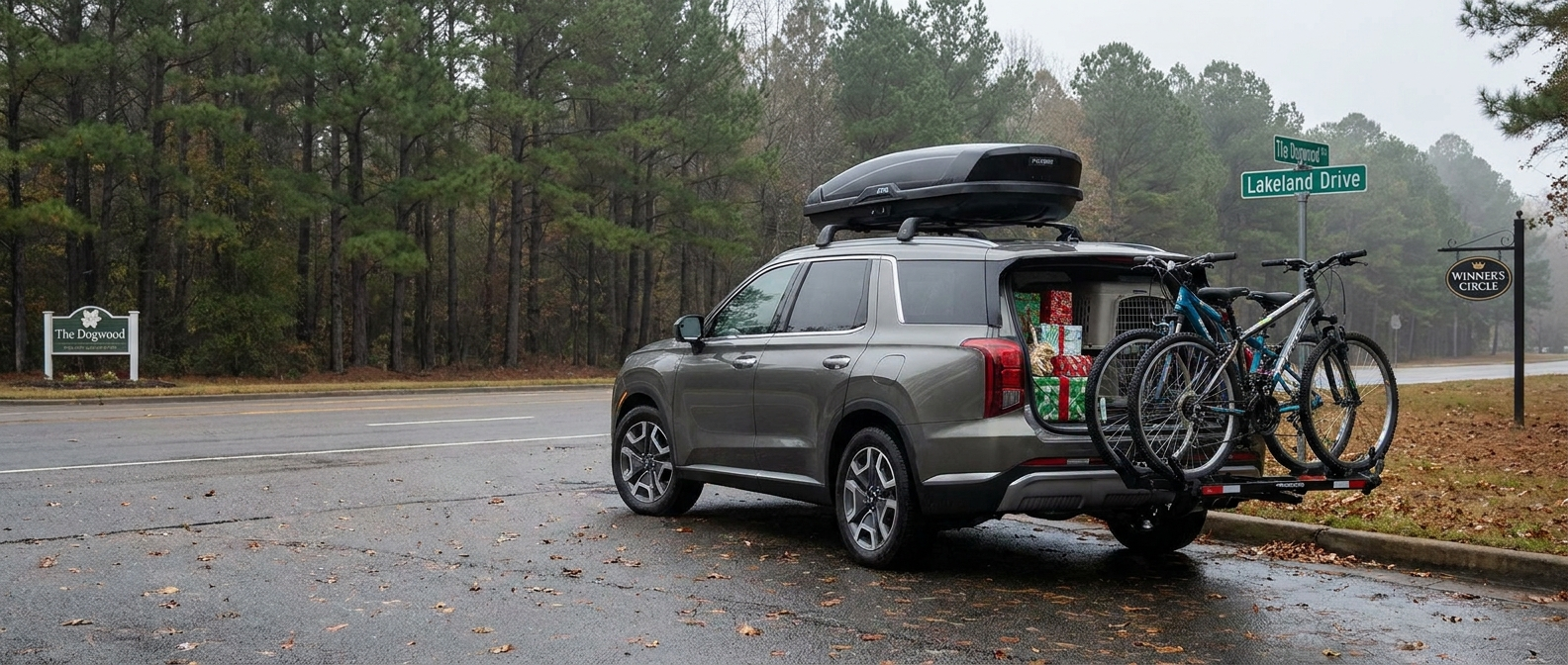
Tires and brakes are the two things that get families home safely when an early-November rain system parks over the I-59 corridor. They're also the two things that are easiest to skip before you load the car.
Whether you're driving a A Palisade packed for Thanksgiving or a Tucson Hybrid running family to Hattiesburg, which Hyundai you're driving doesn't much matter. What matters is that the tread you're rolling on and the pads clamping your rotors are ready for 300-plus miles of wet asphalt before you reach the Alabama line.
Run through this and you'll know what to check, why each item matters, and what the real service thresholds are.
What Goes on the Pre-Trip Checklist?
Work through these items the day before you leave, while the tires are still cold and you've got good daylight to see tread, sidewalls, and fluid clearly. None of it takes special tools, and most of it comes down to a penny, a quarter, and a careful look.
Tires
- [ ] Tread depth. Penny test. Push a penny into the deepest tread groove, Lincoln's head pointing down. If the top of his head shows above the tread, you're at or below 2/32 of an inch. At that point you're at the legal minimum, and it falls short of the target you want for a wet interstate run. Use a quarter instead. If Washington's head disappears into the groove, you've got at least 4/32 of an inch, which is the practical pre-trip minimum for wet roads.
- [ ] Tire pressure. Cold, from the door placard. The right number lives on the sticker inside the driver's door jamb, not on the tire sidewall. The sidewall number is the tire's rated maximum, not the vehicle's target. A NHTSA study found tires lose roughly 1 PSI per month on their own, so a set you haven't checked since August could be running low before you even pull out of Flowood.
- [ ] Sidewall condition. Run a hand along both sidewalls of each tire and look for cracks, bulges, or cuts. A sidewall bulge means the internal structure is compromised. Don't make the trip on it.
- [ ] Spare tire pressure. The spare counts too, and it's the one that's easy to forget. Check it. The spare takes the same placard-specified pressure as the full-size tires, or 60 PSI if it's a compact temporary spare, so check the placard. A flat spare is useless on a rural stretch of I-59 between Hattiesburg and Meridian where the next service exit might be twenty miles away.
Brakes
- [ ] Listen for squealing or grinding. Brake pad wear indicators are metal tabs engineered to squeal against the rotor when the pad material gets thin. Grinding means metal-on-metal contact, the pad material is gone. Either sound is a service appointment, not a "I'll deal with it after the holidays" situation.
- [ ] Feel the pedal. The pedal should feel firm and consistent from a stop. A soft or spongy pedal points to a brake fluid issue. A pulsing pedal when you brake at highway speed usually means a warped rotor.
- [ ] Brake fluid color. With the hood open, look at the brake fluid reservoir. Fresh fluid is nearly clear or pale amber. Dark brown or black fluid has absorbed moisture and should be replaced. That moisture lowers the boiling point of the fluid, which degrades braking performance on a long downhill stretch.
- [ ] Visual pad check, if you can see through the wheel. Through the spokes of most alloy wheels you can see the brake pad pressed against the rotor. The friction material, meaning the pad itself and not the metal backing plate, should be at least 3mm thick. Plan a replacement appointment if you're at or near that number before any highway trip.
Other quick items
- [ ] Wiper blades. Streak-free? November rain on I-59 is not the time to find out they're cracked.
- [ ] All exterior lights working, including brake lights.
- [ ] Tire rotation current? Every 5,000-7,500 miles is the general guideline, and uneven wear from skipped rotations shows up first as one tire failing the penny test while the others still pass.
Why Each of These Items Actually Matters on This Route
Get your service booked before you leave if any item above flags something, and if nothing does, the reasoning below still tells you why each threshold exists, so a borderline reading won't leave you second-guessing at 70 mph on wet pavement.
The tread number that matters is 4/32", not 2/32".
The legal minimum for tire tread in the U.S. is 2/32 of an inch, and tires sold here have built-in treadwear indicators that become flush with the tread surface at that depth. On wet asphalt, though, 2/32" is a very different situation than it is on dry summer highway. Wet-road stopping distance increases measurably as tread depth drops, and from Flowood through Hattiesburg to Meridian, November rain is a real and frequent condition. The National Weather Service forecast for Rankin County shows showers and thunderstorm chances throughout this first week of November, with temperatures running in the mid-60s to upper 70s. Wet roads, moderate temps, and long rural stretches without quick exits add up to the route profile you're preparing for. For a trip like this, the 4/32" quarter test is the right standard.
The brake pad floor is 3mm, and 4mm is when to act.
Technicians widely cite 3mm as the minimum friction material thickness before braking performance starts to degrade. (New pads typically start around 10-12mm.) Most techs plan the replacement when pads reach 3-4mm, because inner and outer pads wear at different rates. The inner pad you can't easily see can run thinner than the one you check through the wheel spokes. If you're at 4mm on the easy-to-see pad, get the service done before the trip, rather than after.
Tire pressure and load change together.
Holiday travel means a loaded vehicle. Three rows of family, gear in the cargo area, maybe a roof box. NHTSA notes that vehicle manufacturers specify cold tire inflation pressure for maximum loaded conditions on the door placard. Check your Hyundai's placard to confirm whether the front and rear pressures differ. They sometimes do, especially in a loaded three-row SUV. Check it cold, in the morning.
Quick check: Brake fluid that looks dark in the reservoir is more than a cosmetic issue. It means the fluid has absorbed water over time, which lowers its boiling point and reduces consistent pedal feel on long downhill grades. A fluid flush before a long trip is a straightforward service item.
Why These Items Matter: At a Glance
| Item | What to check | Act when |
|---|---|---|
| Tread depth (front/rear) | Quarter test: Washington's head disappears into groove | Below 4/32" for a wet-road trip; below 2/32" is the legal floor |
| Tire pressure | Door-jamb placard PSI, checked cold | More than ~3 PSI below placard spec |
| Sidewall condition | Cracks, bulges, cuts | Any bulge or deep crack |
| Spare tire | Placard PSI (or 60 PSI for compact spare) | Any reading below spec |
| Brake pad thickness | Visible friction material through wheel spoke | At or below 3-4mm on any pad |
| Pedal feel | Firm and consistent from a stop | Soft, spongy, or pulsing |
| Brake fluid color | Clear or pale amber in reservoir | Dark brown or black |
| Wiper blades | Streak-free contact across full blade length | Any skipping, streaking, or chattering |
Print-and-Go: Your Pre-Trip Recap
Run this list the evening before you leave, when you can take about fifteen minutes in good light and work through tires, brakes, fluid, and lights without rushing a single check.
- Tires (all four plus spare): Quarter test on tread depth, placard PSI checked cold, both sidewalls inspected.
- Brake pads: Visual check through wheel spokes. Friction material at or above 4mm before a highway trip.
- Pedal feel: Firm press from a parked position to confirm no softness or pulsing.
- Brake fluid: Reservoir check for color (clear/pale amber is good; dark is not).
- Wiper blades: Quick spray-and-wipe on the driveway to confirm streak-free contact.
- Lights: Ask someone to walk around the car while you cycle brake lights, turn signals, and headlights.
If any of these flag something, bring it to us before you load up the car. Our service team can turn around a pre-trip inspection, a tire pressure set, and a brake pad measurement without a long wait, and we'd rather tell you everything looks fine than send you into a wet November afternoon on I-59 with a question mark.
See our full service offerings at Hallmark Hyundai Flowood. We're on Lakeland Drive in Flowood, right on the east side of the metro before you pick up I-20 toward Meridian.
Frequently Asked Questions
Is the penny test or the quarter test the right standard for highway driving?
Both measure tread depth, but they set different thresholds. The penny test tells you whether you're above or below 2/32 of an inch of tread, which is the legal minimum in the U.S. The quarter test tells you whether you're above 4/32 of an inch, which is the practical recommended threshold for wet-road driving. For a highway trip on a route with regular November rain, like the I-59 corridor through Mississippi, use the quarter test. Passing the penny test just means your tires aren't illegal; it doesn't mean they're ready for standing water at highway speed.
What does it mean when the brake pedal pulsates or vibrates under foot?
A pulsing sensation through the brake pedal when slowing at highway speed is most commonly caused by a rotor that has developed uneven thickness or a slight warp from heat cycling. The pad grips at different resistance as it sweeps across the uneven surface, and you feel that as a rhythmic pulse. A rotor in that condition can still stop the vehicle, but braking feels inconsistent and the problem typically worsens under the extended highway braking involved in a long road trip. Have the rotors measured and inspected before the drive rather than after. Resurfacing or replacement at that point is a straightforward fix.
Categories:
Social


