

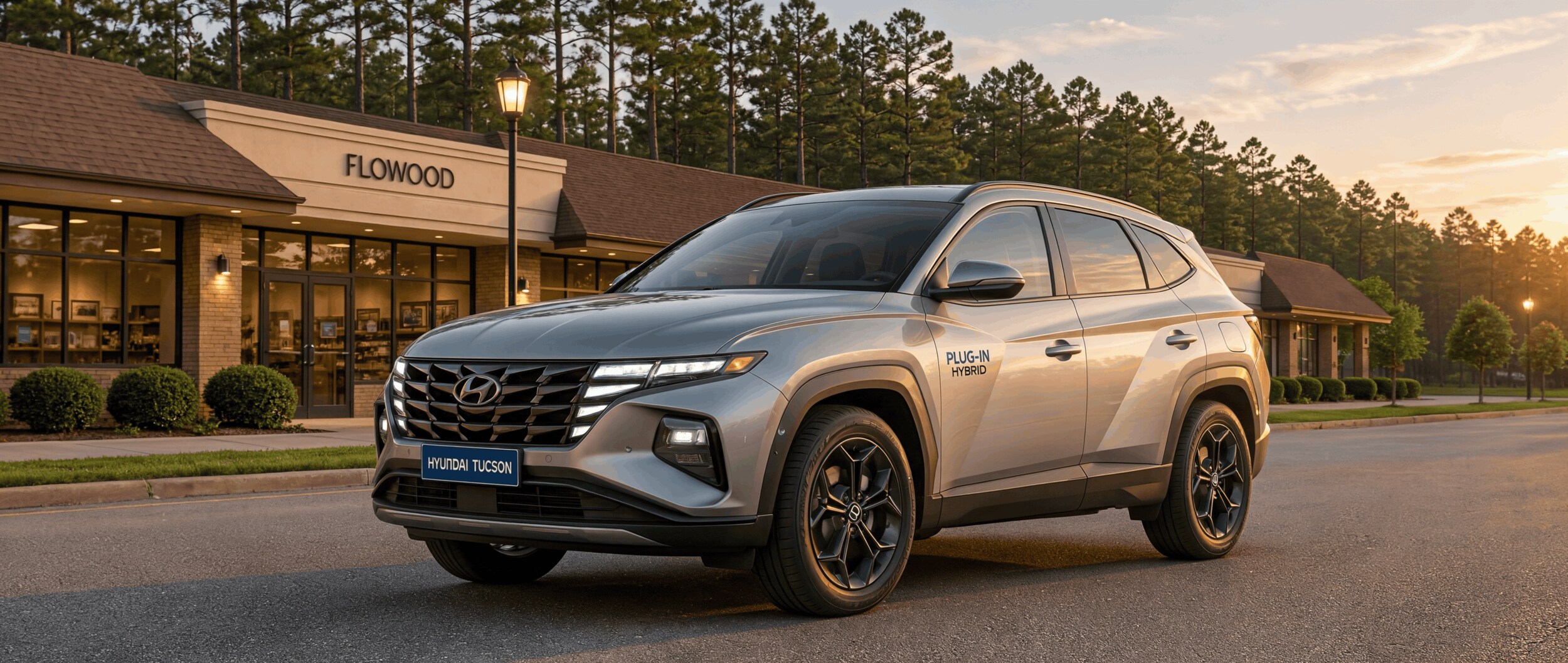
Plug in at home every night, keep your daily round trip under 32 miles, and the plug-in hybrid earns its premium quickly. If you can't or won't plug in consistently, the conventional hybrid is the smarter buy. The answer really comes down to three questions. Do you have somewhere to plug in? How far do you actually drive each day? And which model fits what your household needs?
See the Tucson Hybrid at Hallmark Hyundai Flowood
What actually separates these two powertrains, and which one fits a Flowood-area commute?
Two distinctly different machines share the word hybrid, and the one that suits a Flowood commute comes down to whether you'll plug in at home, with a conventional model charging itself and a plug-in rewarding you only when the outlet gets regular use each night. A conventional hybrid (the Tucson Hybrid, the Santa Fe Hybrid, the Sonata Hybrid) charges its own small battery through regenerative braking and the engine. Fill it with gas, drive exactly as you always have, and the system handles the rest. You never plug one in.
A plug-in hybrid (the 2026 Tucson Plug-in Hybrid) carries a much larger battery that you can and should charge from an outlet. Fill that battery and you drive the first chunk of miles on electricity alone. Once it depletes, the vehicle slips back into conventional hybrid mode. From there, gas takes over.
Most comparison articles skip the part that matters here. Own a plug-in hybrid and rarely plug it in, and you're hauling extra battery weight and paying for capability you're not using. Gas-only efficiency in that case dips below what the conventional Tucson Hybrid delivers.
| Decision axis | 2026 Tucson Hybrid | 2026 Tucson Plug-in Hybrid | 2027 Santa Fe Hybrid |
|---|---|---|---|
| Requires plugging in? | Never | Strongly recommended | Never |
| Combined system power | 231 hp | 268 hp | 231 hp |
| All-electric range | None | 32 miles | None |
| Cargo space (seats up) | 38.7 cu ft | 31.9 cu ft | 14.6 cu ft (3rd row up) |
| Standard AWD | Yes | Yes | Optional HTRAC |
| Seating | 5 | 5 | 7 (three rows) |
| Electric-mode efficiency | N/A | 80 MPGe | N/A |
| Gas-mode efficiency | Mid-30s MPG (est.) | 35 MPG combined | 36 MPG combined (FWD) |
Both ends carry a real tradeoff. The Tucson Plug-in Hybrid's 268 hp is a noticeable step above the conventional Hybrid's 231. The cargo hit is just as concrete, since the plug-in's larger battery pack sits under the cargo floor and trims available cargo volume by roughly the size of a large rolling suitcase compared to the conventional Tucson Hybrid.
Does your home setup and your daily mileage actually support a plug-in hybrid?
For most households this one question settles everything, and it cuts both ways, since a buyer who charges nightly and drives under 32 miles a day gets the plug-in at its best, and a buyer without reliable outlet access ends up trailing the conventional hybrid on gas. So it deserves a direct answer.
The 2026 Tucson Plug-in Hybrid delivers 32 miles of all-electric range on a full charge. Lakeland Drive runs through Flowood and Rankin County. For plenty of commuters on that corridor, 32 miles covers a full day's round trip without waking the gas engine. Drive on electrons in the morning, plug back in at home that afternoon, and your weekly gas spend drops.
Recharging from a Level 2 outlet (240 volts, the type many homeowners add to a garage) takes just under two hours. A standard 120-volt household outlet works too, though a full charge that way runs about ten hours, so overnight's the practical window.
The plug-in and the conventional Tucson share most of their cabin and hardware. The battery size and the outlet are what differ.
Outlet access is where the honest trade lives. Buyers who'll find consistent plugging-in genuinely difficult tend to share a few traits:
- They live in an apartment.
- They rent without dedicated parking.
- They lack garage access.
In that situation the plug-in hybrid runs mostly on its gas engine and returns lower gas-mode efficiency than the conventional Tucson Hybrid. The plug-in earns its premium only when you use the outlet.
See 2026 Tucson Plug-in Hybrid inventory
Which Hyundai hybrid makes sense when you need three rows, more cargo, or a different profile altogether?
Step up to three rows or more cargo and the Santa Fe Hybrid becomes the natural pick for a growing family, while a two-row buyer who simply wants extra space leans toward the conventional Tucson Hybrid instead of any plug-in version. Not every buyer is weighing the Tucson Hybrid directly against the Tucson Plug-in Hybrid. Sometimes the conversation is about seats, cargo, or the odd towing job.
The 2027 Santa Fe Hybrid is the three-row answer. It seats seven, delivers an estimated 36 MPG combined in front-wheel-drive trim, and tows up to 2,000 lbs. No plug, ever. For a family juggling the school run, the airport corridor, and a weekend drive without a thought about charging, it's a capable option that asks nothing of your home electrical setup.
Need two-row practicality but still care about cargo room? The conventional Tucson Hybrid's 38.7 cubic feet of cargo space with the seats up runs noticeably roomier than the plug-in. You'll see that difference on a Costco run, loading sports gear, or stacking luggage before an I-20 road trip.
Browse all Hyundai hybrid models at Hallmark Hyundai Flowood
Frequently Asked Questions About Hyundai Plug-In Hybrids and Hybrids
Does a Hyundai hybrid need to be plugged in?
No. The conventional Hyundai hybrid models (including the Tucson Hybrid, Santa Fe Hybrid, Sonata Hybrid, Elantra Hybrid, and Palisade Hybrid) charge their own batteries through regenerative braking and the engine. You fill them with gas and drive. The plug-in hybrid (Tucson Plug-in Hybrid) sits in a separate category, with a larger battery you charge from an outlet that enables all-electric driving for up to 32 miles before the gas engine takes over.
What happens if I own a plug-in hybrid but never plug it in?
It runs on its gas engine as a conventional hybrid, which is mechanically fine. The practical snag is efficiency. That larger battery pack adds weight the conventional hybrid doesn't carry, so without regular charging you're paying extra for capacity you aren't using, and your gas-mode fuel economy'll trail what the conventional Tucson Hybrid returns in the same driving conditions. If plugging in consistently isn't realistic, the standard hybrid's a better fit for the money.
Which Hyundai hybrid is right for a family that needs three rows?
The 2027 Santa Fe Hybrid. It offers seven-passenger seating, an estimated 36 MPG combined in front-wheel-drive trim, and up to 79.6 cubic feet of cargo space with the rear seats folded. It skips the plug entirely, HTRAC all-wheel drive is available on every trim, and it tows up to 2,000 lbs. There's no plug-in hybrid Santa Fe in the current US market, so the Santa Fe Hybrid is the three-row choice for buyers who want efficiency without a home charging commitment. By the Hallmark Hyundai Flowood Team | November 2026


