

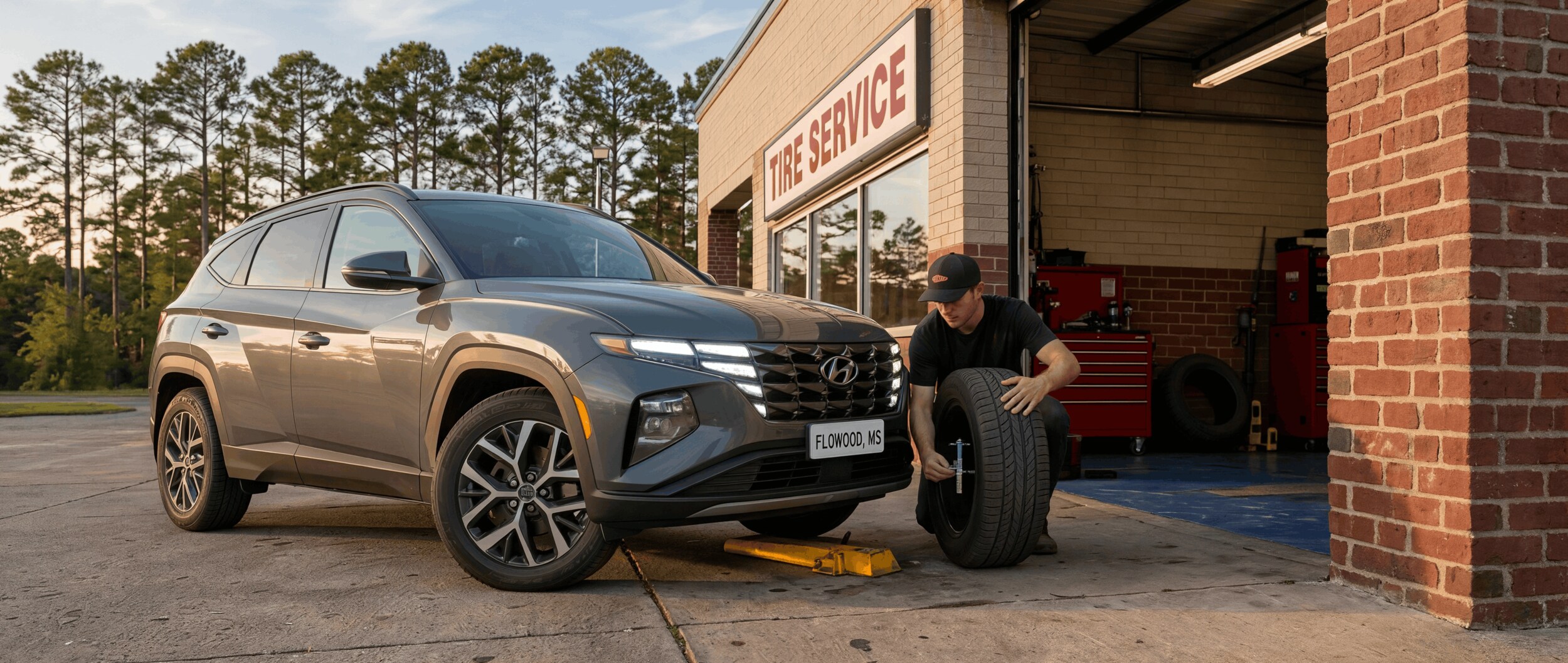
Your tires look fine from the driveway, and that's the catch.
A visual check from three feet away won't tell you whether tread depth is at 6/32 of an inch or 3/32 of an inch, and that difference matters enormously the moment an afternoon storm drops an inch of water on I-20 between Flowood and Brandon. A tire can roll in with its TPMS light never triggered, air pressure holding perfectly, and tread sitting right at the edge where wet-road grip starts to degrade seriously. The driver had no idea. Picking the right tire service window before a road trip isn't about caution for its own sake. You're buying enough lead time to actually fix something if the inspection turns it up.
Schedule your tire check online
- Book a full tire inspection at least 7 to 10 days before any trip longer than 150 miles, so there's time to source and mount tires if needed.
- If tread measures below 4/32 of an inch, replace before you leave, regardless of trip length. That's the threshold where wet-road grip begins to drop.
- AWD Hyundai models (Tucson Hybrid, Santa Fe, Palisade) need more frequent rotation than FWD models. Check your interval if you've recently crossed 5,000 miles.
- TPMS tells you about pressure, not tread depth. Those are two different inspections.
- A pressure-only check can happen the morning before you leave. A rotation, alignment check, or replacement needs days of lead time.
What Actually Matters When Choosing a Tire Service Window?
Timing comes down to three variables that most pre-trip advice blurs together: how much tread you've got left, what kind of trip you're taking, and how much lead time you've built in for repairs. Get those three lined up and the timing picks itself; miss one and you're gambling.
| Situation | Best Service Timing | Key Spec to Check | Honest Tradeoff |
|---|---|---|---|
| Long highway trip, tires 2+ years old | 10-14 days before departure | Tread depth (aim for 4/32" or more) | You may need replacement tires. Source time matters |
| Weekend trip under 200 miles, tires recently rotated | 3-5 days before | Pressure, sidewall, spare | Usually a quick check; can book closer in |
| AWD Hyundai near 5,000 miles since last rotation | 7-10 days before | Rotation + alignment check | AWD models need tighter intervals to protect the drivetrain |
| Any Hyundai with TPMS light on | Immediately, before the trip | Pressure first, then tread and sidewall | TPMS only flags pressure. Tread issue can coexist with correct PSI |
| Tires over 6 years old, any mileage | 10-14 days before | Sidewall cracking, tread depth, age | Rubber degrades over time even with good depth; may need replacement |
Tread Depth Is the Spec That Changes Everything
Tread depth decides more about your wet-weather safety than any other number on the tire, and it's the one you can't eyeball from the driveway. Mississippi summers push that even harder, since the rain here is steady and the roads stay hot and busy.
The I-20 corridor runs through Rankin County, which sits in a humid subtropical climate averaging roughly 60 inches of rain per year, most of it in the warmer months when the roads are hottest and busiest. Afternoon thunderstorms can drop standing water on the highway in minutes.
Here's what happens as tread wears down:
- Tread grooves push water out from under the contact patch as your tire rolls.
- When those grooves wear down, the water has nowhere to go.
- At highway speeds the tire starts riding up on a film of water, and steering and braking response drops off sharply.
The legal minimum tread depth in the US is 2/32 of an inch, which is a floor and nothing more. Wet-road grip begins to degrade noticeably once tread falls below 4/32 of an inch, the practical replacement threshold for anyone who drives in rain. On a Flowood-to-the-coast run or an interstate trip east toward Meridian, you're going to hit rain. Book service early.
Explore Santa Fe models at Hallmark Hyundai Flowood
How Rotation Intervals Change the Math for Hyundai Drivers
Rotation timing is where Hyundai-specific guidance parts ways with generic tire advice, and it's easy to skip in a pre-trip rush. Follow the manual interval and you keep wear even across all four tires; ignore it on an all-wheel-drive model and you can stress the drivetrain. The number depends on which Hyundai you drive.
The owner's manual calls for rotating tires every 7,500 miles on FWD models, a bit longer than you'll see at some tire-only shops. All-wheel drive changes that. On Hyundai's AWD lineup (the Tucson Hybrid, Santa Fe, Santa Fe Hybrid, Palisade, and Palisade Hybrid), rotation should happen closer to every 5,000 miles. The drivetrain feeds torque to all four tires continuously, which wears them more evenly in one sense but demands steady rotation so you don't build the size differences that stress the AWD system.
Say your last rotation was 4,800 miles ago and you're about to add 1,200 miles on a road trip. Get the rotation done before you leave. A standard service visit covers it, no full tire overhaul required, and that same visit is where our team catches sidewall cracking, uneven wear from an alignment that's drifted, or a slow leak you haven't noticed.
Does a quiet TPMS light mean your tires are trip-ready? Not on its own, and that gap is worth understanding. Your Hyundai's tire pressure monitoring system is excellent at flagging when a tire has lost meaningful pressure. It does not measure tread depth. A tire can sit at exactly the right PSI, trigger no warning light, and still run tread at 3/32 of an inch. The two systems do two different jobs, and both need checking before a long trip.
Book a Pre-Trip Tire Inspection
Match the Service to How You Actually Drive
The honest tradeoff in pre-trip tire planning really comes down to timing windows, since a quick pressure check still works the morning you leave, while rotation, alignment, or replacement each need several days of lead time to book and complete. The extra days cover both the appointment slot and the chance a repair means sourcing a specific tire size.
For a Hyundai Elantra or Venue running mostly Flowood errands and an occasional weekend trip, the rotation-and-inspection visit every 7,500 miles is usually sufficient. Book it a week before any trip longer than a few hours.
For a Palisade Hybrid or Santa Fe Hybrid loaded with passengers and luggage, the stakes of a tire issue are higher, the rotation interval is shorter, and the tire size may take a day to source. Ten to fourteen days before departure is the right window, enough time to handle whatever the inspection finds without scrambling.
The rule of thumb is simple. Longer trip, heavier vehicle, older tires, or more time since the last rotation all point one way. Book earlier. A quick overnight run with recently serviced tires on a compact? Three to five days is fine. A family SUV trip with 7,000 miles since the last rotation? Don't cut it to the last week.
Frequently Asked Questions
How far in advance should I schedule Hyundai tire service before a road trip?
Plan for at least 7 to 10 days before your departure for any trip longer than a couple of hours. That window gives our service team time to do a thorough inspection, complete a rotation if it's due, and address anything found, including sourcing a replacement tire in your specific size, which can take a day or two. For short local trips with recently serviced tires, 3 to 5 days is workable. For longer trips on older tires or AWD models due for rotation, give yourself a full two weeks.
Does my Hyundai's TPMS mean my tires are ready for a trip if no light is on?
No, and this is the most common misconception we work through at the service counter. TPMS monitors tire pressure, not tread depth or sidewall condition. A tire can be properly inflated and still have tread well below the threshold where wet-road grip is reliable. Before any significant trip, have both pressure and tread depth checked. Pressure you can verify yourself with a gauge; tread depth requires getting a measurement at each groove, ideally with a tread depth gauge or a quick inspection from our team.


