

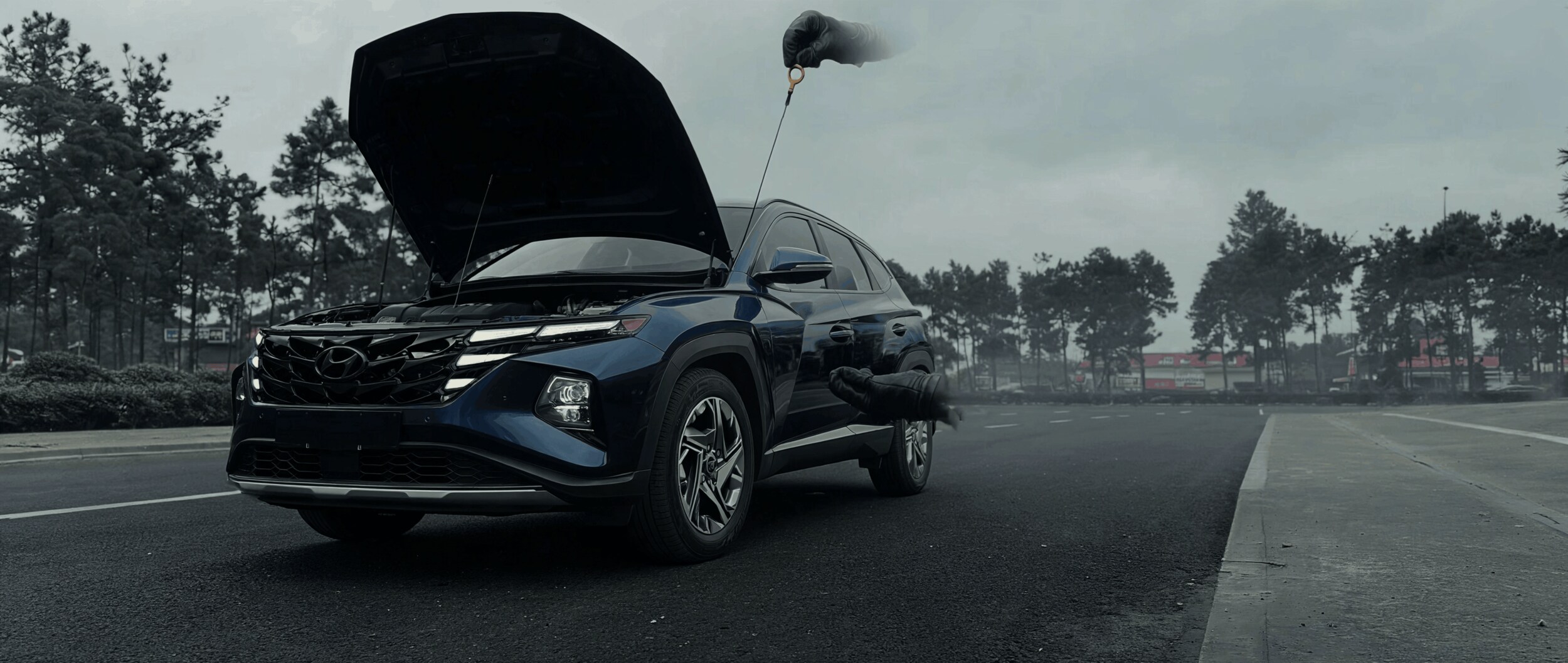
Pull the dipstick before you load the car. Done cold in your driveway the morning of Thanksgiving or Christmas, that one step tells you more than the window sticker ever could. And if you drive Lakeland Drive or the Pearl and Brandon corridors daily, there's a decent chance your Hyundai belongs on a tighter maintenance schedule than you'd guess.
Our team sees this especially with Tucson owners who cover a lot of short errand miles across the retail corridors and the airport side of the metro. Low-speed, stop-and-go running in Mississippi humidity qualifies as Severe driving under Hyundai's own maintenance criteria, which cuts the oil-change interval roughly in half against the Normal track. That distinction matters before you point the car east on I-20 for a few hundred miles.
What's the Plan at a Glance?
A typical Rankin County Hyundai comes down to a handful of fluids, and the table below lays out what to look for and when it matters most before a holiday run.
| Fluid | What to Check | "Bad" Sign | Best Time |
|---|---|---|---|
| Engine oil | Dipstick level and color | Dark brown to black, gritty, below MIN | Cold engine, morning before departure |
| Brake fluid | Reservoir level and color | Dark amber to brown; below MIN line | Anytime hood is open |
| Coolant | Overflow reservoir level and color | Brown, oily, or below MIN marker | Cold engine only |
| Windshield washer fluid | Reservoir level | Empty or near-empty | Any time |
Each of these is a free, two-minute visual check you can run in the driveway. The oil dipstick is the one that actually tells you whether your service timing fits your situation.
Normal vs. Severe: The Question Everybody Gets Wrong
Severe looks like the exception, but in a hot, humid, stop-and-go metro it sits closer to the default, and a lot of Rankin County Hyundai driving lands there without the owner realizing it. Hyundai's Normal schedule puts engine oil changes at every 7,500 miles or 12 months. The Severe schedule moves that to every 3,750 miles or 6 months. Roughly half the interval.
Severe doesn't mean you're doing something wrong. It means your driving conditions match a specific list Hyundai defines in the owner's manual, and two of those conditions apply directly to this market. Extended low-speed operation and prolonged high-humidity driving both qualify. If your day looks like Lakeland Drive at 5 p.m. in August, or a lot of short sub-five-mile trips between errands in Pearl or Brandon, the Severe designation almost certainly applies.
Hybrids still lean on a combustion engine for most of their load, so the same interval question applies to your Tucson Hybrid or your Santa Fe Hybrid. A fully electric vehicle is the exception. If you're in an IONIQ 9, there's no engine oil to change.
Reading the Dipstick and the Brake Fluid Reservoir
Our service team runs these two checks first in any multi-point inspection, and they come first for a reason, since oil and brake fluid decide whether a car is safe to send up an interstate.
For engine oil, park on a level surface and wait at least five minutes after shutting the engine off. Pull the dipstick, wipe it clean, re-insert it fully, then pull it again. You want oil that sits between the MIN and MAX marks and shows a clear amber color when you hold the cloth up to light. Dark brown to black, gritty texture, or anything below MIN means the oil isn't doing its job at the temperatures a highway cruise demands.
For brake fluid, pop the hood and find the reservoir on the driver's side of the firewall. Brake fluid absorbs moisture over time, which is simply how the chemistry works in a humid climate. Fresh fluid is clear to light amber. Fluid that's absorbed significant moisture turns darker amber or brown. Hyundai's schedule calls for brake fluid inspection at 30,000-mile intervals, with replacement at the two-year or 30,000-mile mark, whichever comes first. If you don't have a record of that service being done, it's worth mentioning before the holiday.
Coolant is simpler. Check the overflow reservoir cold, against the MIN and MAX lines on the side. If it's low or visibly brown, that's a system issue to address before a long run.
Washer fluid just needs a top-off. A highway stretch on a wet post-storm morning drains it faster than a week of errand driving.
- Check oil cold, on level ground, engine off at least five minutes
- Amber to light brown on the cloth is healthy; dark brown to black is overdue
- Brake fluid that's dark through the reservoir walls needs a service record or a fresh test
- Coolant checked cold only, against the MIN and MAX markers on the overflow tank
Schedule a Pre-Holiday Service Check
Flowood to Wherever: What I-20 Actually Demands from Your Car
I-20 east out of Flowood toward Meridian and beyond is the main artery for holiday travel from this side of the metro. Drivers heading out from Rankin County for Thanksgiving or Christmas are typically covering two to four hours of highway time each direction, often with a full passenger load.
That steady highway leg is actually gentler on your engine than the stop-and-go that brought you to the on-ramp. The highway leg itself does little harm. The trouble is walking into it with fluids already marginal from the city driving behind you. If you're fueling up at the Love's Travel Stop on Highway 80 East at Exit 47 before getting on the interstate, that's a natural last moment to pop the hood and run a visual sweep. It won't fix a neglected oil change, but it'll catch a coolant level that's dropped since you last looked and a washer fluid reservoir you forgot about.
The smart move is to handle the actual service before that moment. Come in this week.
By the Hallmark Hyundai Flowood Team | November 2026


