
The wrong part shows up more often than you'd think, and it's rarely because the owner guessed. Plenty of folks hand us the correct year, model, and trim and still walk out with a box that doesn't fit. Hyundai updates parts specifications mid-production run, so two Tucsons built in the same model year for the same trim can legitimately carry different brake rotors depending on when they left the factory. Year and model alone won't settle that. Your VIN will.
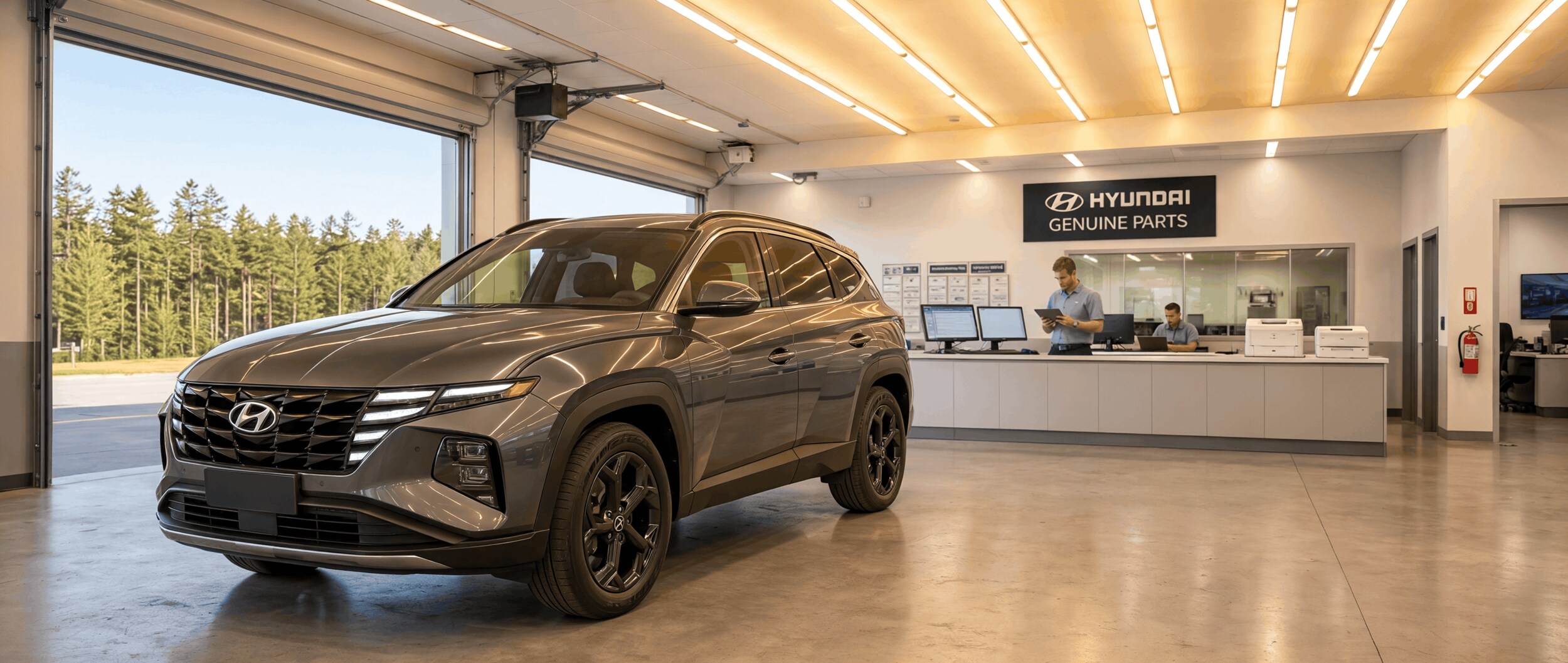
Below you'll find the full process our parts department uses at Hallmark Hyundai Flowood. We've also laid out a plain-language breakdown of which part categories need the most care.
- Your 17-digit VIN accounts for mid-year production changes, engine variants, and trim-specific hardware differences that year-and-model searches miss.
- Genuine Hyundai Replacement Parts are engineered to the same factory specifications as your original components.
- Filters, wipers, and bulbs are the most forgiving categories for fitment. Brakes, suspension components, and sensors are the least forgiving.
- Bring your full VIN, your trim level, and (when possible) the part you're replacing to the counter.
- Our team can order anything not on the shelf. Call (601) 914-4200 or book a service appointment online.
Which Parts Are Straightforward and Which Ones Catch People Out?
Not every part carries the same fitment risk, so the practical answer is that roughly half the catalog is forgiving and roughly half demands care depending on the engine displacement, the wheel-size package, the assembly date, or the trim code. Some parts stay practically uniform across a model's production run. Others shift with all four of those variables at once.
Our team sorts them this way.
| Part Category | Fitment Risk | Key Variable | What to Bring |
|---|---|---|---|
| Cabin air filter | Low | Mostly consistent within a generation | Year, model, generation |
| Engine air filter | Low-Medium | Engine displacement (1.6T vs. 2.5T, for example) | Year, model, engine size |
| Wiper blades | Low | Driver and passenger sides differ in blade length | Year, model |
| Oil filter | Low-Medium | Engine-specific; gasket diameter matters | Year, engine code |
| Brake rotors | High | Wheel size keys the rotor diameter; trim determines wheel size | Full VIN, wheel size or trim code |
| Brake pads | High | Matched to rotor spec; front and rear calipers differ | Full VIN, axle (front/rear) |
| Suspension components | High | Production-date changes affect bushing specs and mount dimensions | Full VIN, production date |
| Sensors (O2, ABS, MAP) | High | Engine variant and sub-revision both matter | Full VIN |
| Body panels and trim clips | Medium | Facelift changes alter clip patterns and body lines | Full VIN, color code |
| Battery | Medium | Group size varies by engine and electrical load package | Year, model, engine, trim |
Owners in the forum community have documented this exact brake-parts problem. Someone orders by year, model, and trim, and the rotors still arrive wrong. What happened is that a small production run got built with hardware configured for a different wheel-size package. The VIN identifies that, and year and model alone can't.
Browse our pre-owned Hyundai inventory if you're shopping a used vehicle and want to identify which generation you're working with before you need parts.
Why Does the VIN Matter More Than Year and Model Alone?
Your 17-character Vehicle Identification Number matters more than year and model because it works as a production fingerprint, and a plain year-and-model search simply can't see the mid-cycle details it captures about the exact car sitting in your driveway. It encodes the model year, the manufacturing plant, the body style, the engine type, the restraint system, and a unique production sequence number. The production sequence is what parts databases lean on to flag mid-cycle changes, the ones that alter a brake rotor diameter or a sensor harness connector without touching the model year badge on the car.
On most Hyundais, your VIN shows up in three places. Start with the lower driver's-side corner of the dashboard, visible through the windshield from outside the car. You'll also find it on the driver's-side door-jamb sticker and on your registration and insurance documents. The dashboard location is usually the fastest.
When you bring a VIN to our counter, our system cross-references the production date against the factory parts database. That's the step that catches the edge cases. We ask for it even on routine maintenance parts, because confirming costs nothing and the two-trip problem is a real headache.
Our financing team is here if you're weighing whether to keep maintaining your current vehicle or move into something newer. That conversation often starts at the parts counter.
OEM vs. Aftermarket: The Honest Version
Genuine Hyundai parts are the safer call for anything precision-critical, and a quality aftermarket option is a reasonable choice for maintenance consumables, so the honest answer here depends on the category you're shopping and how much the tolerances matter. Most guides just tell you OEM is always better. They aren't wrong, but they leave out the useful part.
Genuine Hyundai parts are built to the same design specifications as the parts installed on your vehicle at the factory. For categories where tight tolerances matter (brake hardware, ABS sensors, suspension geometry), that spec-matching counts for a lot. A rotor that runs slightly undersized, or a sensor with a compatible connector but a different resistance curve, can create intermittent behavior that takes real diagnostic time to trace.
For categories where tolerances are wider, the tradeoff looks different. Cabin air filters, wiper blades, and bulbs don't depend on that kind of precision. Quality aftermarket options exist in those categories and perform comparably in everyday use. The difference there comes down mostly to availability backing rather than function.
| Genuine Hyundai Parts | Aftermarket | |
|---|---|---|
| Fitment certainty | Exact (factory spec) | Varies by tier and manufacturer |
| Availability for recent models | High | Grows as the model ages |
| Sensor/electrical compatibility | Full | Varies; resistance and connector tolerances differ |
| Brake and suspension precision | Full | Premium tiers perform closely; budget tiers don't |
| Maintenance consumables (filters, wipers) | Full | Comparable at mid-to-upper tiers |
The working rule at our counter is a simple one. For anything touching braking, steering, or engine management, stay with genuine parts. For maintenance consumables on a vehicle no longer in its early ownership years, the choice is yours, so long as you verify by VIN rather than by part description.
Explore current Tucson configurations and trims to see how equipment packages vary, since the wheel-size and engine options on your trim directly affect which part category your vehicle falls into.
Schedule a Parts or Service Appointment
Which Generation Fits Your Situation?
If your Hyundai has a few years on it, there's a generation question sitting underneath the parts question, and the right answer shifts at the redesign boundaries where availability and fitment both change. Hyundai redesigns its models on roughly six-to-eight year cycles, and parts availability, fitment complexity, and OEM stock depth all move at those lines.
Current-generation vehicles: Models in their active generation have full OEM parts availability, no superseded numbers on common components, and no shelf-sourcing delays. The Elantra (sixth generation, 2021 to present) falls here.
Prior-generation vehicles (the mid-availability window): A 2019 to 2021 Tucson or a 2019 to 2023 Santa Fe sits in what our team thinks of as the careful zone. Parts are in stock, but this is exactly the range where mid-cycle production changes create the rotor and sensor mismatches described above. The VIN lookup matters most here.
Older models: Vehicles from 2015 and earlier may need an order rather than shelf stock for body panels and trim pieces. Common maintenance parts like filters, belts, and gaskets stay well-stocked. Less common items can take a few business days.
If your vehicle lands in that 2019 to 2023 window, bring the VIN every time, not just for the big repairs. Our parts counter is in Flowood, Mississippi. It's a small habit that reliably prevents the wrong-part problem.
Frequently Asked Questions About Finding the Right Hyundai Parts
Why did I get the wrong Hyundai part even though I gave the correct year and model?
Hyundai updates parts specifications during a model year's production run without changing the model year badge on the vehicle. Two Hyundais with the same year, model, and trim can need different brake rotors, sensors, or suspension components depending on their assembly date and option configuration. Your VIN carries a production sequence number that pins down exactly which specification applies to your vehicle. Order with the full VIN and you'll clear this up before the box ever ships.
Do aftermarket parts affect my Hyundai?
Running an aftermarket part doesn't automatically create a problem. But if an aftermarket component turns out to have caused or contributed to a failure, that specific repair may be handled differently than one involving a genuine Hyundai part. For powertrain and safety-system components on newer vehicles, genuine Hyundai parts are the lower-risk choice. For maintenance items on a vehicle that's been on the road for several years, the call is yours.
Where is the VIN on my Hyundai, and what does it tell a parts specialist?
The easiest spot is the lower driver's-side corner of the dashboard, visible through the windshield from outside the car. You'll also find it on the driver's-side door-jamb sticker and on your registration and insurance documents. A parts specialist uses the VIN to pin down your vehicle's exact production configuration (engine displacement, wheel-size package, assembly date, and restraint system), which settles the correct part number when a year-and-model search would return more than one result. By the Hallmark Hyundai Flowood Team | November 2026


