


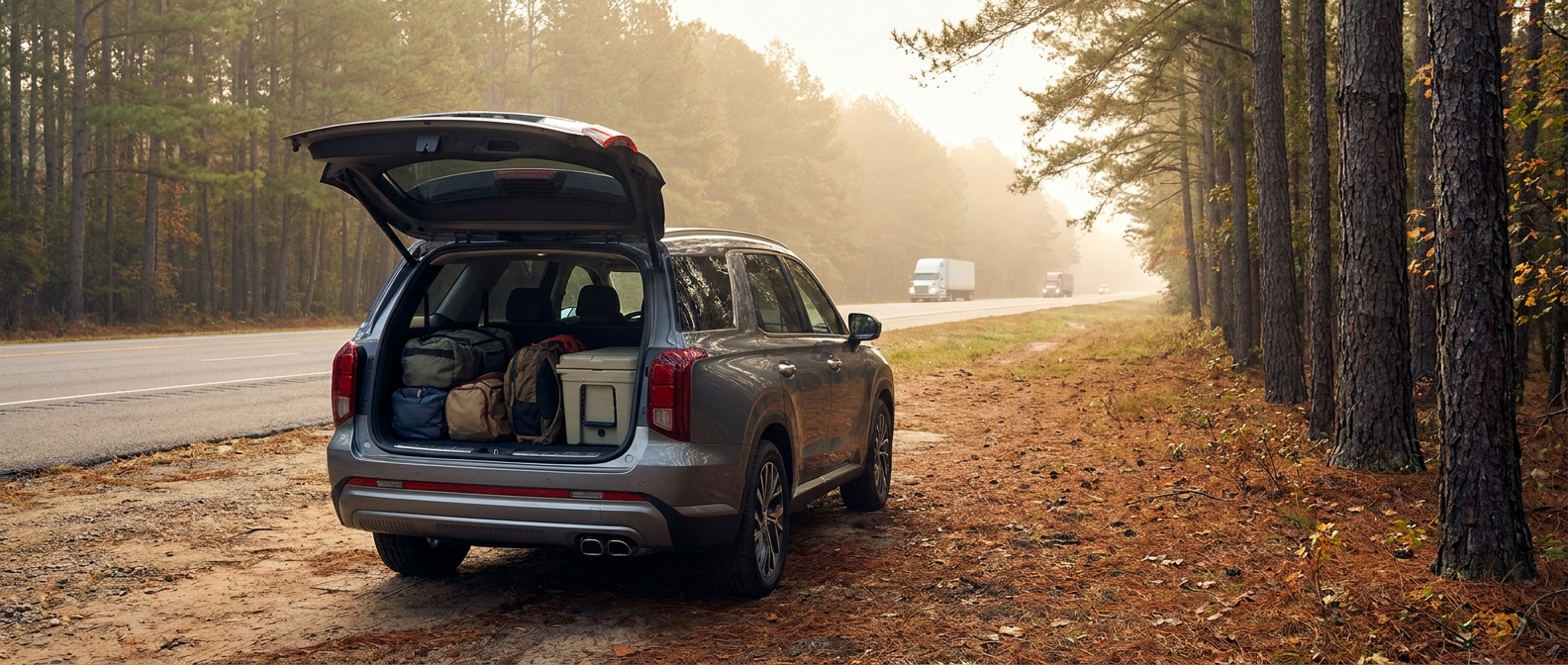
Does this SUV have enough room? For a family trip the question that matters more is whether everything fits with everyone in the car, or just with the car empty. They're not the same thing. The answer depends on which Hyundai you're driving, how many rows you're filling, and how realistic you are about cargo numbers when three kids each show up with their own bag.
Sort out your Hyundai's real cargo math before you leave Flowood. You'll skip a hot parking-lot repack.
How Much Space Do You Actually Have?
The spec sheet answers this well once you read all three numbers rather than only the headline figure. Hyundai publishes cargo volume in several configurations, and each one maps to a different trip scenario, so the number that fits your family depends on how many seats you plan to fill.
| Model | Cargo (3rd Row Up) | Cargo (2nd Row Folded) | Max Cargo | Rows | Real-World Note |
|---|---|---|---|---|---|
| 2026 Palisade | 19.1 cu ft | 46.3 cu ft | 86.7 cu ft | 3 | Right for 6-8 passengers plus carry-on bags |
| 2026 Santa Fe | 14.6 cu ft | 40.5 cu ft | 79.6 cu ft | 3 | Works well for 5-6 passengers; tighter behind the 3rd row |
| 2026 Tucson | 38.7 cu ft (SAE) | 74.8 cu ft (max) | 74.8 cu ft | 2 | No third-row compromise; generous for a family of four or five |
Cargo figures per Hyundai. Actual usable space varies with seating configuration and cargo shape.
Here's the honest tradeoff on the Palisade. Its third row delivers a Hyundai-listed 32.1 inches of legroom, real space for kids or shorter adults. You gain an occupied third row, you give up trunk depth. A fully loaded eight-passenger Palisade heading to Biloxi for a long weekend has 19.1 cubic feet of trunk space. The figure is real but not limitless, and it's the one that's easy to underestimate before you load. Plan around it before you load, not after.
Where Does Everything Charge on a Long Drive?
Charging is where the 2026 Palisade quietly earns its keep on a long drive, since Hyundai equipped it with six 100-watt USB-C ports spread across all three rows, though you'll still want to confirm the accessory outlet on your own trim before you leave. A device can charge in every seat. The wattage runs well past the trickle-charge standard of older vehicle USB ports, because 100 watts fast-charges a modern smartphone or tablet. Three kids in three rows, each with a device, and nobody shares a cable.
The 2026 Santa Fe and the 2026 Tucson also include USB ports throughout the cabin. If your family runs on two rows, the Tucson handles a family of four without any three-row port arithmetic. For anything that needs accessory power (a 12V cooler, a portable pump), check your specific trim's power outlets before the trip. Stop by our service team or look over the window sticker and you'll have an easy answer.
Before a long trip: Mississippi fall afternoons still push into the mid-70s to low 80s. If you're stopping at Biloxi or along the Natchez Trace Parkway and stepping away from the vehicle, don't leave food or loose valuables on a rear seat in direct sun. The Palisade Calligraphy trim includes a UV-C sterilization compartment in the center console for smaller items you want cleaned at a rest stop.
The 2026 Hyundai Palisade's six 100-watt USB-C ports, spread across all three rows, fast-charge modern smartphones and tablets simultaneously, per Hyundai's published specifications.
How Should You Actually Pack the Cargo Area?
Think about access priority before size when you load, since the thing you need at the first stop should ride on top where you can grab it. The Natchez Trace Parkway (the entrance near Clinton is less than 20 minutes from Flowood on I-20) and the Gulf Coast run (approximately 130 miles south via I-20 and I-59, roughly two hours) are two long local trips, and both reward a real strategy over tossing bags in the back.
Pack by access priority, not size. The items you need at every stop go in last and ride on top. A family heading to the coast shouldn't bury a beach bag under three roller bags and a playpen.
- Use soft-sided bags when the third row is occupied. The Palisade's cargo opening is approximately 47.75 inches wide by 32 inches tall, per Hyundai. Soft duffels compress and stack around irregular shapes; rigid hard cases fight back.
- Flat-fold the third row only if you're running five or fewer people. With it down you have 46.3 cubic feet in the Palisade, which handles a family's full week of luggage. With it up you're working with 19.1.
- Use the underfloor storage compartment. Every 2026 Palisade trim includes one in the cargo area, and it's the right place for a first-aid kit, jumper cables, and items you want handy but out of sight. Don't waste it on snacks.
- Coolers go behind the second row, not jammed into the third-row cargo area. They're too heavy to lift over a seat back at a rest stop. In the Tucson, this isn't a concern; the 38.7-cubic-foot cargo area handles a soft cooler alongside luggage without any seat gymnastics.
- A rooftop cargo carrier earns its keep on a Natchez Trace trip. The Trace has no commercial stops once you're on it; you want everything with you and no last-minute reshuffling.
Schedule a Pre-Trip Service Check
Plan the Trip This Way
The Palisade's tri-zone automatic climate control lets front, second-row, and third-row passengers each dial in their own temperature, which earns its keep here more than you'd expect. In Rankin County in early November the afternoons can still reach the mid-70s while the mornings stay cool, so one thermostat for the whole cabin rarely satisfies everyone. In this climate tri-zone reads less like a luxury feature and more like a practical fix.
Hyundai SmartSense (Lane Following Assist, Forward Collision-Avoidance Assist, Smart Cruise Control) comes standard on the 2026 Palisade. On a straight Mississippi interstate with a full load, Smart Cruise Control is the kind of feature you'll lean on instead of leaving it buried in the settings menu.
The fuel economy is the weak spot, plain and simple. The EPA rates the FWD 2026 Palisade at 21 mpg combined. Fully loaded, with the air running and a highway climb in the load, your real-world numbers will land below that estimate. Plan an extra fuel stop on any trip over 150 miles rather than assuming the EPA figure holds under load. Budget for it.
Browse our current Hyundai inventory to confirm which features and trims are on the lot right now. Check before you plan a trip around a spec.
Frequently Asked Questions
What is the cargo space in the 2026 Hyundai Palisade with the third row occupied?
The 2026 Hyundai Palisade offers 19.1 cubic feet of cargo space behind the third row when all seats are filled, per Hyundai. Fold the third row flat and that expands to 46.3 cubic feet. With both rear rows fully down, maximum cargo space reaches 86.7 cubic feet. The third-row legroom is 32.1 inches, per Hyundai, which is real usable space for kids, though those passengers come at a cost to the trunk.
Is the 2026 Hyundai Tucson a better choice for a road trip than the Palisade if we only have four or five people?
For a family of four or five, the Tucson is genuinely worth considering over the Palisade. Without the three-row layout, the 2026 Tucson delivers 38.7 cubic feet of cargo space behind the rear seats (SAE-measured, per Hyundai) and up to 74.8 cubic feet with the seats folded. You get more usable trunk depth and no third-row cargo compromise. The Palisade earns its size when you're filling three rows. At four to five passengers, the Tucson packs more efficiently and is easier to navigate in a parking lot.
How many USB charging ports does the 2026 Hyundai Palisade have?
The 2026 Palisade includes six USB-C ports distributed across all three rows, rated at up to 100 watts each, per Hyundai. That wattage level is fast-charge capable for modern smartphones and tablets, not the slower speeds typical of older vehicle USB ports. On a full-family road trip with devices running in every row, six 100-watt ports is enough for everyone to charge simultaneously without port-sharing arguments.
Categories:
Social


