

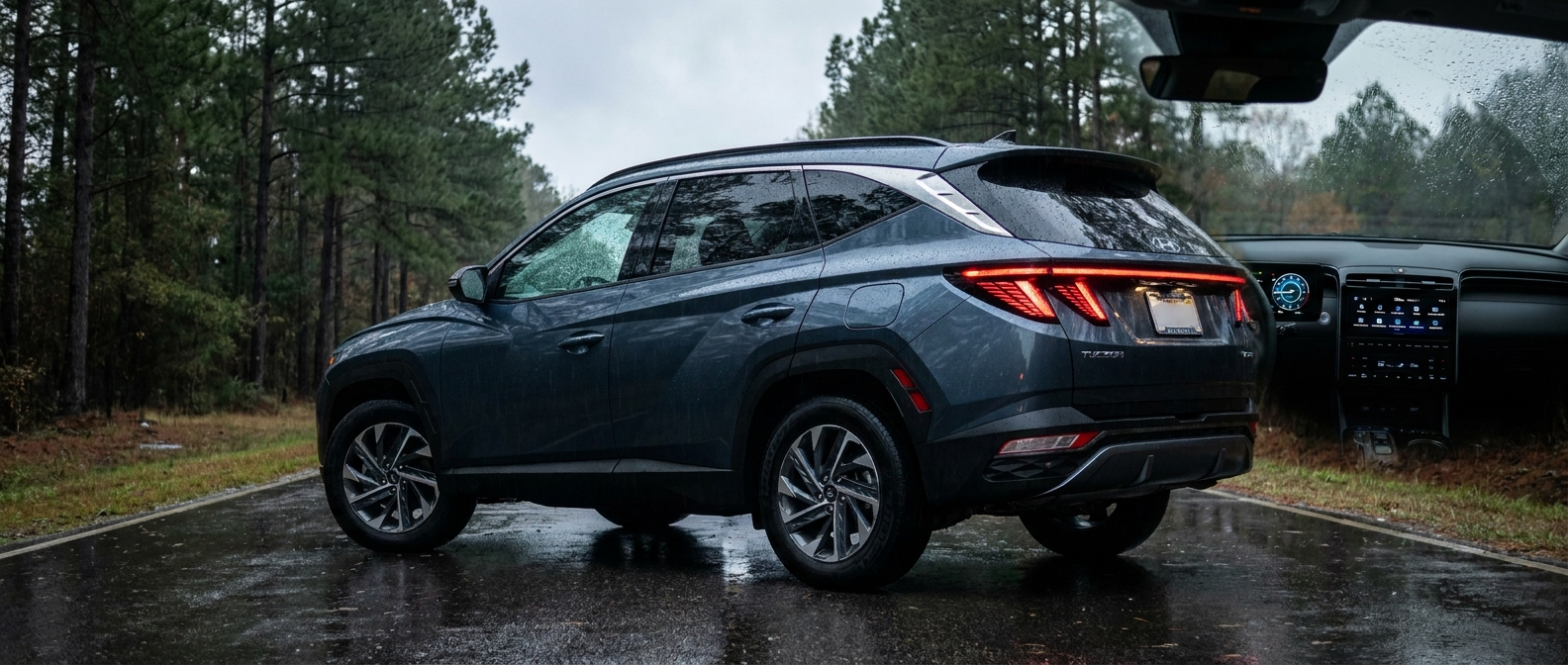
November in Rankin County runs wet. Climate averages put Jackson-area November rainfall around nine rainy days for the month, and when a cold front rolls in ahead of Thanksgiving week, it brings the heaviest rounds. If you're pointing your Hyundai toward family somewhere down I-20 or up through Brandon, that rain's going to be part of the drive. A Hyundai prepared the right way handles it without drama. A lot of prep guides split tires, wipers, and built-in safety tech into three separate to-do items, when they really run as a dependency chain. Tires set the foundation, wipers give you the information, and Hyundai SmartSense does its best work only once both of those are handled.
This guide walks you through the steps in the right order. We'll stick to the specs that actually matter for a wet-road drive out of Flowood.
We see this play out in our service lane. A customer brings in a Hyundai with every dashboard system working perfectly, and the tires are sitting at or below the point where wet stopping distances climb sharply. The tech's there. The rubber underneath it isn't.
Our Tucson inventory is a natural fit for Rankin County holiday runs, with available HTRAC all-wheel drive and SmartSense standard across every trim. But getting the most out of those features starts before you leave the driveway.
What Do You Need Before You Start?
You need three tools and about twenty minutes on a weekend morning before the trip, plus one habit that matters more than the gear. Check your tires cold, meaning before the car has moved that day, because warm tires read slightly higher pressure and can mask a shortfall you'll feel on a wet highway.
| Item | What You Need | Why It Matters |
|---|---|---|
| Tire pressure gauge | Digital or stick; check cold in the morning | Door-jamb placard PSI (not the sidewall number, which is a maximum) |
| Coin for tread test | A quarter works; a penny confirms the floor | 4/32 inch is the practical wet-weather threshold before stopping distance climbs noticeably |
| Clean cloth or paper towel | For windshield and camera lens wipe-down | SmartSense front camera reads better when the lens area is free of grime |
| Washer fluid (pre-mixed) | Check the reservoir; top up if below the mark | An empty reservoir fails you on the first mile of a standing-water splash |
Nothing exotic goes in that kit. You don't need anything special, you just need to do it before you pack the car, not in the gas station parking lot an hour into the drive.
Preparing Your Hyundai Step by Step
Work the steps in this order, because each one builds on the last, and jumping ahead to the tech before the tires are sorted is how a prepared-looking car still comes up short on a wet road. We'll start at the contact patch and move up to the cameras.
Step 1: Check tire tread depth on all four tires.
Do the quarter test on each tire at the center groove and both shoulder grooves. Insert a quarter upside down into the tread. If you can see the top of the head, your tread is down around 4/32 of an inch or less. Treat that as the practical wet-weather threshold, not the legal minimum. The federal minimum for passenger vehicles is 2/32 of an inch, though industry testing consistently shows wet stopping distance climbs well before you reach that floor. At 4/32 on a wet I-20 at highway speeds, you're already working with notably longer stopping distances than a tire with fresh depth. Flag any tire at or below 4/32 before this trip.
Santa Fe owners running available HTRAC AWD have one more reason to care. A tread depth difference greater than 2/32 of an inch between front and rear axles can stress the AWD coupling, so staying on the rotation schedule matters beyond just wet-road grip.
Step 2: Set tire pressure from the door-jamb placard.
Open the driver's door and find the sticker on the door jamb. That number is your target PSI for your specific Hyundai. The figure molded into the tire sidewall is the maximum inflation rating, so the door-jamb placard is where your target comes from. November mornings in Flowood can run 15 to 20 degrees cooler than afternoon highs, and tire pressure drops roughly 1 PSI for every 10 degrees Fahrenheit of temperature change. A tire that read fine in October may be soft now. Check pressure cold, before the car has moved, and set it to the placard spec.
Step 3: Test your wiper blades under real water.
Run your washer fluid and watch the full sweep of each blade. Chattering, streaking, or a persistent hazy arc on the glass means the blade isn't making clean contact. Hyundai's service guidance calls for annual blade replacement at minimum. A blade that survived a Mississippi summer of heat and UV exposure without use can look fine and perform poorly the moment it hits real rain. When there's any doubt, replace both front blades before the trip. Our service team can swap them quickly if you'd rather not DIY it.
Rain-sensing wipers are available on upper Hyundai trim levels (the system uses an optical sensor on the windshield to detect moisture and adjust speed automatically). If your Hyundai has this feature, make sure the wiper stalk is set to Auto before you start. It's not on by default after the ignition cycles.
Step 4: Wipe down the windshield interior and the SmartSense camera lens area.
Hyundai's SmartSense suite (Forward Collision-Avoidance Assist, Lane Keeping Assist, and Blind-Spot Collision-Avoidance Assist) ships as standard equipment across every 2026 Hyundai trim. The always-on systems, ABS and Electronic Stability Control, work regardless of conditions. The camera-dependent features are a different story. Per Hyundai's owner documentation, the front camera's field of view can be temporarily reduced by wet-surface glare, road spray, and grime on the windshield interior. A quick wipe of the inside glass, plus a check that the small camera housing area above the rearview mirror is clear, takes thirty seconds and gives those systems a better starting point.
Step 5: Check washer fluid level and test headlights.
A dry reservoir is a nuisance on a clear day. On a rainy highway, when the semi in front of you kicks up a rooster tail of dirty water, it turns into a real problem. Top up with washer fluid rated for your climate. While you're at it, walk around and confirm every exterior light is working, low beams, taillights, brake lights. Mississippi driving conditions in November rain mean reduced visibility for everyone around you. Being seen matters as much as seeing.
Step 6: Check brake fluid condition if the fluid hasn't been serviced recently.
Brake fluid absorbs moisture over time. Hyundai recommends checking brake fluid condition according to your model's service schedule. If the fluid's dark or the service interval is approaching, have it inspected before a long wet-road trip. Brake fluid is the one item here that's hard to DIY without a test strip, so it's worth asking about at a service visit.
Your Print-and-Go Rainy Travel Checklist
Run through this the morning of your trip, ideally before the car has warmed up.
- [ ] Tire tread: quarter test at center and both shoulders of all four tires; flag anything at or below 4/32 inch
- [ ] Tire pressure: check cold against door-jamb placard PSI (not the sidewall number)
- [ ] Wiper blades: run washer fluid through a full sweep; replace if chattering or streaking
- [ ] Wiper stalk: set to Auto if your trim has rain-sensing
- [ ] Washer fluid reservoir: topped up
- [ ] Windshield interior: wiped clean, especially in the camera housing area above the mirror
- [ ] All exterior lights confirmed: headlights, taillights, brake lights
- [ ] Brake fluid condition: noted if service is approaching
- [ ] SmartSense: system check light clear on the instrument cluster
A Quick Recap Before You Head Out
If you do nothing else before a rainy holiday trip, do Steps 1 and 2, because tires and pressure are the foundation every other system on your Hyundai sits on, and the smartest tech in the world still can't grip water it can't channel. SmartSense is genuinely good wet-road technology, but it assists a prepared vehicle. It does not replace one. Our service team at Hallmark Hyundai Flowood handles tires, blades, and fluid checks as a combined pre-trip inspection, so you can knock the whole list in one visit rather than piecing it together across a few afternoons.
One straight note is worth adding before you commit to the drive. If your Hyundai is high-mileage and several items on this list need attention at once, it's worth a conversation about whether the vehicle makes sense for a long holiday run, or whether this is the moment to look at what it's worth and make a move. The Palisade Hybrid is what we'd point a Rankin County family toward for a comfortable, capable holiday drive, with HTRAC AWD standard on most trims and an EPA-estimated 36 city / 32 highway mpg rating for the hybrid powertrain. It's a conversation worth having ahead of Thanksgiving week rather than after.
The Lakeland Drive and I-20 corridors through Flowood and Pearl are well-maintained roads, but Pearl River basin weather means standing water on lower sections is a real possibility in a heavy November storm. Prepared tires and clear visibility keep a wet-road drive routine instead of eventful.
By the Hallmark Hyundai Flowood Team | November 2026


