

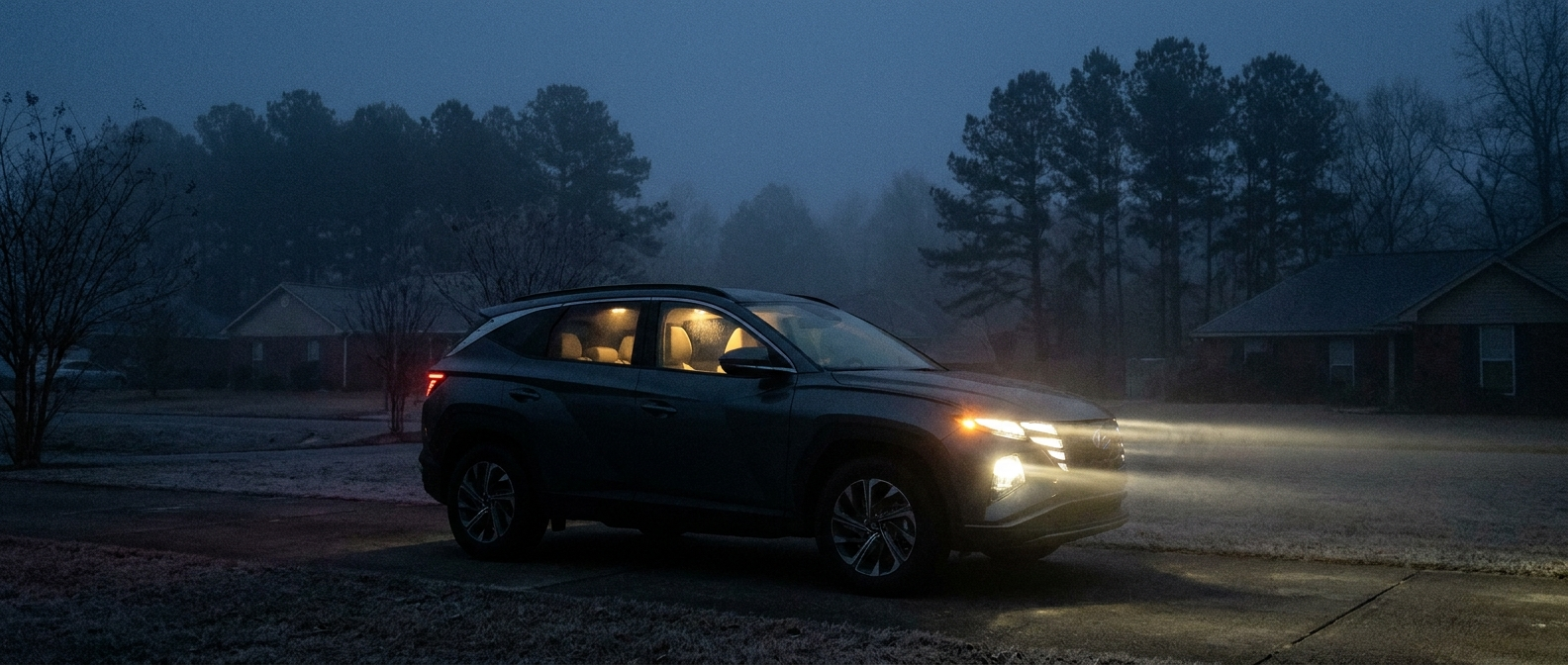
The first Southwest flight to Houston out of Jackson-Medgar Wiley Evers International Airport boards around 5:40 AM. So you're on I-20 westbound at 4:30 in the morning in early November, in the dark, with the air sitting in the mid-40s. If your battery has been quietly losing capacity since July's heat, and your DRL strip has been running with a moisture pocket behind the lens, that drive to the airport is exactly when both problems decide to introduce themselves, usually at the same moment.
The short version is simple enough. Your Hyundai's battery and lighting systems work together as a single electrical circuit, and Mississippi's seasonal pattern is hard on both. Six months of Flowood summer heat degrades battery chemistry from the inside. The first genuinely cold pre-dawn of fall is when that degraded capacity shows up. We'll walk through what to actually check, what the warning signs mean, and when to bring it to our service bay before you're standing in a dark parking lot off Airport Road at 4:45 AM.
The Hyundai Tucson carries a lot of Rankin County's early-morning traffic, so it serves as our reference throughout, but everything here applies across the 2026 Hyundai lineup.
Why Does a Pre-Dawn Airport Run Test Both Systems at Once?
A pre-dawn airport run stacks cold temperature, darkness, and a fully loaded electrical state into one moment, which is why it demands more from your Hyundai's battery than almost any other daily drive, and why a weak link in either system tends to show itself right there in the driveway.
| Local condition / use | The Hyundai system it stresses | Why it matters on the Flowood-to-JAN run |
|---|---|---|
| November air temps in the 40s at 4-5 AM | 12V battery starting reserve | The AAA Automotive Research Center reports a battery loses roughly 35% of its strength at 32 degrees F; at 40 degrees you're already drawing on reduced reserve |
| Pre-dawn darkness on I-20 | LED headlight system and DRL circuit | Full LED output from cold draws a brief current spike; a moisture-compromised DRL strip may flicker or drop a segment right at startup |
| Heated seats, rear defroster, navigation, and climate running simultaneously | Battery's ability to supply sustained load while the alternator warms up | On a 15-minute airport run, the alternator barely recovers what startup consumed |
| Six months of Flowood summer heat preceding November | Battery internal chemistry | Heat accelerates electrolyte evaporation and plate degradation; the battery arrives at fall already weakened |
| Sealed LED headlight assemblies on 2026 Hyundai models | Full-assembly replacement if an LED element fails | Unlike halogen bulbs, individual LEDs in sealed Hyundai assemblies are not separately serviceable |
That last row is the one people don't expect. We'll come back to it.
The Battery: What Summer Heat Actually Does, and Why Cold Mornings Reveal It
Most pre-trip checklists tell you to test the battery before winter, and that's reasonable, but for a Flowood driver the timing starts earlier, because a summer-weakened battery can already be compromised by November and the cold morning simply reveals it. Cold doesn't do the damage. It exposes it.
The AAA Automotive Research Center reports that a car battery can lose roughly 35% of its strength at 32 degrees F and approximately 60% of its power at 0 degrees F. Flowood doesn't regularly hit zero, but those figures describe an output reduction that starts affecting you at temperatures we see in November and December. AAA also documents that cold starting can require up to twice the normal current from the battery, because cold engine oil resists the starter more than warm oil does. That double squeeze (less available output, more current demanded) is the mechanical reason a battery that started the car fine yesterday won't start it at 4:30 this morning.
Heat is the actual damage mechanism. Hyundai's service guidance recommends inspection for batteries over three years old and specifically calls out temperature extremes as an accelerating factor. If your Hyundai spent the summer parked on a hot driveway off Lakeland Drive, the battery absorbed that heat for months. It may still read an acceptable resting voltage. Under a cold-morning load test, that same battery may not hold voltage when it matters.
Book a battery load test with our service team before your next early departure. A resting voltage reading and a load test aren't the same thing. A healthy battery reads 12.6 volts or higher at rest, according to Hyundai. What you can't determine from resting voltage alone is whether the battery holds that voltage under the actual demand of starting a cold engine. The load test measures exactly that. It's the difference between a number and an answer.
Watch for the warning signs before it becomes urgent. A slower crank than you're used to on cool mornings, interior lights or the instrument cluster dimming briefly at startup, or the battery discharge warning appearing on your instrument panel during short stop-and-go runs. That warning is Hyundai's Intelligent Battery Sensor signaling that the battery isn't recovering charge at the rate the system expects. It's not a dead battery. It's a thin margin.
LED Assemblies on 2026 Hyundais: What "Sealed" Actually Means for a Failing Light
Every 2026 Hyundai in our lineup runs LED lighting as standard across all trim levels, which is a genuine advantage once you're driving pre-dawn, but the sealed design also changes what "a light is out" means at the service level, and that's the part worth understanding before anything fails. What's easy to miss is how little a dark segment tells you about the fix.
The Hyundai Elantra's dual LED projector system, the Tucson's LED reflector headlights on SE and SEL trims, and the higher-trim projector systems are all sealed assemblies. The individual LED emitters are integrated directly into the assembly's circuit board. If a segment of the DRL strip goes dark or an LED element in the main beam fails, you're not replacing a bulb. You're replacing the entire headlight assembly. The distinction matters when you're deciding whether to bring it in now or wait.
It matters for two reasons specific to our market. First, polycarbonate lenses take six months of Mississippi summer UV and humidity hard, and lens hazing scatters the beam before you even factor in the LED output. Second, Hyundai issued Technical Service Bulletin 23-BD-002H, covering moisture and condensation inside headlamp, DRL, and fog lamp assemblies across a range of Hyundai models. The bulletin distinguishes between normal condensation (a small amount that clears after the lights run warm) and a seal failure (persistent water droplets pooling at the bottom of the housing). The first is cosmetic. A seal failure puts the internal DRL electronics in a moisture environment, which leads to corrosion and eventual circuit failure.
Run this walk-around check the night before an early departure. It takes about four minutes.
- Turn on all lights and walk around the vehicle. Look at both DRL strips from the front. One segment noticeably dimmer than the other, or not illuminated at all, signals an internal LED issue.
- Look through the lens at the inside of the housing. Standing water or persistent fogging visible through the lens is a different condition from a slight haze that cleared last time.
- Confirm your headlight mode is set to Auto, not parked on the DRL-only setting. Daytime Running Lights are a visibility cue, not full-output headlights. The Auto setting activates your full low-beam projection when ambient light drops below the threshold.
- Check headlight aim. On a dark stretch of I-20, a beam aimed too low cuts your forward sightline. A beam aimed too high pushes glare at the car in front of you.
Schedule a Pre-Departure Service Check
The Concrete Fit: Why November Is the Right Window, Not an Arbitrary One
The honest trade-off is that a battery load test and a lighting walk-around take time nobody has much of in November, between school schedules, work travel, and holiday planning, and yet this is genuinely the window to do it, because of how the physics line up rather than any seasonal marketing calendar. Nothing about the timing is arbitrary.
Mississippi summer heat does real internal damage to battery chemistry. The first cold mornings of November reduce the battery's output and increase starting demand at the same moment. That combination turns a marginal battery into a no-start. And the airport runs that start before 5:30 AM, on I-20 in the dark through the Flowood and Pearl corridors, are where a DRL failure or a weak battery stops being a background irritation and becomes a problem you're managing in the dark.
The Palisade and Palisade Hybrid carry a lot of Rankin County families to the airport in the early hours. Running a full three-row load of passengers and luggage puts a higher electrical demand on departure than a solo commute, and a battery that's marginal under light load may not cover it, not with everything running at once.
Both checks are part of our standard multipoint inspection. You don't need separate appointments for each system. Bring it in before your next pre-dawn run and we'll give you a straight answer on where both systems stand.


