

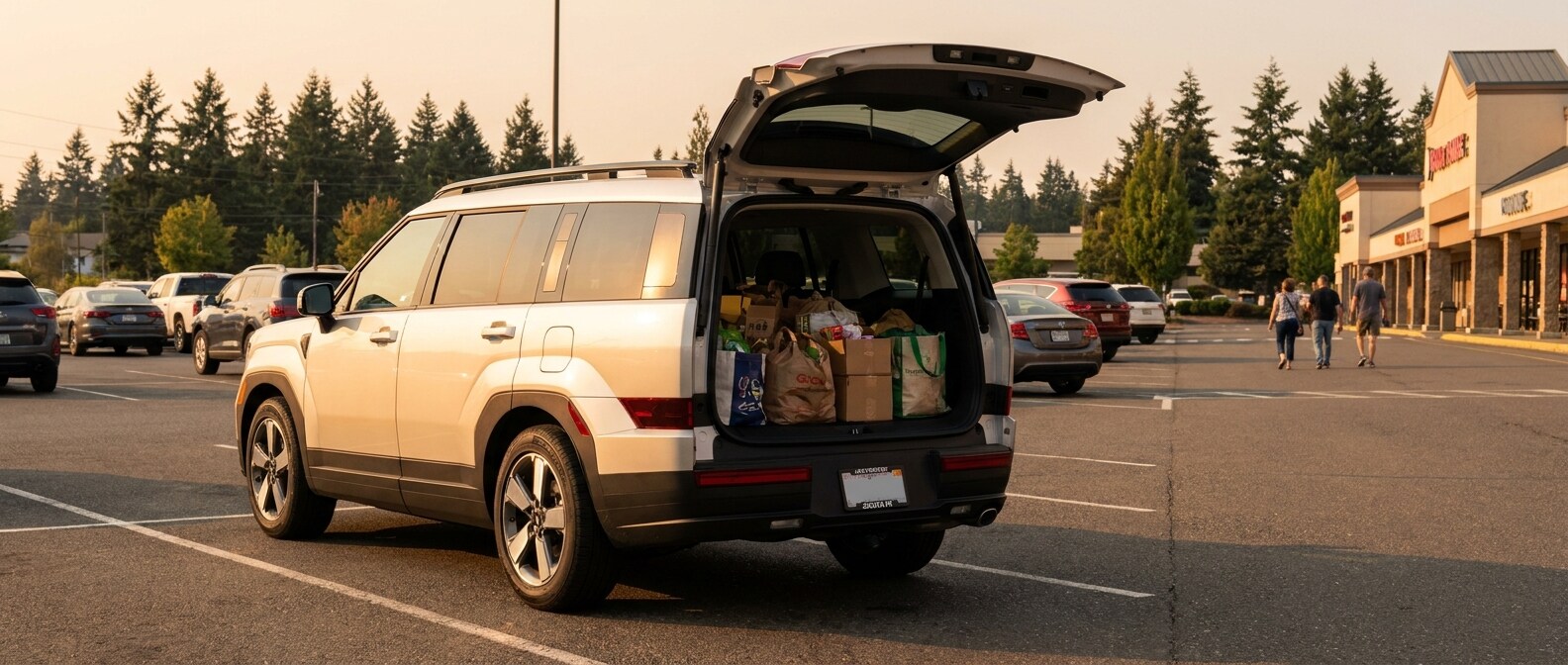
For most Rankin County families, the Hyundai Tucson is the one we'd point to first. It gives you 41.2 cubic feet of usable cargo behind a full five-passenger cabin, and that number holds whether you've got five seats filled or none. The 2026 Hyundai Santa Fe hands you more total flexibility (a third row, up to seven seats, and a maximum of 79.6 cubic feet with everything folded), but that third row is exactly what makes cargo planning trickier. If you haul a full crew and want real trunk space at the same time, the Santa Fe is built for that tradeoff. If you mostly need cargo with the odd five-passenger run, the Tucson does it more cleanly.
Which SUV Actually Gives You More Cargo Room?
Either SUV can win this one, and the answer flips entirely on how many rows you've got in play, with the Tucson taking a commanding lead when all five seats are filled and the Santa Fe clawing nearly all of that ground back the moment its third row folds flat. Hyundai's own specifications lay it out.
| Configuration | 2026 Tucson | 2026 Santa Fe |
|---|---|---|
| All seats up (seats in use) | 41.2 cu ft (behind row 2) | 14.6 cu ft (behind row 3) |
| Middle row only (rear row folded) | 80.3 cu ft | 40.5 cu ft (row 3 folded) |
| Maximum (all rear seats folded) | 80.3 cu ft | 79.6 cu ft |
| Row count | 2 rows / 5 seats | 3 rows / 6-7 seats |
Read the table and the pattern jumps out. When every seat is occupied and both vehicles are doing their main job, the Tucson carries nearly three times the behind-seat cargo of the Santa Fe. Fold the Santa Fe's third row down and that gap shrinks to almost nothing, putting you at 40.5 versus 41.2 cubic feet behind your passengers. Drop every seat flat and they're basically even at around 80 cubic feet.
The pattern behind it is straightforward. The Santa Fe's third row is what creates the cargo deficit in full-seat mode, and it's also what hands you the recovery option when you flip it down. The Tucson skips that tradeoff because it was never built around it.
Browse the 2026 Hyundai Santa Fe on our lot if you need that third row. If you don't, keep reading.
Does the Cargo Gap Matter for How Rankin County Families Actually Pack?
It matters a lot on the days your cabin is already full and almost not at all on the days it isn't, so the honest test is to picture how a typical Rankin County errand run actually loads up along Lakeland Drive on a busy Saturday afternoon. Grocery stop, Costco run, maybe a kids' sports pickup. Five people aboard, every seat taken, and you still need the trunk to hold something real. The Tucson's 41.2 cubic feet earns its keep right there, roughly three large checked-luggage suitcases standing upright.
Now our team has to be straight with you. The Santa Fe is the smarter vehicle for a household that rotates between six- and seven-seat needs. Families with three kids, or the ones who regularly bring another family along for the drive over to Brandon or down I-20 for a weekend, get real use out of that third row. With every seat up, the Santa Fe's trunk is cramped. The cargo hit is real, but it's recoverable the second the third row folds flat (which it does easily, releasing with power-folding on upper trims).
The Santa Fe Hybrid keeps that same three-row flexibility with a small trim to maximum cargo, down to 79.6 cubic feet (Hyundai packages the hybrid system under the rear load floor, which the company notes cuts total interior volume by about one cubic foot versus the gas model). So the hybrid math doesn't really move the cargo comparison.
| Your situation | Recommended SUV | Why |
|---|---|---|
| Consistent cargo with five people | Tucson | 41.2 cu ft behind rear seats, always |
| Third row needed occasionally | Santa Fe | Fold row 3 flat: 40.5 cu ft; fold all: 79.6 cu ft |
| Seven people regularly | Santa Fe | Only option in this lineup for 7-seat capacity |
| Airport run with luggage for five | Tucson | 41.2 cu ft beats the Santa Fe's 14.6 with all rows up |
| Active lifestyle, cargo varies week to week | Santa Fe | Third-row flip-down gives you two modes |
What About Cargo Features Beyond the Raw Cubic Feet?
They share plenty here, and in day-to-day loading the convenience features can end up mattering as much as the raw cubic feet, which is why it's worth looking past the spec sheet at how each SUV actually folds, lifts, and swallows a week's worth of errands. Both SUVs share more than the raw numbers suggest. Each comes with a 60/40 split-folding rear seat (Tucson) or configurable second and third rows (Santa Fe), a hands-free smart liftgate on most trims, and a dual-level cargo floor in the Tucson that lets you raise or lower the deck to match the seat height when you fold.
The Santa Fe adds power-folding second-row seats on upper trims, which genuinely helps if you're loading and unloading all the time. One feature like that turns the Santa Fe from a "think before you pack" vehicle into a quick-configure one.
When the rear seats fold, the Tucson's flat load floor is one of the cleaner setups in the compact SUV segment. Hyundai built the seat backs to fold flush, so you aren't climbing over a step to load a bike or flat-pack furniture. The result is tidy. For the driver making regular Lakeland Drive errand runs between stops, that low liftover height and clean floor matter more than they sound.
See the Tucson Hybrid if you're leaning Tucson and want to add efficiency to the equation. The hybrid version keeps the full 41.2 cubic feet behind the rear seats, since Hyundai packages the battery under the floor, so it doesn't trim cargo volume against the gas model.
Explore the Santa Fe Hybrid for the three-row version with hybrid efficiency.
Which Hyundai SUV Should You Actually Buy?
Buy the Tucson if you fill all five seats on a regular basis, and buy the Santa Fe if you truly need six or seven even a handful of times a month, because the call really does come down to how often that cabin runs full rather than how big the trunk looks empty. For the regular five-seat household, the Tucson is the cleaner choice. It delivers consistent, usable cargo space in every configuration, fits into Rankin County parking lots without drama, and the compact footprint handles the stop-and-go rhythm of Lakeland Drive and I-20 more easily than the larger Santa Fe.
If your answer is "we need six or seven seats even a few times a month," the Santa Fe earns its size premium. Those moments may be rare, but when they come, nothing else in this lineup replaces that third row. And folded to two rows, it matches the Tucson's everyday cargo almost exactly.
Our direct read is that a five-person household with steady cargo needs comes out ahead in the Tucson, because the space is there to count on, every trip. The Santa Fe is for the household that truly moves people and accepts the cargo compromise as the price of that capability.
Frequently Asked Questions
How much cargo space does the 2026 Hyundai Tucson have?
The 2026 Hyundai Tucson offers 41.2 cubic feet of cargo space behind the rear seats with all five passengers seated, expanding to 80.3 cubic feet when the rear seats are folded flat. Those figures come from Hyundai's own specifications and use the SAE measurement standard.
How much cargo does the 2026 Hyundai Santa Fe have with the third row up?
With all three rows in the upright position and all six or seven seats occupied, the 2026 Hyundai Santa Fe provides 14.6 cubic feet of cargo space behind the third row. Fold the third row flat and that expands to 40.5 cubic feet. Fold both rear rows and you reach a maximum of 79.6 cubic feet.
Is the Tucson or Santa Fe better for a family of five who needs cargo space?
For a consistent five-person household focused on cargo, the Tucson is generally the better fit. Its 41.2 cubic feet of behind-seat cargo is available every trip without any configuration change. The Santa Fe's third row leaves only 14.6 cubic feet when all seats are occupied, so unless your family regularly needs six or seven seats, the Tucson's layout serves everyday cargo needs more reliably.


