


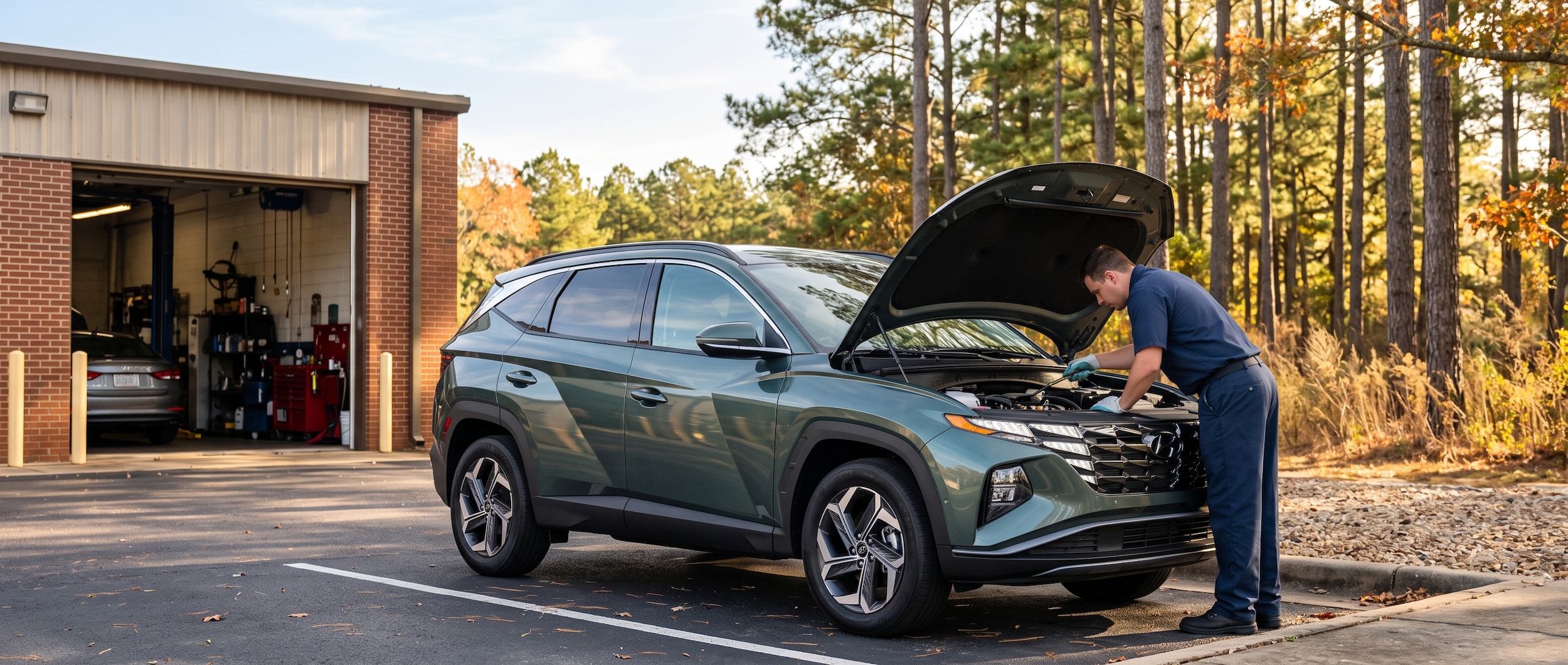
Mississippi doesn't do fall the way the rest of the country does. By the time October 1 rolls around in Flowood, we haven't had a freeze, we haven't had a cold snap worth mentioning, and we're probably still running the A/C for part of the afternoon. What we have had is five months of sustained heat, humidity, afternoon thunderstorms, and the kind of stop-and-go Lakeland Drive commuting that quietly wears on tires, batteries, wiper blades, and cabin filters while you're focused on everything else.
So the honest context for fall maintenance here isn't preparation for winter. It's recovery from summer, right before October rain squalls make every degraded component show up in ways that cost more than a service visit would have.
Schedule a service appointment at Hallmark Hyundai Flowood
What Goes on the Checklist?
Below is the full list our service team runs through on a fall visit, every item in one place so nothing slips. Pull it up, print it out, or screenshot it before you book.
| Item | What to Check | Why It Matters Here |
|---|---|---|
| Battery | Load test cold-cranking amps; inspect terminals for corrosion | Heat drains reserve capacity faster than cold does; a battery that survived June barely might not survive November starts |
| Tires | Pressure against door-jamb spec; tread depth; visual sidewall check | Temperature swings of 20-30 degrees F between morning and afternoon will shift pressure by 2-3 PSI; low pressure affects fuel economy and wet-road grip |
| Wiper blades | Streak test; inspect rubber edge condition | Blades that sat unused through dry August will streak badly the first time real rain comes in on I-20 |
| Cabin air filter | Visual inspection; replace if at or past 12,000-mile interval | Humid summers push mold and debris load up fast; a clogged filter cuts airflow and makes defrost lag |
| Engine air filter | Inspect at 15,000-mile service; replace if visibly dirty | Dusty summer road debris accumulates; a restricted filter increases fuel consumption |
| Brake pads and rotors | Thickness check; rotor surface condition | Wet October roads and stop-and-go on Lakeland Drive demand responsive stopping |
| Coolant | Level and freeze-point inspection | Flowood doesn't freeze, but coolant still degrades; correct concentration protects against overheating as temperatures finally swing |
| Wiper fluid | Top up with washer fluid rated for your climate | Leaf debris on the windshield in October combines with afternoon rain; a dry reservoir fails you exactly then |
| Exterior lighting | Walk-around bulb check | Days are shortening; headlights and brake lights take more load heading into fall commutes |
| Hyundai SmartSense sensors | Visual check for debris, road film, or damage on camera lenses and radar fascia | Bugs, humidity, and road film from summer driving can obscure forward cameras and radar; a blocked sensor quietly reduces ADAS effectiveness |
So that's the full list. The next section explains which items run most time-sensitive for a Rankin County driver and why.
Why These Items Matter Most in Our Climate
The battery is the one that catches drivers off guard
A lot of the generic fall-maintenance articles get this backward, so here's the correction worth reading twice. Heat is harder on a car battery than cold is. High under-hood temperatures speed up the internal chemical reactions that cause electrolyte loss, and a battery that spent summer parked on asphalt in 95-plus-degree heat may already be running on reduced capacity before October starts.
You won't necessarily notice until a cooler morning drops to the low 50s and the cranking feels sluggish. A proper load test, the kind that checks actual cold-cranking amps rather than just resting voltage, tells you where you really stand. A resting voltage reading of 12.6 volts is what a healthy, fully charged battery should show. What a load test adds is the story of what happens under draw, and that's the reading that counts.
The Tucson and Palisade both carry enough electronics, from ventilated seats to SmartSense processing, that a marginal battery shows up in the electrical system before it shows up in starting behavior. Get ahead of it in October.
Tire pressure: your TPMS light in October is not a mystery
Every 10 degrees F drop in ambient temperature costs your tires roughly 1 PSI, and Flowood's October mornings are built to exploit exactly that. Early-month lows sit in the mid-60s, then slide into the low 40s by the third week. You're looking at a potential 2-3 PSI pressure drop from what you set your tires to in August, and it can happen gradually enough that the TPMS light comes on without any obvious cause.
Hyundai's recommended cold tire pressure sits between 32 and 35 PSI depending on your model and trim (the exact spec lives on the door-jamb placard, not the tire sidewall). Check tires cold, meaning after the vehicle has sat for at least three hours, and always use the placard figure. A tire running 3 PSI low won't trip the TPMS warning, but it will show up as slightly reduced fuel economy and faster inner-edge wear on a stop-and-go commute like the Lakeland Drive corridor.
The cabin air filter is the most commonly skipped item
Hyundai USA recommends replacing the cabin air filter every 12,000 miles. In a humid Mississippi climate, treat that interval as a ceiling, not a number to push past. Summer heat and humidity create exactly the conditions Hyundai USA's own service guidance flags, meaning mold and debris accumulation that cuts airflow through the HVAC system. The practical result is a defroster that takes longer to clear the windshield, a heater that feels weaker, and a musty smell when you first flip on the heat.
The cabin air filter on most Hyundai models is a straightforward swap at a regular service visit. It also feels optional right up until October fog has you waiting an extra four minutes for a clear windshield on the way to the airport.
Fall filter check: If you've had the car through a full Mississippi summer and you're within a few thousand miles of the 12,000-mile mark, go ahead and replace it now rather than waiting. The cost difference is negligible, and the airflow difference is immediate.
The EPA-verified fact behind the TPMS October surprise: tire pressure drops approximately 1 PSI for every 10 degrees F of ambient temperature decrease, which means Flowood's 20-to-30-degree morning-to-afternoon swings in October can quietly push your tires 2-3 PSI below spec without any leak at all.
Wiper blades and SmartSense sensors: the visibility pair
Wiper blades degrade from UV exposure and heat whether or not they're getting used. A blade that sat through a dry August on a vehicle parked in direct sun has a compromised rubber edge, and it will streak on the first real October rain. Hyundai's service guidance calls for annual replacement at minimum, more often if you're seeing smearing or skipping.
Check the forward-camera and radar cluster while you're at it, since that hardware powers Hyundai SmartSense features including Forward Collision-Avoidance Assist and Lane Keeping Assist. Road film, bug residue, and humidity from summer driving pile up on camera lenses and radar fascias. A visual check and gentle cleaning belong in a proper fall inspection. A partially obscured sensor reduces the system's responsiveness without necessarily throwing a warning light.
Schedule Your Fall Service Visit
Print-and-Go Recap
Take this with you. Read it once before you book so you know what to ask about.
Battery: Load test (not just voltage). Ask for the CCA result. Tires: Check cold pressure against the door-jamb spec. All four plus the spare. Wiper blades: Replace if they streaked at all during summer storms. Annual at minimum. Cabin air filter: Replace if at or near 12,000 miles, or if airflow feels reduced. Engine air filter: Inspect at 15,000-mile service; replace if visibly dirty. Brakes: Pad thickness and rotor condition. Wet October roads are unforgiving on worn pads. Coolant: Level and condition check. Heat degrades it; this isn't a skip-year item. Wiper fluid: Top up before leaf season starts. Exterior lights: Walk around and test everything including rear brake lights. SmartSense sensors: Visual check for film, debris, or damage on cameras and radar.
If you've put 7,500 miles on since your last oil change, that service rolls right into this checklist, so combine them. The Santa Fe and Elantra owners sitting close to that interval will check off most of this list in a single visit.
We handle all of these items in our service department at Lakeland Drive. Book online or call (601) 914-4200 and our team will set you up.
Frequently Asked Questions
Does a Hyundai in Mississippi really need fall maintenance if it doesn't get cold here?
Yes, and the reason runs opposite to what you'd expect. Fall maintenance in Flowood is mostly about the damage that piled up over summer, not preparation for a freeze. Heat accelerates battery degradation, UV and heat compromise wiper blade rubber, humidity loads up cabin air filters with mold and debris, and extended dry spells mask tire pressure loss until the first cool morning brings the TPMS light on. Skipping fall maintenance because "it doesn't get cold here" leaves all of that summer wear unaddressed heading into the rainier, shorter-day months of October and November.
How often should I replace the cabin air filter in a humid climate like Flowood?
Hyundai USA recommends replacing the cabin air filter every 12,000 miles. In a humid Mississippi climate, treat that as a firm interval rather than something to push. Mold, pollen, and summer debris accumulate faster in high-humidity conditions, and a restricted filter reduces airflow through the HVAC system, slows windshield defrost performance, and can produce a musty smell when you first run the heat. If you're within a few thousand miles of the 12,000-mile mark and the vehicle has been through a full summer, go ahead and replace it at your fall visit.
Categories:
Social


