


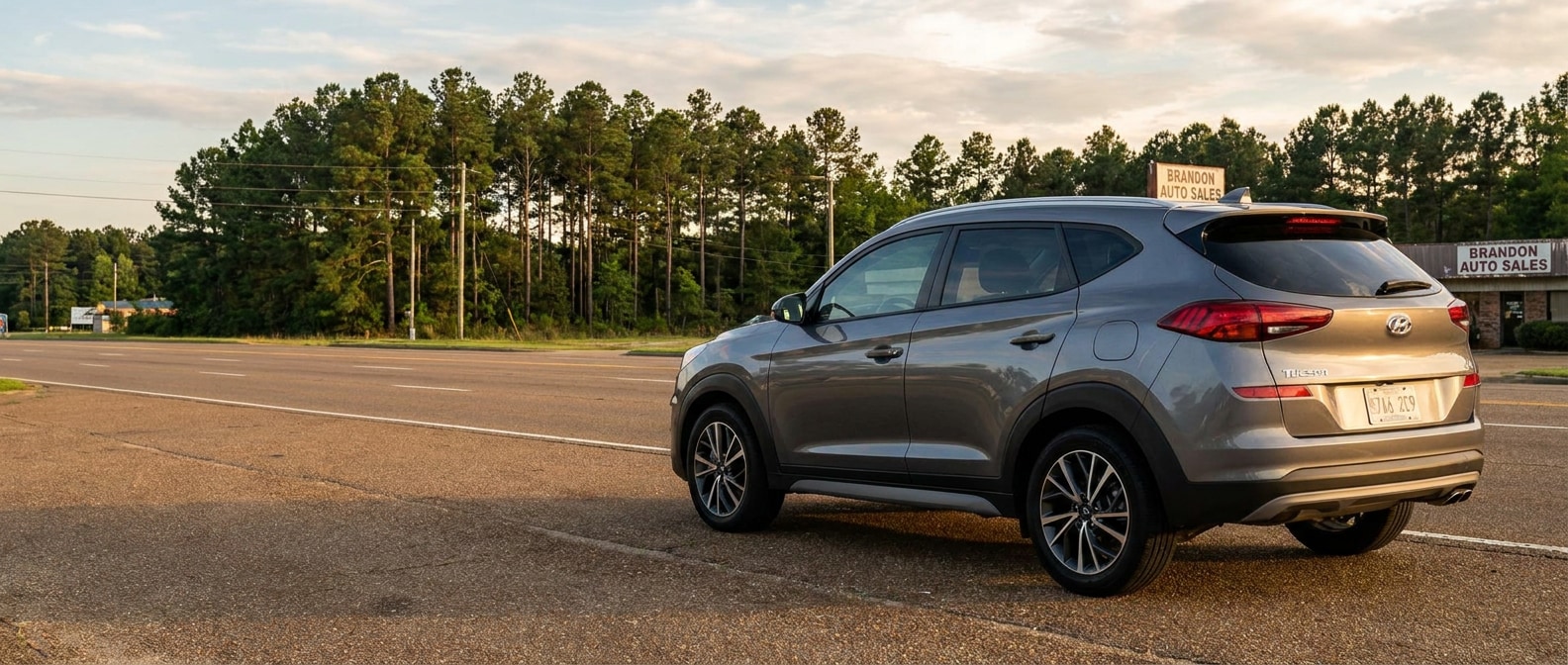
If you're shopping a used Hyundai SUV near Brandon right now, the nameplate matters less than the year. A 2021 Tucson and a 2016 Tucson aren't the same vehicle in any practical sense. The 2016 carries documented recall exposure that the 2021 largely resolves, and that gap shows up in NHTSA complaint data by a factor of roughly twenty to one. Buy the wrong year of an otherwise solid Hyundai nameplate and you've made an avoidable mistake. We put this guide together to help you skip it.
We're covering the two Hyundai SUVs that come up most in used searches around Brandon and Flowood, the Tucson and the Santa Fe. For each one, we'll walk you through the years worth targeting, the years that deserve extra scrutiny, and the specific NHTSA recall numbers you should run against any VIN before you sign.
Browse used Hyundai SUVs at Hallmark Hyundai Flowood
The short version
- Tucson sweet spot: 2020 and 2021 (6-speed conventional automatic, low complaint volume, ABS recall resolvable with VIN check)
- Santa Fe sweet spot: 2020 (8-speed torque-converter automatic, avoids both Theta II engine era and 2021 DCT complication) and 2022-2023 (stronger tech, solid recall record when cleared)
- Tucson years to watch: 2016 (1,115-plus NHTSA complaints, 4 recalls) and 2017 (NHTSA Recall 21V-727 for engine fire risk on ~82,000 units)
- Santa Fe years to watch: 2013-2018 Theta II engine era (documented rod-bearing failure history); 2021-2023 turbo models (wet DCT oil-pump recall. Confirm closed before buying)
- Always run the 17-digit VIN at nhtsa.gov/recalls before committing to any specific vehicle
Which Tucson Model Years Are the Sweet Spot for Used Buyers?
The 2020 and 2021 Tucson are the years we'd steer a Brandon buyer toward first, both running a 6-speed conventional automatic that sidesteps the dual-clutch trouble of 2016 and 2017, though neither year is flawless and both still want a VIN check before you commit. Per NHTSA data, the 2016 Tucson logged more than 1,100 owner complaints and 4 recalls. The 2021 sits at around 58 complaints on record. That difference is big enough to shape your shopping list before you've laid eyes on a single vehicle.
The EPA rates the 2021 Tucson FWD (2.0L four-cylinder) at 23 city and 28 highway. For buyers who run the stop-and-go Lakeland Drive corridor daily, where short-trip driving is the norm, that number is worth noting. The 2020 carries similar specs and a similarly clean complaint record. Neither year is perfect, but both clear the most serious hurdles.
The 2022 Tucson is genuinely better in several ways. It's the first year of the fourth-generation redesign, with a larger interior, a more modern cabin, and a stronger standard technology suite. The honest trade-off is that first-year redesign examples piled up 433-plus NHTSA complaints faster than the late third-gen cars did. A well-maintained, recall-cleared 2022 is a solid purchase. Just do the VIN work first.
| Model Year | Generation | Transmission | NHTSA Complaints | Key Recalls | Verdict |
|---|---|---|---|---|---|
| 2016 | 3rd gen | 7-spd DCT (1.6T) or 6-spd auto (2.0) | 1,115+ | 4 recalls; 22V-056 ABS fire | Avoid |
| 2017 | 3rd gen | 7-spd DCT (1.6T) or 6-spd auto (2.0) | 716+ | 21V-727 engine fire; 22V-056 ABS | Verify both recalls closed |
| 2018 | 3rd gen | 7-spd DCT (1.6T) or 6-spd auto (2.0) | ~383 | 22V-056 ABS module | Verify recall closed |
| 2019 | 3rd gen | 6-spd auto | ~349 | 22V-056 ABS (expanded scope) | Acceptable; verify recall closed |
| 2020 | 3rd gen | 6-spd auto | Low | 22V-056 ABS | Sweet spot |
| 2021 | 3rd gen | 6-spd auto | ~58 | 22V-056 ABS | Sweet spot |
| 2022 | 4th gen | 6-spd or 8-spd auto | 433+ | 3 recalls | Verify all closed; solid if done |
See new Hyundai Tucson models at our Flowood location
Which Tucson Years Should You Watch Out For?
Treat the 2016 and 2017 as the Tucson years that call for serious scrutiny before you buy, not because Hyundai SUVs are unreliable as a category (they aren't), but because two documented issues follow those model years wherever they land on the used market. Neither one is a dealbreaker on its own. Both are reasons to slow down and read the paperwork.
The first is the 7-speed dual-clutch transmission on turbocharged 2016-2017 models. This DCT generated a high volume of owner complaints around shuddering, hesitation, and inconsistent low-speed behavior. You'll feel that kind of problem on a Lakeland Drive commute with lots of slow-and-go traffic, not on a highway run where the transmission stays in a higher gear.
The second is NHTSA Recall 22V-056 (Hyundai's internal Recall 218). Per NHTSA documentation, this recall covers 652,024 Tucson units from model years 2016 through 2021 for an ABS module that can develop an electrical short and cause an engine compartment fire even while the vehicle is parked. Technicians install a fuse kit and update the ABS software, free, at a Hyundai dealer. On 2017 models, there's a second recall to verify separately, NHTSA 21V-727 (Recall 209), which covers approximately 82,268 Tucsons for premature connecting rod bearing wear that, if unaddressed, can cause the engine to stall and in some cases catch fire.
Both recalls can be repaired, and an open status isn't an automatic disqualifier. Treat it as a reason to confirm the work is done and documented before you take delivery.
See new Hyundai Santa Fe models for size comparison
Pros and Cons of Buying a Used Hyundai Tucson
| Pros | Cons |
|---|---|
| 2020-2021 sweet spot is well-documented with low NHTSA complaint volume | 2016-2017 DCT requires careful VIN and transmission inspection |
| Compact footprint fits Brandon and Flowood retail-corridor driving well | ABS recall 22V-056 spans 2016-2021; VIN check required for every example |
| EPA 23/28 mpg (2021 FWD) holds up in daily stop-and-go commuting | Tops out at 5 passengers; no three-row configuration available |
| Strong Hyundai dealer network for completing any open recall repairs | 2022 first-year redesign carries more initial complaints than late third-gen |
Which Santa Fe Model Years Are Worth Your Attention?
The Santa Fe's used-buying story has one clean dividing line, the engine era, and which side of it a given SUV lands on matters more than trim or mileage, though even a strong fourth-generation example still earns a full pre-purchase inspection before you commit. Everything from 2013 through 2018 used Hyundai's Theta II four-cylinder in several configurations, and that engine family has a documented history of rod-bearing failure as mileage accumulates. Based on NHTSA data, the 2018 is the cleanest of that third generation. It shows 7 recalls and 489 complaints, lighter than the earlier years, but it still carries the ABS module recall (22V-056) and warrants a thorough pre-purchase inspection if mileage is significant.
The fourth generation (2019-2023) is where the Santa Fe improves meaningfully. We'd steer buyers who want to dodge the most complications toward the 2020. It benefited from Hyundai's 2019 platform refresh without carrying the first-year 2019 issues, and it predates the 2021 facelift that brought a wet dual-clutch transmission to turbocharged trims. That 2021 DCT, an 8-speed wet clutch unit, triggered a recall for a high-pressure electric oil pump failure that could cause complete loss of drive power while moving. A 2020 non-turbo Santa Fe with its conventional 8-speed torque-converter automatic sidesteps that entirely.
The EPA rates the 2020 Santa Fe FWD (2.4L four-cylinder) at 22 city and 29 highway. The 2021 Santa Fe FWD (2.5L four-cylinder, non-turbo) comes in at 25 city and 28 highway, a meaningful bump in city mileage if fuel economy is a priority. Both the 2022 and 2023 Santa Fe are worth considering once recalls are confirmed cleared. NHTSA data shows the 2020 carrying roughly 165 complaints and 2 recalls, against 489 complaints and 7 recalls on the 2018.
| Model Year | Generation | Key Engine | NHTSA Complaints | Watch For | Verdict |
|---|---|---|---|---|---|
| 2013-2017 | 3rd gen | Theta II 2.4L / 2.0T | High | Rod-bearing failure; multiple recalls | Avoid without thorough inspection |
| 2018 | 3rd gen | 2.4L / 2.0T / 3.3L V6 | 489 | 7 recalls; ABS 22V-056 | Inspect carefully |
| 2019 | 4th gen | 2.4L / 2.0T | ~201 | 3 recalls; first-year examples | Acceptable; verify recalls |
| 2020 | 4th gen | 2.4L (8-spd torque converter) | ~165 | 2 recalls | Sweet spot |
| 2021 | 4th gen (facelift) | 2.5L / 2.5T (wet DCT on turbo) | ~244 | DCT recall on turbo trim | Verify DCT recall closed |
| 2022-2023 | 4th gen | 2.5L / 2.5T | Moderate | Verify recalls | Strong buy when cleared |
Which Year Fits Which Brandon Buyer?
Pulling the two questions together, Tucson or Santa Fe and which model year, comes down to how you actually drive around Brandon day to day, and the four profiles below sort the common situations by use rather than by badge. Match the vehicle to the driving first. The recall checks come right after.
The daily commuter on Lakeland Drive or the I-20 corridor. A 2020 or 2021 Tucson makes the most sense here. It's compact enough to move through Brandon's commercial corridors without feeling like too much vehicle for an errand, the 6-speed automatic is mechanically straightforward, and fuel economy in the mid-20s combined holds up in short-trip stop-and-go. The friction our team keeps coming back to is simple. On 2016-2017 turbo models, the 7-speed dual-clutch shows its low-speed shudder most in exactly this stop-and-go, the driving a Lakeland Drive commute is made of. The 2020-2021 with its conventional 6-speed simply doesn't have that issue.
The family that regularly fills seats or loads the cargo area. The 2020 Santa Fe is the call. You get more interior volume than the Tucson, a conventional torque-converter automatic with no recall complications from the DCT era, and a used price point that reflects solid depreciation without giving up the features a family actually uses day to day. If a 2022 or 2023 fits the budget, the interior improvements and expanded standard tech are real and worth the step up.
The buyer who wants current safety technology on a used budget. A 2022 Tucson or a 2022-2023 Santa Fe, with every recall confirmed resolved, hands you the full Hyundai SmartSense suite as standard across most trims. You get forward collision avoidance assist, lane keeping assist, and blind-spot monitoring without paying for a new vehicle to land them. Take the extra ten minutes on the VIN check at nhtsa.gov/recalls and ask for the service records.
The buyer considering a turbocharged Santa Fe for a different driving feel. The 2020 turbo (2.0L, four-cylinder, conventional 8-speed automatic) is the cleaner pick over a 2021 or 2022 turbo if you'd rather skip the DCT recall conversation entirely. Want a 2021-or-newer turbo instead? That's a reasonable choice, as long as the oil pump recall is confirmed resolved and the service documentation backs it up.
Find your next used Hyundai SUV at Hallmark Hyundai Flowood
Explore Your Financing Options
Frequently Asked Questions
What NHTSA recalls should I check before buying a used Hyundai Tucson?
Two matter most on 2016-2021 examples. NHTSA Recall 22V-056 (Hyundai Recall 218) covers a wide range of Tucson model years for an ABS module electrical short that can cause an engine compartment fire even while the vehicle is parked, and the remedy is a free fuse kit installation and ABS software update at a Hyundai dealer. On 2017 models specifically, also check for NHTSA Recall 21V-727 (Hyundai Recall 209), which covers approximately 82,268 Tucsons for premature connecting rod bearing wear that can lead to engine stall and fire risk if unaddressed. Run the 17-digit VIN at nhtsa.gov/recalls to confirm the status of both on any vehicle you're considering.
Is a used Hyundai Santa Fe a reliable buy?
The fourth-generation Santa Fe (2019-2023) has a substantially stronger record than the third-generation Theta II engine era (2013-2018). The 2020 Santa Fe in particular sits at roughly 165 NHTSA complaints and 2 recalls, compared to 489 complaints and 7 recalls on the 2018. A pre-purchase inspection focused on engine condition, plus a VIN-based recall check, are the two steps that do the most work before you commit to any specific used example.
Should I buy a used Tucson or a used Santa Fe near Brandon?
It depends on what the vehicle needs to do day-to-day. The Tucson is the right fit for a single commuter or a smaller household that values a more manageable footprint in stop-and-go traffic between Brandon and Flowood. The Santa Fe fits a family that regularly needs the extra interior volume or cargo space, or that wants more comfort margin on longer runs on I-20. Both nameplates have reliable model-year windows to target, so once you've settled on the size that matches your actual use, the decision comes down to which specific years have their recall history in order.
Categories:
Social


