


Walk into a dealership confused and walk out more confused, and you're in good company. The 2026 Hyundai lineup has a lot going on. Hybrids, a three-row electric SUV, redesigned everything. Our team gets it. The question worth asking isn't "what does this vehicle have?" It's "which features make a difference on Lakeland Drive at 5:15 on a Tuesday, or on I-20 to Brandon with three kids in the back?" The answer comes down to your driving profile, not a spec sheet, and we'll show you how we sort it out.
Browse the 2026 Hyundai lineup at Hallmark Hyundai Flowood
What's Actually Going On? Matching Your Drive Profile to the Right Feature Set
Underneath every question a shopper asks on the lot sits a real problem, and the fix is usually one feature rather than a whole different vehicle, which is why we start by diagnosing instead of recommending. The table below maps the four most common Rankin County driving profiles to the symptom that sends you shopping, the feature that addresses it, and the 2026 model where that feature lives. The goal here is a right fit for how you actually drive.
| Your Driving Profile | The Problem You're Solving | The Feature That Fixes It | The 2026 Model That Has It |
|---|---|---|---|
| Daily Lakeland Drive commuter, stop-and-go | Fuel spend on a slow, signalized corridor | Regenerative braking hybrid system; EPA 54 mpg combined | Elantra Hybrid Blue |
| Rankin County family hauler, school run + weekends | Not enough cargo space, not enough seats | 80.3 cu ft cargo; up to 38 mpg combined (hybrid) | Tucson Hybrid |
| Three-row family, road trips to the Gulf Coast or Memphis | Eight seats, real towing, long highway comfort | 3.5L V6, 287 hp, 5,000 lb tow, 181 cu ft interior | Palisade |
| EV-curious, airport runs, daily errand loop | Range anxiety on longer drives, heat concerns | EPA-estimated 335 miles all-electric range; 300+ miles on every trim | IONIQ 9 |
Plenty of drives fall into one row cleanly, and once you've found your row the trim conversation handles any overlap. A few span two.
The Efficiency Gap Is the Feature Flowood Drivers Feel Most
Hybrids earn their keep in stop-and-go, and Lakeland Drive hands you plenty of it, so the efficiency gap is the feature you'll feel first, with one point worth naming up front. The 2026 Elantra Hybrid Blue is EPA-rated at 54 mpg combined (51 city, 58 highway). That city figure tends to hold up in real-world stop-and-go, because regenerative braking captures energy every time you slow for a light. The system works harder when traffic gets heavier, the inverse of how a gas engine behaves. You don't change a thing.
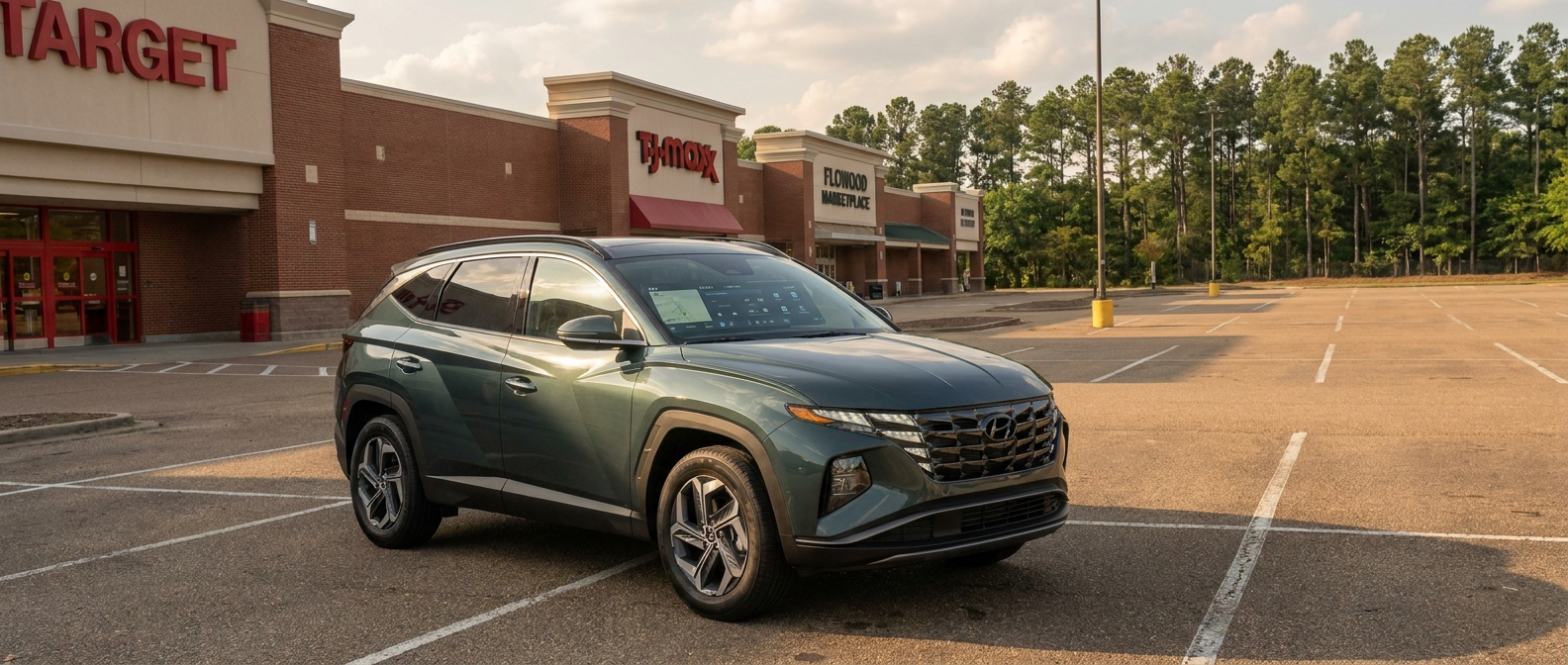
The Elantra Hybrid comes with one tradeoff, it's a sedan, so if you need cargo flexibility or more than five seats, the efficiency answer shifts. The 2026 Tucson Hybrid Blue hits EPA-estimated 38 mpg combined in front-wheel drive, which on a 13.7-gallon tank gives you a driving range of over 500 miles between fill-ups. For a Flowood family running errands between Dogwood Festival Market and Brandon on the same afternoon, that 80.3 cubic feet of cargo with the seats folded makes the number genuinely practical.
On our lot, folks cross-shopping the Tucson Hybrid and the standard Tucson often don't realize how different the real-world experience is on slow arterials. The gas Tucson returns EPA-estimated 26 mpg combined. A solid number, but the hybrid gap is real on a commute that rarely lets you cruise.
Worth knowing before you decide on a trim. Ventilated front seats are available on upper Tucson trims and on the Palisade Calligraphy. If you're driving in Flowood's summer heat (average highs up to 92F) and spend more than twenty minutes in traffic regularly, that feature has a measurable comfort payoff the spec sheet undersells. Ask about it before you settle on a trim.
The 2026 Tucson Hybrid Blue is EPA-estimated at 38 mpg combined, and with a 13.7-gallon tank that translates to a real-world range of more than 500 miles between fill-ups.
Three-Row Territory: When Size Is the Feature
The 2026 Palisade Hybrid is new for this generation, and it shifts the math on the family-hauler question, though the right pick still depends on whether you tow or just haul people. The Palisade lineup now splits into two powertrains. The standard 3.5L V6 makes 287 horsepower (EPA-estimated 20 mpg combined), and the new Hybrid pairs a 2.5L turbocharged four-cylinder with an electric motor for 329 combined horsepower and 339 lb-ft of torque.
Both versions seat up to eight and share the same 181 cubic feet of interior volume. For a Brandon school-district family with car seats, a dog, and a Costco run on the same Saturday, that volume is the spec that matters. The V6 is the right call if you tow regularly, rated for 5,000 pounds with the conventional powertrain confidence for a loaded trailer on I-20. The Hybrid earns its place on fuel economics and that extra kick of electric torque, handy when you're merging onto the interstate with seven people aboard.
Both Palisade configurations come standard with a 12.3-inch touchscreen, wireless Apple CarPlay and Android Auto, and over-the-air software updates. The Passenger Talk intercom (which lets the driver speak to third-row passengers through the audio system) is the kind of feature you either never miss or wonder how you lived without. Load that third row with people who can't project. Then it's worth a test.
Schedule a Model Walkthrough with Our Team
The IONIQ 9: What the EPA Number Means for Rankin County Daily Use
The 2026 IONIQ 9 is a legitimate three-row electric SUV, and a fair question before you commit is whether the range holds up in real use, so the EPA number deserves a straight read. The EPA-estimated range for the rear-wheel-drive S trim is 335 miles. Every trim in the lineup, including all-wheel-drive models, is EPA-estimated at 300 miles or above. The EPA publishes that figure, and Hyundai's own official press material backs it.
For most Rankin County daily use, that range is far more than you'll touch. Jackson-Evers International Airport sits less than ten miles from Flowood. A Flowood-to-Brandon round trip runs under thirty miles. What matters in practice is whether you can charge overnight, because an IONIQ 9 owner in this market is almost certainly plugging in at home rather than hunting for a fast charger mid-commute. If you've got a standard 240-volt outlet at the house, that's the conversation to have.
One honest constraint stays in the picture, and it shows up on long trips. If your household does regular long-distance runs (Memphis is about three hours on I-20 / I-55, the Gulf Coast is similar), think through where fast-charging stops fit into those trips. For families using the IONIQ 9 as their primary local vehicle and planning longer drives with charging-stop awareness, that's no dealbreaker. Filling a tank just gives way to a different pre-trip mental model.
Knowing What to Explore on Your Own Versus Getting a Walkthrough
Some of this you can settle on your own before you ever visit us, and some of it only clicks once you're in the seat, so it helps to know which is which. EPA figures and cargo specs are published and accurate, so you can sort the lineup on paper before you come in. The decision table above gives you a real starting point.
What's harder to judge from a website is how a feature feels inside your actual routine. The Elantra Hybrid's regenerative braking paddle option, the weight and action of the Palisade's third-row fold, the knee room in the IONIQ 9's second row with the captain's chair configuration, the cooling speed of those ventilated seats on a 90-degree afternoon. None of that translates to a spec sheet. Our team's job is to put you in the right seat, not to tell you which vehicle you should like.
Tell us which driving profile fits you, and we'll build the conversation from there. We don't run high-pressure walkthroughs.
Frequently Asked Questions
Which 2026 Hyundai model gets the best fuel economy for Flowood stop-and-go driving?
The 2026 Elantra Hybrid Blue is EPA-estimated at 54 mpg combined, with a city rating of 51 mpg. Because regenerative braking captures energy every time you decelerate, real-world city figures for hybrids like this one often track close to the EPA estimate in stop-and-go conditions, including the signalized traffic common on Lakeland Drive. Want an SUV instead of a sedan? The Tucson Hybrid Blue steps that up to EPA-estimated 38 mpg combined with a lot more cargo space.
Is the 2026 Hyundai IONIQ 9's range realistic for daily driving in the Jackson metro area?
For most daily driving in the Jackson metro and Rankin County, yes. The EPA-estimated range for the IONIQ 9 rear-wheel-drive S trim is 335 miles, and every trim in the 2026 lineup is EPA-estimated at 300 miles or more. Daily commutes and errand loops in this market cover well under 100 miles. The practical question is overnight charging access at your home rather than range for routine use. For regular long-distance trips, planning around fast-charging stops is part of the ownership model.
Categories:
Social


