


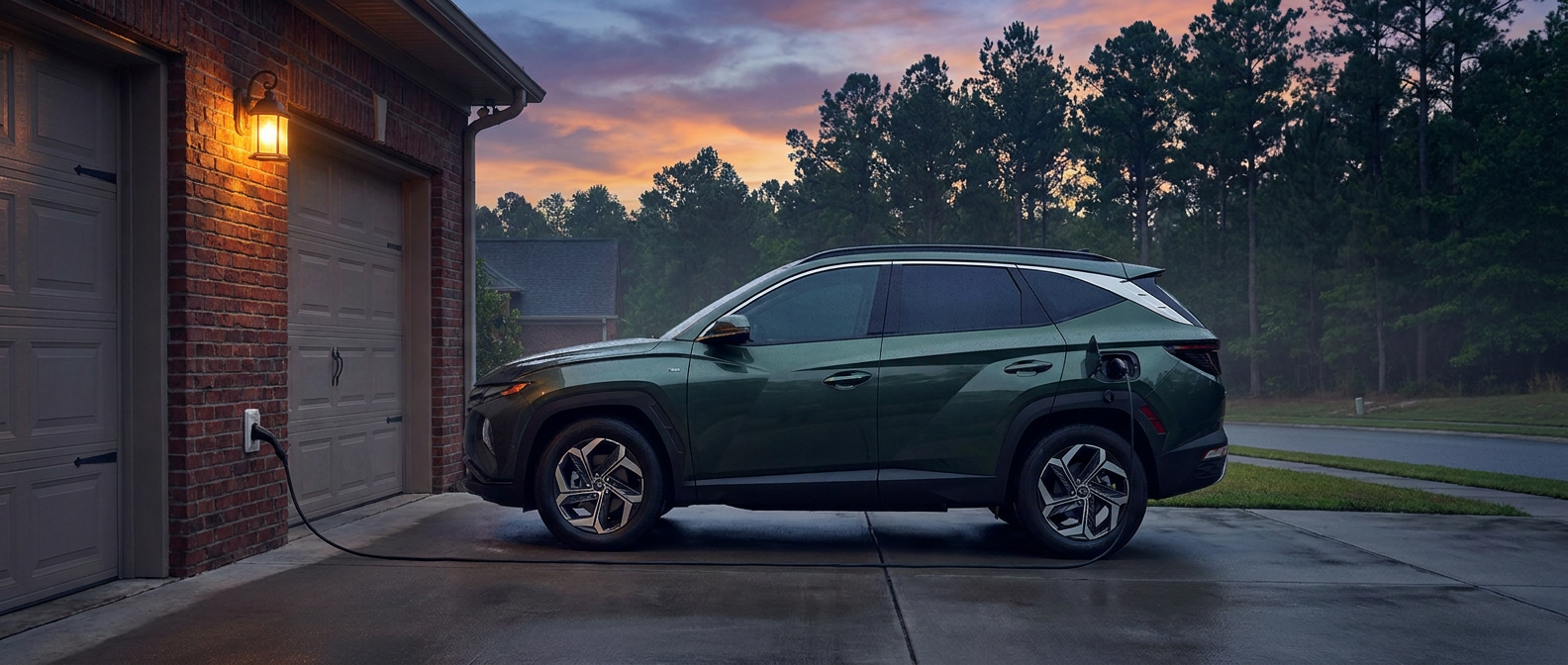
A fair question before any plug-in purchase has nothing to do with horsepower or cargo space. It runs simpler than that. Do I need to wire my garage before I bring a plug-in hybrid home? The answer is no. The 2026 Hyundai Tucson Plug-In Hybrid ships with a cable that works in any standard outlet, so you could plug it in tonight. Whether the PHEV genuinely fits your life, though, comes down to how far you drive, where you park, and one habit you'll need to build. We'll give you the same read we'd give a neighbor asking the same thing.
What Makes a Plug-In Hybrid Different from a Regular Hybrid?
A conventional Hyundai hybrid charges its own small battery on its own, drawing from the engine and regenerative braking, so you'll never plug it in, while the plug-in version carries a far larger pack you recharge from an external source for genuine electric-only miles. Hyundai lists that pack at 13.8 kWh on the 2026 Tucson PHEV. When the charge runs out, the Tucson PHEV shifts smoothly into regular hybrid operation. No drama, no detour home.
The no-detour part matters more than the spec sheet lets on. Unlike a full battery-electric vehicle, a PHEV never strands you. The gas engine is always there, and it's built specifically for drivers who want real daily electric miles without fully committing to a charge-only life.
See the current Hyundai lineup at Hallmark Hyundai Flowood
How Far Will It Really Go Here on Electricity?
The EPA rates the 2026 Tucson Plug-In Hybrid at 32 miles of all-electric range on a full charge and 80 MPGe in electric mode, and those are Hyundai's published figures. Real-world numbers shift with speed, temperature, and how hard you're running the AC.
| Driving Condition | Estimated Electric Range | Source / Note |
|---|---|---|
| EPA full-charge rating | 32 miles | Hyundai USA / EPA official |
| Mixed highway driving | 27-30 miles | Real-world testing |
| City stop-and-go (ideal) | 32-33+ miles | Regenerative braking recaptures energy |
| Mississippi summer with AC on | ~25-28 miles | Cabin cooling draws from the battery pack |
| Gas-only mode (battery depleted) | 35 mpg combined | EPA estimate, Hyundai USA |
For Rankin County daily driving, the Lakeland Drive and I-20 corridors are exactly the short-leg, stop-and-go running where regenerative braking does its best work. A typical errand loop through Flowood's retail stretch, or a round trip to Pearl for school pickup, won't test that 32-mile electric window. A longer run toward downtown Jackson and back, covering 28-to-35 miles, can carry you right to the edge of the electric range before the gas system picks up without a stutter.
Mississippi summers run long and humid, and cabin cooling in July and August pulls genuine energy from the battery. Plan for the lower end of that table on summer afternoons and you won't get caught off guard.
The EPA rates the 2026 Tucson Plug-In Hybrid at 32 miles of all-electric range and 80 MPGe in electric mode. In stop-and-go city driving, regenerative braking can recover enough energy to match or slightly exceed that EPA figure.
Where Do You Charge Locally, and What Does It Take?
Where you park decides more here than any spec on the window sticker, and for most Flowood, Pearl, and Brandon households you won't need extra charging equipment to get started, though that changes fast if your parking spot has no outlet within reach. The picture is reassuring for anyone with a garage or carport.
The Tucson Hybrid (the non-plug-in version) doesn't need charging infrastructure at all, ever. Step up to the PHEV and the breakdown runs like this.
Level 1 (standard 120V household outlet) Consumer Reports tested the Tucson PHEV on its included charging cable and measured just under 11 hours for a full charge at 120V. Plug in at 7 p.m., and the battery's full before your first alarm goes off. For most Rankin County homeowners with a garage or covered carport, that handles your daily routine with nothing extra. No installation, no electrician.
Level 2 (240V, like a dryer outlet) Check your garage for an existing 240V outlet before you price anything out. Hyundai rates Level 2 charging time at approximately 2 hours for the 2026 Tucson PHEV, so a simple adapter or a dedicated Level 2 unit gets you a full charge in an afternoon if the outlet's already there. If it isn't, most Rankin County electricians can wire a 240V garage outlet in a half-day job.
DC Fast Charging The Tucson PHEV doesn't offer DC fast charging, which is a genuine limitation for road-trip top-ups, though in daily use it rarely bites. The 13.8 kWh battery is small enough that Level 2 handles it in about 2 hours, and an overnight home charge covers that pack with room to spare. On longer drives, the gas engine covers the miles while you skip the public charger entirely.
Public Level 2 stations are available in the Flowood area and along the I-20 corridor toward Jackson, per the U.S. Department of Energy's Alternative Fuels Station Locator. They work for a midday top-up when you're nearby, and they aren't something you'll depend on for daily charging.
Charging caution: If you park at an apartment complex or rental property without a dedicated outlet accessible to your spot, the PHEV convenience drops significantly. In that scenario, the Tucson Hybrid may serve you better. It never needs plugging in, and the fuel economy's strong on its own.
Print-and-go checklist: Before you decide on the Tucson PHEV
- [ ] Confirm you have a covered parking spot with an outlet within cable reach
- [ ] Check whether your home has a 240V outlet (garage panel, dryer circuit, or outdoor unit)
- [ ] Map your typical daily round trip (under 32 miles = mostly electric if you charge each night)
- [ ] Factor in Mississippi summer AC use: plan for 25-28 miles of electric range on hot afternoons
- [ ] Decide whether Level 1 overnight charging handles your routine, or if Level 2 speed matters to you
- [ ] Talk to our team about whether the Tucson PHEV or the Tucson Hybrid fits your parking situation
Explore Financing Options for the Tucson Plug-In Hybrid
Plan It This Way
Standing in front of both Tucson models, the call comes down to one habit, because the PHEV pays off in efficiency only when you plug in consistently, and if you skip that, you're driving a heavier car that burns more gas than the hybrid you could have picked instead.
Consumer Reports measured the Tucson PHEV at approximately 31 mpg combined in gas-only mode after the battery depletes. The standard Tucson Hybrid returns an EPA-estimated 38 mpg combined. Blame the roughly 330 pounds of extra battery the PHEV carries for that 7 mpg gap. The weight isn't a flaw in the design, it's the tradeoff for the larger pack that gives you 32 electric miles per charge. The math only tips in the PHEV's favor when you're actually using those electric miles most days.
Our read is this. If your garage has an accessible outlet and your daily driving stays around 30 miles round-trip or less, the plug-in hybrid is worth serious consideration. If your commute is mostly highway miles, you travel a lot, or nightly charging isn't realistic where you live, the Tucson Hybrid is an excellent car that never asks more of you than a gas station. Either way, the I-20 run toward Jackson and the longer leg past Brandon on I-20 East are completely stress-free in either version.
Once the Tucson PHEV's electric range is spent, you're in a 35-mpg combined SUV with standard HTRAC all-wheel drive. The gas engine fills in without a gear change or a pause. No anxiety, no planning ahead for a charger.
Have questions about the Tucson PHEV's charging setup? Our team is here.
Frequently Asked Questions
Can I charge the Hyundai Tucson Plug-In Hybrid with a regular household outlet?
Yes. The 2026 Tucson Plug-In Hybrid includes a Level 1 charging cable that works in any standard 120V wall outlet. Consumer Reports' testing measured just under 11 hours for a full charge at that level. For most drivers who park at home in the evening, overnight Level 1 charging is a complete solution with no additional equipment or installation required.
What happens if I don't plug in the Tucson PHEV consistently?
The car still runs as a conventional hybrid. But Consumer Reports found the Tucson PHEV returns approximately 31 mpg combined in gas-only mode once the battery is depleted, compared to an EPA-estimated 38 mpg combined for the standard Tucson Hybrid. The difference comes from the roughly 330 pounds of extra battery weight the PHEV carries. Consistent nightly charging is what makes the PHEV's efficiency advantage real.
Does Mississippi heat affect the electric range on the Tucson Plug-In Hybrid?
Yes. The air conditioning system draws from the same 13.8 kWh battery pack that powers the electric motor. In peak Mississippi summer heat with the cabin cooling system running hard, expect electric range to fall to the 25-to-28-mile window rather than the EPA estimate of 32 miles. The gas engine picks up the difference without interruption, so there's no impact on the drive itself.
Categories:
Social


