


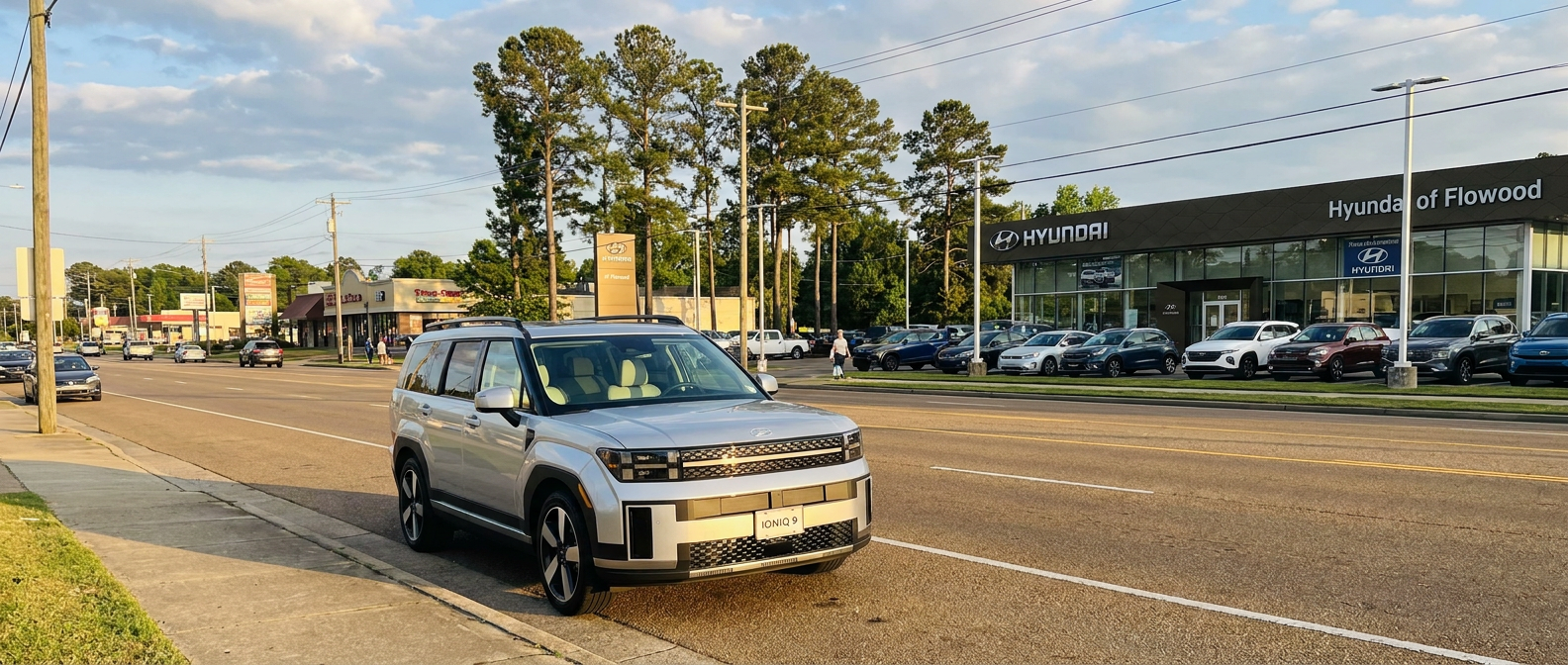
Before you sign anything, we want you to walk out of a test drive knowing exactly how the 2026 Hyundai IONIQ 9 holds up against your actual life. Your commute, your summer afternoons, your airport runs, your weekend errands on Lakeland Drive. Range is the first question every new EV buyer has, and it's the one most test drives never really answer. So we built this itinerary around five specific stops in the conversation. Each one hands you a real number, a real scenario, or a real piece of information to take home.
The EPA rates the 2026 IONIQ 9 RWD S at 335 miles of estimated range per charge. That's the headline. What matters more is what it means for the way you drive here, in this market, in this heat.
What's the Route? A 5-Stop Pre-Drive Checklist
The route runs five stops in order, each one a question to settle before you leave the lot, so the range number you carry home reflects your actual driving rather than a brochure figure. Work through them top to bottom.
| Stop | Focus Question | What to Check | What to Note |
|---|---|---|---|
| 1. Trim Walk | Which trim fits my needs? | RWD S (335 mi EPA) vs AWD SE/SEL (320 mi EPA) vs AWD Performance (311 mi EPA) | Drivetrain choice directly changes range. Pick your trim before worrying about numbers |
| 2. Range Display | What does the dash show at 100% charge? | Estimated range on the instrument cluster | The display reads real conditions, not just the EPA label. Temperature matters |
| 3. A/C Loaded Drive | How does Mississippi heat affect this? | Take 10-15 min with A/C at full cooling, normal acceleration | Research data shows EVs shed roughly 5% range at 90 degrees Fahrenheit and up to 17-18% at 100 degrees Fahrenheit. Feel the difference |
| 4. Regen & Stop-Go | Does Lakeland Drive stop-and-go actually recover energy? | Toggle regenerative braking levels through a stop-light stretch | Regen braking routes energy back to the battery; city driving benefits more than you'd expect |
| 5. Charging Q&A | Where do I charge in Rankin County today? | Ask our team about the NACS port, local fast chargers, and home charging setup | The IONIQ 9 can reach 10-80% in roughly 24 minutes on a 350 kW fast charger |
Stop 1: Nail the Trim First, Then the Range Number
The range question only makes real sense once you've picked a powertrain, because the 2026 IONIQ 9 comes in three configurations and the spread between them is meaningful enough to change your decision before you ever glance at a charging estimate.
The RWD S pairs a single 160 kW motor with the EPA's top estimate of 335 miles. Rear-wheel drive, 215 horsepower, and the longest range in the lineup. Step up to AWD (the SE or SEL) and you get dual motors producing 303 horsepower and 320 miles of EPA-estimated range. Go all the way to the Performance AWD trims (Limited, Calligraphy, or Calligraphy Design) and the output jumps to 422 horsepower, 516 lb-ft of torque, and a still-strong 311 miles of EPA-estimated range.
For most Rankin County buyers, the AWD SE or SEL is the sweet spot. The 24-mile gap between the S and the SE is real but not dramatic on a daily basis. What drives the choice is whether you want AWD capability and the features packaged with it. We'll walk you through the comparison on the lot before you drive anything. Trim first, range second.
Stop 2: Read the Range Display at Full Charge
A fully charged IONIQ 9 won't always show you the EPA number on the dash, and that catches people off guard, because the instrument cluster reports a calculated estimate built from recent driving history and current conditions rather than the lab figure on the window sticker.
On a mild day with a fresh charge, the display might land close to the EPA figure. On a humid October afternoon in Flowood when it's still 88 degrees and the A/C is already running, it may read lower. Neither reading is wrong. The display is doing exactly what it should, accounting for the real world instead of the test lab.
The 110.3 kWh battery ranks among the largest in any mainstream three-row SUV right now. At 3 miles per kWh, a reasonable real-world efficiency in relaxed driving, that pack supports well over 300 miles. Reading the display calibrates your expectations against today's conditions. Not against a test-cell spec sheet.
Stop 3: Drive It in the Heat With the A/C On
Mississippi heat does cost you range, and the only way to feel how much is to drive the IONIQ 9 with the A/C at full cooling, which is the test a lot of drives skip and the one we build into ours on purpose.
Mississippi summers run long. October in Flowood still reaches the high 80s.
Recurrent's study of roughly 30,000 real-world EVs found that range loss at 90 degrees Fahrenheit is around 5%, mostly from air conditioning draw and the battery thermal management system running at the same time. Above 100 degrees Fahrenheit, which our market sees from June through August, that loss can reach 17 to 18%. On a 335-mile EPA estimate, 17% works out to about 57 miles. Worth knowing before you buy.
The trade-off is straightforward. Even on a hot day, the 2026 IONIQ 9 still covers the distance most Rankin County drivers need. The typical Flowood commute on Lakeland Drive and I-20 runs well under 50 miles round-trip. The heat impact matters most for longer weekend trips, the run to the Gulf Coast, a day in Natchez, a drive up to Memphis. For those, planning a charging stop is genuinely part of the ownership model. We'll say so plainly, because buyers who get it before they sign end up happier owners.
At 90 degrees Fahrenheit, real-world EVs lose roughly 5% of EPA range to A/C and battery cooling load; above 100 degrees Fahrenheit that figure rises to 17-18%, per Recurrent's analysis of data from approximately 30,000 vehicles.
Timing note for your test drive: If you want to feel the actual thermal conditions your IONIQ 9 will face in a Rankin County summer, book an afternoon appointment between May and September. Our October drives stay warm enough to be instructive, but a July afternoon at 2 p.m. tells the full story faster.
Stop 4: Feel the Regenerative Braking on a Stop-Light Stretch
The Lakeland Drive corridor is practically built for regenerative braking, because every traffic light, every turn into a retail parking lot, and every slowdown from 45 mph feeds energy back into the battery that a gas car would simply throw away as brake heat. None of it is free miles. The system recovers energy that would otherwise bleed off as heat in a conventional brake setup.
The IONIQ 9 gives you adjustable regen levels through paddle shifters behind the steering wheel. The most aggressive setting, i-Pedal, lets you slow the vehicle significantly just by lifting off the accelerator, with barely any use of the friction brakes. On our drives, we point buyers toward each level on the commercial stretch near the dealership so they can find the one that feels natural.
This matters to the range conversation because the city-and-errand pattern of Pearl, Brandon, and Flowood actually plays to an EV's strengths. Stop-and-go driving is where EVs outperform gas engines most clearly. Your commute mileage on Lakeland Drive isn't the drag on the battery that highway miles would be.
Learn about Hyundai EV service and care
Stop 5: Ask the Charging Questions Out Loud
Charging is the stop worth spending the most time on, since the answers depend entirely on where you park at night and how far you drive, so bring your specific situation and we'll walk through all of it with you.
The 2026 IONIQ 9 comes with a NACS (North American Charging Standard) port. It's directly compatible with Tesla Superchargers, and a Tesla Supercharger station sits at Bass Pro Drive in Flowood, about two miles from our lot on Lakeland Drive (confirmed location). You'll also find Level 2 public charging at the Home2 Suites on Hospitality Drive near Jackson-Medgar Wiley Evers International Airport, less than five minutes away. Downtown Jackson added eight EV charging stations at three locations in 2025 through the Charge Up Mississippi initiative at Union Station, Thalia Mara Hall, and the Mississippi Museum of Art.
Picture your driveway, not a public plaza. The charger you install at home matters more than any station on this list. A Level 2 home charger on a 240-volt circuit adds about 25 to 30 miles of range per hour of charging. For buyers who drive under 80 miles a day, plugging in overnight means a full battery every morning without ever touching a public charger during the week. The public network handles occasional use. Your home charger runs daily life.
The fast-charging math is worth knowing, too. The IONIQ 9's 800-volt E-GMP architecture supports up to 350 kW DC fast charging. At a capable fast charger, the battery climbs from 10% to 80% in approximately 24 minutes. A lunch stop, a coffee run, or a parking garage visit recovers serious range.
Categories:
Social


