


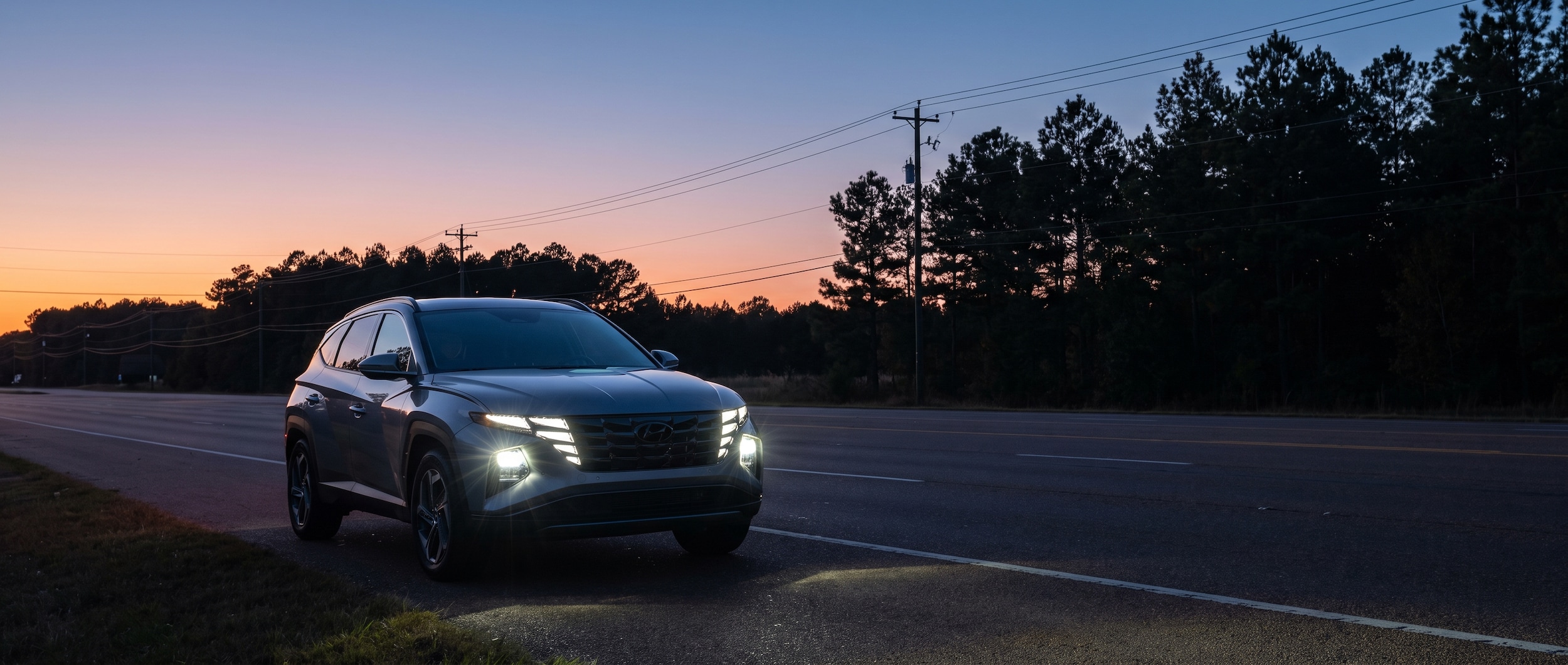
Bottom line before the days get short. Fall in Flowood means the sun is setting around 6:44 PM and dropping a little earlier every day for the next two months. If you've been driving mostly in daytime conditions since April, your headlights haven't had a real test in a while, and Mississippi's summer UV and humidity aren't gentle on polycarbonate lenses or sealed headlight housings.
Knowing what you've got matters here. The 2026 Hyundai lineup doesn't hand every driver the same headlight system. A base-trim Elantra owner and a Tucson Limited owner are working with genuinely different equipment, and that changes both what to inspect and what you can reasonably expect after dark. Our team walks through this by tier below, since the right maintenance step for your car depends on which system sits under that lens.
The Elantra is a good place to start. You'll spot it all over the Lakeland Drive corridor, and we know it well.
What Do You Actually Get at Each Headlight Tier?
Every current 2026 Hyundai runs LED technology as its baseline, which already puts the lineup ahead of a lot of older vehicles still using halogen reflectors, though the word LED covers a wide performance range, so what you actually get on the road depends on your specific trim and not the badge. The main models in our lineup break down like this.
| Model / Trim | Headlight Type | What It Means in Practice | Who It Suits |
|---|---|---|---|
| Elantra (all trims) | Dual LED projector, standard across lineup | Focused beam, consistent brightness side-to-side, long LED lifespan | Daily commuters on Lakeland Drive and I-20 who want reliable nighttime visibility without upgrading |
| Tucson SE / SEL | LED reflector | Solid illumination, wider spread, performs well in normal conditions | Families and commuters who drive mostly lit commercial corridors |
| Tucson XRT / SEL Premium / Limited | LED projector (Limited: bi-LED projector) | Sharper beam cutoff, better projection distance, reduced oncoming glare | Higher-mileage drivers and anyone regularly on unlit sections of I-20 or county roads east of Brandon |
| Sonata SE / SEL | Standard LED projector | Bright and effective for suburban and highway use | Drivers who stick to Pearl and Flowood corridors where ambient lighting helps |
| Sonata SEL Plus / Limited | Premium or Matrix LED | Multi-element array with more uniform light distribution; some trims add adaptive bending | Drivers who want the most from the system at highway speeds or in less-lit conditions |
| Palisade / Santa Fe | Full LED with available adaptive headlights on higher trims | Widest coverage for larger vehicle footprints; well-suited to interstate runs | Families using these for airport runs or longer trips east on I-20 |
One detail worth knowing is that headlight assemblies are trim-specific in most of these vehicles. The Sonata's standard LED projector and its premium Matrix LED are not interchangeable, since the wiring harnesses and control modules differ between them. That matters if you're ever sourcing a replacement assembly, and it's another reason to know exactly which tier your car carries.
The Mississippi Lens Problem That Sneaks Up on You
On vehicles that have spent a few Rankin County summers in open driveways and parking lots, the headlight lens can degrade well past what you'd expect even when the bulb itself is working fine, so a car that seems to have healthy lights can still be losing real output to a cloudy lens. The lens does the quiet damage here.
Polycarbonate lenses leave the factory with a UV-protective coating, and Mississippi's summer UV and persistent humidity make a rough pair. The UV load degrades the factory coating, and once that's compromised, the humidity speeds up the breakdown of the polycarbonate surface underneath.
Oxidized headlight lenses can cut the light actually reaching the road by up to 80%, per published restoration data. Which means a technically functional LED may be throwing only a fraction of its rated output.
Run your hand across the lens when it's cool and dry; the practical check takes about two minutes in your driveway. A surface that feels rough or gritty is oxidizing externally, which is restorable with the right process. A surface that's smooth but still hazy from the inside points to a different problem, a failed housing seal letting moisture in. Sanding a lens with internal fogging won't help.
Also watch for the Hyundai technical service bulletin 23-BD-002H, which applies to certain Sonata models and covers moisture accumulation in headlamps and DRLs. If you own a Sonata from the 2020 through 2026 production run and notice persistent internal fogging after the housing is dry externally, that TSB is worth a conversation with our service team.
Next step: If your lens feels rough or looks hazy, bring it in before the nights get longer. External oxidation is restorable. Internal fogging needs a sealed housing inspection, and catching it now is less work than catching it in January.
What a Pre-Fall Headlight Check Actually Covers
A thorough pre-fall check has four parts, and while we run all of them when a vehicle comes in for service, you can handle the first three yourself at home with nothing more than a helper and a flat wall. The last one is where we tend to add the most value.
Aim. Aim is the one that catches drivers off guard. A headlight that lights up the road in front of you but points slightly too low will cost you stopping distance you didn't know you were losing. A headlight aimed too high throws glare at the car ahead of you on the westbound I-20 run. To check it, park facing a flat wall or garage door with about 25 feet of distance, mark the center of each beam on the wall, then pull forward to 10 feet and compare. Both beams should sit at or just below the marks. If they're noticeably low or mismatched, that points to alignment, not the bulb.
Daytime running light and turn signal function. The daytime running lights and turn signals ride on separate circuits from the main headlights in most current Hyundai vehicles, and they can fail on their own. Have someone stand at each corner of the car while you cycle through the low beams, high beams, DRLs, left turn, right turn, and brake lights. Takes four minutes. A hyper-flashing turn signal (one that blinks faster than normal) usually means a bulb is out.
Lens condition. The rough-versus-smooth hand check above. On any vehicle that's a few years old and parked outside most of the time, this is the variable most likely to be degraded.
Housing seal. Look inside the housing when the lights are warm, ideally an hour after they've been on in the evening. Condensation that appears and then clears as the light warms up is often normal. Condensation that sits inside for hours, or water droplets that don't clear, points to a seal failure.
Schedule a service appointment with our team if anything in steps two through four doesn't pass. We can handle lens restoration, housing assessment, and aim correction in one visit.
The Smart-Check Frame for Your Drive Home
Flowood's evening commute on Lakeland Drive and the stretches of I-20 between Pearl and Brandon take on a different character in October, because the sun drops below the treeline earlier and the late-afternoon glare that was only a nuisance in summer turns into a genuine visibility problem. Flowood is in Rankin County, Mississippi. Vehicles heading eastbound on I-20 in early evening will be running into that low-angle sun, and the same commuters heading westbound later in the evening will need their headlights fully functioning before they hit the interchange.
One upgrade case is worth naming. If you're on a Tucson SE or SEL and keep wishing for more reach on the darker county roads east of Brandon, the jump to a bi-LED projector system is a meaningful real-world difference. That's a Tucson Limited feature. It isn't a reason to trade the car on its own, though if you're otherwise near the decision point, it's a real capability difference you can feel on the road.
What doesn't make sense is upgrading headlight bulbs in a sealed LED assembly the way you might swap a halogen bulb. Most 2026 Hyundai LED headlight assemblies are sealed units, so the LED elements aren't user-replaceable the way halogen bulbs are. If the LED module itself fails, you're looking at an assembly replacement through a service visit rather than a parts-store bulb swap.
Sonata owners on higher trims have sealed matrix-style systems. Treat the lens as your maintenance priority, well ahead of the bulb.
Frequently Asked Questions
Do all 2026 Hyundai models come with LED headlights standard?
Yes. Every 2026 Hyundai model in our lineup includes LED headlights as standard equipment across all trim levels, including the base Elantra SE. The difference between trims is the type of LED system: reflector-style, standard projector, bi-LED projector, or matrix LED. What you're evaluating when you move up a trim is beam precision and projection distance, not whether the technology is LED or halogen. That baseline is confirmed across the 2026 Elantra, Tucson, and Sonata lineups.
My headlights look fine but seem dimmer than they used to. What's happening?
This is usually a lens condition issue rather than a bulb issue. Polycarbonate headlight lenses have a UV-protective coating from the factory. When that coating degrades, and Mississippi's UV exposure is significant year-round, the lens surface oxidizes. The LED element inside the housing can be fully functional while the lens itself is blocking a substantial portion of the output. The touch test (rough or gritty surface when cool = external oxidation, restorable with the right process and a UV sealant) is the first diagnostic step. If the surface feels smooth but still looks hazy, look more carefully for internal fogging, which is a different problem that requires a housing seal inspection.


