


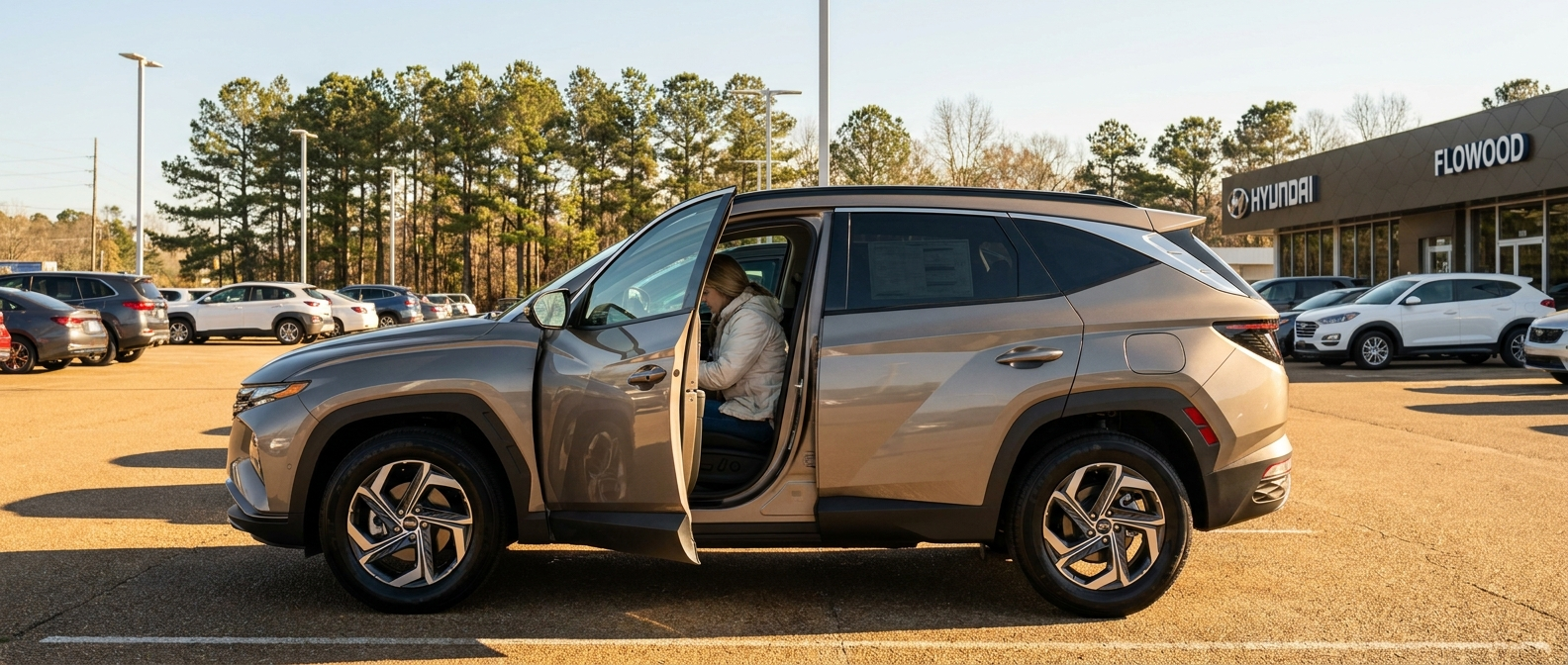
Plenty of shoppers pull onto Lakeland Drive, drive a quick lap, come back, and say "felt good." A test drive like that won't tell you much. The call you're trying to make deserves more than a gut feeling, and a 20-minute structured visit gives you something concrete to compare once you're back home.
The short version is quick. Bring your license and proof of insurance, decide in advance which two or three features matter most to your daily drive, request a route that includes a Lakeland Drive stretch and a stop-and-go segment, and leave time to sit in the back seat. Run those four and you've covered the whole procedure. The steps below make each of them useful.
The 2026 Hyundai Tucson is the model we get asked to demonstrate most often on the east side of the metro, but this guide works for every vehicle on our lot.
An easy trap is focusing entirely on how the car feels at speed while never testing the features you'll use every single day (the climate system, the driver-assist alerts, the cargo arrangement). Test the ordinary stuff on purpose.
What You Need Before You Start
Bring a short stack of items and settle two or three decisions before you arrive, and our team can pull the vehicle, check the fuel level, and have the infotainment ready to pair with your phone while you handle paperwork, but only if you've already handled the items below.
| Item or decision | Why it matters here |
|---|---|
| Valid driver's license | Required before any test drive; brings a copy, not just a phone photo |
| Proof of insurance | State law and our standard process; your insurer's app works fine |
| Your phone (charged) | You'll pair it via Apple CarPlay or Android Auto to test the real infotainment experience |
| Child safety seat (if applicable) | The only way to know whether it fits your specific seat is to install it yourself |
| List of two or three priority features | Focuses the 20 minutes so you're not just surfing menus |
| Your current vehicle's key fob | If you're considering a trade-in, our team can give you a real value while you drive |
We'll be straight with you about one tradeoff. A single 20-minute test drive cannot tell you how a vehicle rides over a long highway haul. It is enough to evaluate cabin comfort, climate performance, tech intuitiveness, and low-to-mid-speed driving behavior, which is exactly what Lakeland Drive stop-and-go tests. If you need to evaluate long-haul ride quality, ask for a second, longer loop and we'll arrange it.
The Steps: How to Run a Test Drive That Actually Tells You Something
Run these eight steps in the order they're written, and resist the urge to skip the first three just to get behind the wheel faster, because the stationary checks are where most of your decisions get made before the car even moves.
Step 1. Do a walkaround before you touch the ignition. Take two minutes on the outside. Open every door, the liftgate, and (if equipped) the hood. You're not inspecting for defects on a new vehicle. You're calibrating your spatial sense of the car before you're behind the wheel. Notice where the door handles sit, how the liftgate opens, and whether you can reach the cargo floor without contorting. The 2026 Hyundai Palisade's third row is a good example. A third row existing is one thing, and whether your tallest passenger can climb into it comfortably is what you're checking. You'll know in 90 seconds.
Step 2. Set up the driver's position completely before the car moves. Seat height, seat distance, lumbar support, steering column height and reach, headrest, and mirrors. All of it. Then check your sightlines. Give yourself four or five minutes here, since this step tells you whether the vehicle fits your body. A car that makes you crane your neck to see the backup camera on a regular basis is a car you'll eventually resent. Get your passengers settled in their actual seats too, particularly if you have rear passengers with long legs.
Step 3. Pair your phone and navigate the infotainment from a standstill. All 2026 Hyundai vehicles support Apple CarPlay and Android Auto. Pair your phone now, while the car is stationary, and tap through the climate controls, audio, and the driver-assist settings. Notice which controls require two taps and which are one. Lakeland Drive at afternoon rush has enough going on that you won't want to be learning the menu structure while merging.
Step 4. Ask our team to walk through the SmartSense features before you pull out. Hyundai SmartSense comes standard across the entire 2026 lineup. The list covers Forward Collision-Avoidance Assist with Pedestrian Detection, Lane Keeping Assist, Lane Following Assist, Blind-Spot Collision Warning, Rear Cross-Traffic Collision-Avoidance Assist, and Driver Attention Warning. All of it on the base trim, no upgrade required. Our team will show you which display indicators to watch and how to adjust the sensitivity. On Lakeland Drive, where light cycles stack traffic in clusters, Forward Collision-Avoidance Assist activates in real-world conditions you can feel. You don't want to learn a feature like this from the owner's manual on your driveway.
Step 5. Request a route with three distinct segments. Ask for three segments. (1) a Lakeland Drive stretch in normal traffic, (2) an I-20 on-ramp merge, and (3) a low-speed parking-lot segment. We pick that sequence on purpose. Lakeland Drive gives you the stop-and-go that represents most east-metro commuting. I-20 acceleration gives you a genuine sense of engine response when you need power. And the parking lot tells you what the backup camera, parking sensors, and turning radius feel like in a real confined space. The 2026 Hyundai Santa Fe and the Tucson handle very differently in that third segment, and a low-speed circle in the lot will tell you more than 10 minutes on the highway.
Step 6. Test the climate system deliberately. Mississippi in October is still running air conditioning. On our lot, we see vehicles come back from test drives with the climate on auto and the fans barely humming. A test like that tells you nothing. Set the AC to max cold, aim the vents at your face, and give it three or four minutes. If the cabin isn't comfortable in that window, it won't be comfortable on a Brandon school-run in August either. Ventilated front seats, when equipped, are worth activating during the drive rather than in the driveway. The difference in a black interior is not subtle.
Step 7. Sit in every seat you actually use. Driver, front passenger, and all rows you'll occupy regularly. Check the rear legroom with the front seat in your actual driving position, not slid all the way forward. If you carry a child seat, install your own at this step, since child-seat anchor setups aren't all equally accessible, and you'll only know by bringing the seat.
Step 8. Drive it exactly like you drive. If you brake late in daily driving, brake late here. Accelerate hard from a light? Do that. If you're gentle, be gentle. The test drive should mirror how you drive, not a performance your instincts put on for a salesperson.
The step that's easy to rush: Step 3 (infotainment setup). Skip it and you'll arrive home unable to remember how to find the heated-seat controls or whether the navigation response felt laggy. Two minutes parked at the curb will save you a week of wondering.
Get a Trade-In Value While You Drive
A Tip From What We See on the Lot
The most useful thing we can tell you from what we see on the lot is to give yourself room to compare, because buyers who arrive set on a single model and one trim tend to spend the drive confirming a choice rather than testing one, and that habit is fine but a back-to-back pairing in the same afternoon tells you far more. If you're between an Elantra and a Tucson, for example, the gap in cargo volume and ride height is something you feel the moment you step out of one and into the other. Give yourself permission to drive two.
Your Quick-Reference Recap Before You Walk In
Print this or screenshot it. It covers everything in order.
| Sequence | What to do | What you're evaluating |
|---|---|---|
| Before you arrive | License, insurance, charged phone, child seat if needed, two priority features written down | Readiness |
| Walkaround | All doors, liftgate, cargo floor reach, entry/exit of every row | Spatial fit |
| Stationary setup | Seat, mirrors, steering, infotainment pair | Ergonomics and tech intuitiveness |
| SmartSense walkthrough | FCA, Lane Assist, BSW indicators and sensitivity | Safety-feature familiarity |
| Lakeland Drive segment | Stop-and-go behavior, climate test, lane-assist feel | Daily-commute simulation |
| I-20 ramp | Acceleration, lane-change assist, highway noise | Power and highway comfort |
| Parking lot | Backup camera, parking sensors, turning radius | Tight-space confidence |
| Back seat | Legroom in your actual seat position, child-seat anchor access | Passenger fit |
| Post-drive | Notes on two or three specific things before you step back inside | Comparison clarity |
Browse our current new Hyundai inventory before your visit if you want to confirm which trims and colors are on the lot. So you're not test driving a configuration you'd never buy.
One last thing on timing. Weekday mornings before noon give you the most flexibility on route choice and vehicle availability. Weekend afternoons on Lakeland Drive are genuinely busy, which is useful for testing stop-and-go behavior but tighter on the lot. Either works, just know what you're getting. Our team is here at 4200 Lakeland Drive in Flowood, and the sales line is (601) 914-4200.
*By the Hallmark Hyundai Flowood Team | October 2026*
Frequently Asked Questions
What should I bring to a Hyundai test drive in Flowood?
Bring a valid driver's license, proof of insurance (your insurer's app works), your phone for pairing via Apple CarPlay or Android Auto, and your child safety seat if you need to check compatibility. Deciding on two or three priority features before you arrive will help you use the 20 minutes effectively.
How long should a Hyundai test drive be?
Twenty minutes is a reasonable minimum for evaluating cabin comfort, climate performance, and infotainment, but it's not long enough to fully assess long-haul ride quality. We recommend requesting a route with three segments: a Lakeland Drive stop-and-go stretch, an I-20 on-ramp for acceleration, and a low-speed parking-lot loop. If you're comparing two models, plan for a back-to-back drive in the same visit.
Categories:
Social


