


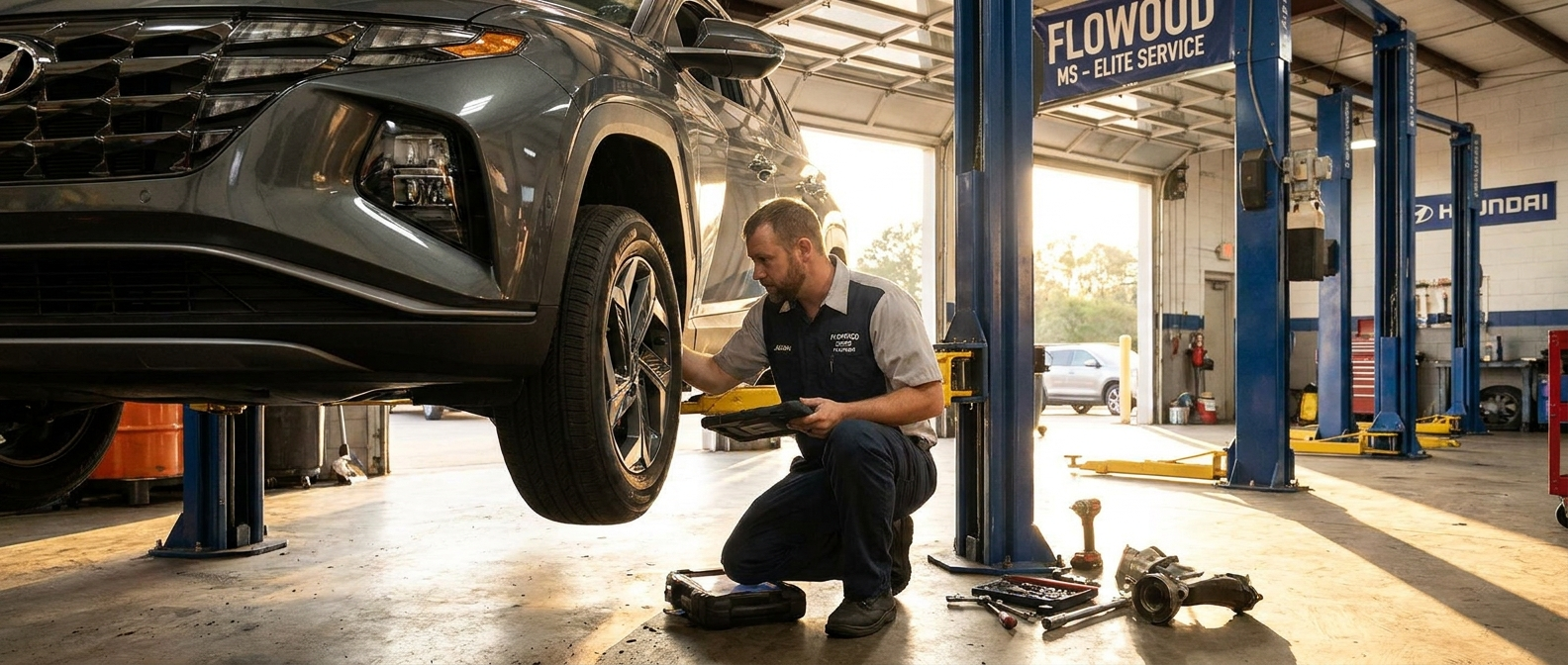
A vibration in your Hyundai is your car telling you something specific. The tricky part is knowing whether it's saying "come see us this week" or "come see us right now." Timing settles that question faster than anything else, which is why we always start there. Your best clue is timing.
Before our service team at Hallmark Hyundai Flowood ever puts a car on the lift, the answer starts the same way. Start with the conditions, then the feeling. Does it happen at a stoplight? Does it show up at 65 mph on I-20 and then smooth out past 70? Does it only appear when you're pressing the brake pedal? Each of those is a different system talking.
Book a service appointment online
The short version
- Vibration only when braking: warped rotors are the most common cause; schedule service within the week.
- Vibration at highway speed (especially 55-70 mph): tire balance or a bent wheel; schedule soon, drive cautiously in the meantime.
- Vibration at idle that smooths out while driving: engine mounts or a misfire; have it checked, do not ignore it long-term.
- Vibration after hitting a pothole on Lakeland Drive or I-20: get an alignment and tire inspection before your next highway run.
- Any new vibration accompanied by a warning light, unusual noise, or pulling to one side: stop driving and call us. That combination rarely resolves on its own.
What Actually Matters When Choosing How Urgently to Act?
What matters most isn't how bad the shake feels but what the vibration reveals about a specific component, and the fastest route there is timing, since the moment a vibration appears (idle, braking, cruising, or acceleration) steers our technicians toward the system at fault well before a car ever reaches the lift. A shake at idle, a shudder under braking, and a hum at cruise each point to a different culprit, so the first thing to pin down is when it happens. Timing beats intensity every time.
| Vibration Pattern | Most Likely Cause | Urgency | Recommended Action |
|---|---|---|---|
| Only during braking, felt in pedal or wheel | Warped brake rotors | Moderate. Schedule within days | Service inspection; rotor resurfacing or replacement |
| Steady hum between 55-70 mph, fades above 75 | Out-of-balance tire or bent wheel | Moderate. Drive cautiously | Wheel balance and tire inspection |
| At idle only, goes away once moving | Worn engine mounts or cylinder misfire | Low-to-moderate. Check soon | OBD scan + mount inspection |
| Under acceleration from a stop, not at cruise | CV axle or drivetrain component | Moderate-to-high. Limit hard acceleration | CV joint and axle inspection |
| Constant, plus a warning light or pulling | Multiple systems or structural | High. Limit driving | Immediate service visit |
| New vibration after pothole or curb impact | Alignment knocked out, tire or wheel damaged | Moderate-to-high, before next highway trip | Alignment check, tire and wheel inspection |
| Loose or rhythmic shake at any speed, new vehicle | Loose wheel hardware (see recall note below) | High. Do not delay | Dealer inspection per NHTSA guidance |
The timing of the vibration. Idle, braking, cruising speed, or acceleration. Is the primary diagnostic variable a Hyundai technician uses to narrow the likely system. Describe when it happens before you describe how bad it feels.
The Two Most Common Vibration Sources in Flowood Driving Conditions
Two causes come up more than any others in Flowood, and both trace straight back to how local roads load your car, since the stop-and-go grind on Lakeland Drive puts repeated thermal stress on the brake rotors and a steady highway cruise out on I-20 is where you'll feel an out-of-balance tire start to show itself. Those two roads surface two different symptoms, and they're distinct enough to tell apart before a car is on the lift.
Brake rotor issues. When rotors develop uneven surface contact from repeated heat cycles, the brake pedal pulses and the wheel shudders, and you feel it only while braking. That pulse is uneven rotor thickness meeting the pads at slightly different pressures as the wheel turns. A warped rotor doesn't heal on its own. Let it go and the pads wear unevenly, which turns one repair into two.
Tire and wheel balance. An out-of-balance tire hands you a vibration that builds with speed, that's most noticeable around 55-70 mph, and often smooths back out once you climb higher. NHTSA's technical documentation on wheel-related vibration notes that even a small weight imbalance generates centrifugal force during rotation, and that force transmits right up through the steering column. A wheel knocked out of alignment by an I-20 entrance ramp pothole can throw a similar pattern. The distinction matters. Balance gets corrected at the tire machine, while alignment needs a rack measurement and adjustment.
See the current Tucson lineup or explore the 2026 Elantra if you're evaluating vehicles alongside a service decision.
Service tip. What to write down before you call us. Jot down three details before you call, and they'll help our technicians most. First, when in the drive it starts, whether right away, after warming up, or only at speed. Second, where you feel it, steering wheel, seat, or brake pedal. Third, any recent road event, a pothole, a curb tap, a recent tire change. Those three answers can shave real time off the diagnostic.
Pros and Cons: Waiting vs. Scheduling Promptly
| Pros of Scheduling Promptly | Cons of Waiting |
|---|---|
| Catch a single-component issue before it affects adjacent parts | A warped rotor can cause uneven pad wear, turning one repair into two |
| Confirm whether a new vibration is recall-related (free repair) | An out-of-balance tire that goes unchecked wears the tire tread unevenly |
| Engine misfire caught early avoids catalytic converter damage | A CV joint that's worn through its boot will eventually fail completely |
| Alignment issue identified before additional tire wear sets in | Loose wheel hardware, the rarest but highest-consequence scenario. Does not self-correct |
One Active Recall Worth Knowing About Right Now
NHTSA issued campaign 26V693000 on October 21, 2026, covering certain 2026 Hyundai Elantra, Elantra Hybrid, Elantra N, and Venue vehicles, and though it reaches only a small slice of those models, the defect it addresses shows up as a vibration you'll feel. NHTSA's recall documentation explains that the wheel lug nuts on a small number of these vehicles (17 total in the US population) may not have been tightened to specification during production. Loose lug nuts throw off abnormal noise and vibration while you're driving. The remedy, an inspection and lug nut tightening with hub bearing replacement if needed, is performed at the dealership at no charge.
Owner notification letters are scheduled to mail by December 19, 2026. If you own one of these four 2026 models and you're feeling a new or unusual vibration, don't wait for the letter. Schedule an appointment with our team, and we can check your VIN against the recall right now. Skip the wait.
The broader lesson from this recall is worth remembering. A new vibration on a car you bought recently deserves a call even if you assume it's minor, and under-torqued wheel hardware is one of the few vibration causes with no warning-light signal, so the vibration itself is your only early clue.
Schedule a Service Appointment
Match the Vibration to How You Actually Drive
The Rankin County commute tends to run as a mix, with stop-and-go on Lakeland Drive, a few surface streets through Pearl or Brandon, and then a stretch of I-20 or the bypass that opens up to highway speed. That pattern means you're working both your brakes and your tires hard inside a single trip.
The practical takeaway is straightforward. When a vibration shows up during only one phase of that drive, at the stoplight, or at highway cruise, it's pointing at a single system. When it shows up across multiple phases, you're into a broader conversation that almost certainly needs a lift and a trained eye rather than a wait-and-see approach.
Our service team is at 4200 Lakeland Dr here in Flowood. You can book an appointment through our online tool in a couple of minutes, and the notes field lets you describe the symptom so you'll give our technicians a head start before the car even arrives. If the vibration is new, bring it in. Vibrations rarely clear up on their own, and the ones that do were usually just masking a developing problem.
Frequently Asked Questions
What does it mean when my Hyundai vibrates at highway speed but not in town?
Speed-dependent vibration that appears at highway cruise and fades above or below a certain mph window is the classic signature of a tire balance issue. NHTSA's technical guidelines describe this pattern: weight imbalance in a tire creates centrifugal force at higher rotation speeds, which transmits through the suspension into the steering column. It's typically not urgent enough to pull off the highway immediately, but it should be addressed before the tire develops uneven tread wear from the repeated oscillation. A bent wheel produces a very similar pattern and is diagnosed the same way, on a balance machine or road-force balancer.
My Hyundai vibrates only when I press the brake pedal. Is that a tire problem or a brake problem?
That's almost certainly a brake issue rather than a tire issue. When a vibration appears specifically during braking and is felt through the pedal or the steering wheel, the most common cause is brake rotors that have developed uneven thickness through repeated heat cycles. NHTSA's documentation on brake system complaints describes this as a pulsing or shuddering sensation during deceleration. Tires and wheels produce vibration related to wheel speed (rpm), not to brake application, so if it disappears entirely the moment you release the pedal, that narrows the field significantly. Schedule a brake inspection; catching this at the rotor stage is much simpler than waiting until pad contact is also affected.
Categories:
Social


