


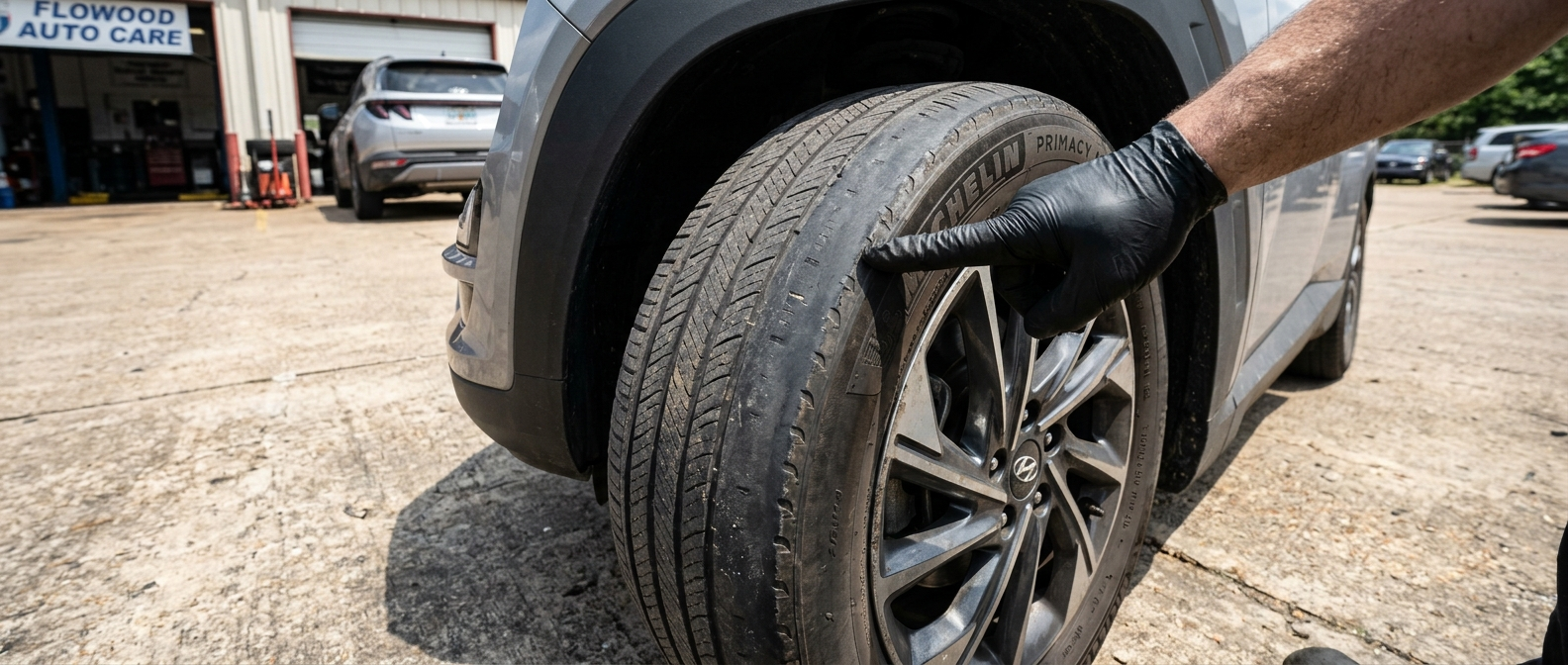
You glance down at a front tire and the tread looks uneven, with one shoulder more worn than the rest. Uneven wear is a symptom of something upstream. The good news is that the pattern itself does the diagnosing for you. Read it right and you'll know whether you need a quick pressure adjustment or a trip to the service bay. Most of the time the cause is one of four things (inflation, alignment, a suspension component, or a skipped rotation). We'll show you how to tell them apart.
Schedule a service visit with our Flowood team if anything you read here matches what you're seeing.
What's Actually Going On With That Tread Pattern?
Different wear patterns point to different root causes, so the shape of the wear usually tells you more than the amount of it does. Run your hand across each tire from shoulder to center and notice where the low spots sit. The table below maps the most common patterns to their likely causes and the right first move.
| Wear Pattern | What It Looks Like | Most Likely Cause | First Step |
|---|---|---|---|
| Both outer edges worn, center fine | Shoulders low, middle stands up | Chronic underinflation (tire bowing outward) | Check cold PSI against door-jamb spec |
| Center worn, edges standing up | Crown worn down, shoulders still full | Overinflation (tire riding on its middle) | Bleed to door-jamb cold spec |
| Inner edge only | Inside shoulder significantly lower than outside | Negative camber, toe misalignment, or worn suspension parts | Alignment check; suspension inspection if alignment won't hold |
| Outer edge only | Outside shoulder lower | Positive camber or underinflation combined with cornering stress | Alignment check; verify cold pressure first |
| Cupping or scalloping | Diagonal patches, wavy across the tread | Worn shocks or struts, wheel imbalance | Suspension inspection, balance check |
| Feathering | Ribs rounded on one side, sharp on the other (run your hand across) | Toe misalignment (toe-in or toe-out) | Alignment correction |
On AWD Hyundai models (Tucson, Santa Fe, Palisade), a tread depth difference greater than 2/32 inch between front and rear axles can stress the all-wheel-drive coupling. Match rotation intervals closely.
The Most Likely Culprit: Alignment or Pressure (Usually Both Are Part of It)
Inner-edge wear on a front tire usually traces back to alignment, pressure, or both working together, and sorting out which one takes a close look rather than a guess. Excessive negative camber tilts the top of the tire inward, which loads the inside edge every time the vehicle moves. Over time that concentrated pressure wears the inner shoulder down, and it can hide from a casual glance unless you inspect the tire closely.
For Rankin County drivers, there's a seasonal wrinkle worth knowing. Mississippi summers run long and hot, and heat is an underinflation accelerant. Tire pressure rises roughly 1 PSI for every 10 degrees Fahrenheit increase in temperature, so a tire reading correctly in your cool garage at 7 a.m. can read higher after an hour on a hot surface. The trap is checking a hot tire, seeing a high number, and bleeding air out. Bleed a hot tire down to the sticker number and it'll be underinflated the next cool morning. Underinflation in summer is exactly the condition that destroys tires. An underinflated tire bows at the shoulders. Driven daily on Lakeland Drive stop-and-go or I-20 highway miles, those bowed shoulders scrub down fast.
If uneven wear is already visible, address the alignment before you install new tires. Otherwise fresh tires can develop the same pattern fast. The sequence matters here. Fix the cause first, and replace the rubber second.
Owners of the 2026 Hyundai Tucson and Santa Fe with AWD should pay particular attention here. Rotating tires every 7,500 miles is essential to equalize tread wear across all four positions. On AWD models, a tread depth difference greater than 2/32 inch between front and rear tires can stress the all-wheel-drive coupling.
Service note from our team. We check cold tire pressure as part of every multi-point inspection. If your TPMS light has come on, note that the system is calibrated to warn at roughly 25 percent below the placard pressure. By that point, sidewall flex and heat buildup have likely already begun their work on the tread. Don't rely on the light alone as your pressure gauge.
- [ ] Look at all four tires from directly behind and in front. Do any lean visibly inward or outward?
- [ ] Run your palm across the tread surface of each tire. Feel for feathering (sharp edge on one side of a rib) or cupping (wavy diagonal patches)
- [ ] Check cold PSI against the door-jamb sticker (check before the first drive of the day, not after)
- [ ] Note which tire position shows the most wear (front left, rear right, etc.). It helps us diagnose faster
- [ ] Check the tread depth across the width of the tire, not just in the center groove
- [ ] If you have an AWD Hyundai, compare front tread depth to rear tread depth
- [ ] Pull up your mileage since last rotation (Hyundai's owner's manual recommends rotation every 5,000 to 7,500 miles for FWD and RWD models)
How Often Rotation Actually Prevents This
Rotation works because front and rear tires take on very different cornering, weight, and braking loads during daily driving, and swapping their positions evens out what would otherwise be lopsided wear. On front-wheel-drive models such as the Hyundai Elantra, the front tires do three jobs at once. They transmit engine torque, handle steering inputs, and take over 60 percent of total braking force. So unrotated front tires can wear at up to twice the rate of the rears.
We'll be straight with you about the one limitation here. Rotation prevents wear disparity between positions, but it won't fix a misalignment or a worn strut. If the underlying mechanical issue goes unaddressed, rotating the tires just moves the damage around. Think of rotation as a prevention tool rather than a correction tool. So if you're already seeing a pronounced pattern, the rotation conversation has to come after the alignment or suspension one.
Staying on schedule is still worth it. Hyundai Elantra owners on a regular city commute get the most out of the shorter end of the interval (closer to 5,000 miles), since front-wheel-drive stop-and-go loads those fronts hard. Hyundai Palisade and Palisade Hybrid drivers with AWD should treat 5,000 to 7,500 miles as a firm ceiling they don't exceed, given the coupling sensitivity described above.
DIY Check vs. See Our Service Team
Some of this you can handle in your own driveway in about five minutes with a gauge and a coin, while some of it genuinely needs a lift and an alignment rack to sort out. Knowing which bucket your situation falls into saves you a trip, or tells you it's time to make one. The split breaks down this way.
Handle it yourself:
- Cold pressure check with a gauge (use a gauge, since the TPMS light is only a last warning)
- Visual inspection for obvious shoulder wear or sidewall bulges
- Penny test for tread depth. Insert a penny with Lincoln's head pointing down into the tread groove. If the tread covers any part of Lincoln's head, your tread depth is above 2/32 inch. If Lincoln's entire head is visible, the tire is at or below 2/32 inch and it's legally worn out.
- Quarter test for the caution zone. Same method with a quarter. Insert the quarter with Washington's head down. If the entire head is visible, tread is at or below 4/32 inch, approaching the safety threshold where wet traction begins to decline.
Bring it to us:
- Any inner-edge or feathering wear pattern (these require an alignment rack)
- Cupping or scalloping (shocks and struts need hands-on inspection)
- Wear that's uneven tire-to-tire at the same axle (not just front-vs-rear)
- Alignment that drifts out of spec shortly after correction (points to a worn ball joint, tie rod, or bushing)
- AWD models where front and rear tread depths differ by more than 2/32 inch
Book a tire and alignment inspection with our Flowood team and bring that checklist with you. It saves time.
Schedule a Tire Inspection in Flowood
Our service team works out of 4200 Lakeland Drive in Flowood, right off the I-20 corridor that runs through Pearl and Brandon. If you're noticing vibration at highway speed or a steering pull to one side, don't wait on it. Both are early signals that the tread pattern you've been watching has a mechanical root cause rotation alone won't solve.
Frequently Asked Questions
Can I fix uneven tire wear without replacing the tires?
It depends on how far the wear has progressed and whether the underlying cause is corrected first. Sometimes the tread is still in good shape and the uneven wear is mild. If the wear is asymmetric but the tread depth still clears 4/32 inch across the whole tire, and you correct the alignment or pressure that caused it, the tire can often keep going safely. A significantly worn inner or outer edge can't be reversed, though, because the rubber is gone. Correcting the cause stops further damage, but it doesn't undo what's already happened. Our team can measure tread depth across the full contact patch and tell you whether the tire is salvageable.
How do I know if it's an alignment problem or a suspension problem?
Alignment issues cause predictable, repeatable wear across the tires. If the wear is symmetric left-to-right but concentrated at the same edge type, alignment is often the culprit. Worn suspension parts (bad shocks, strut mounts, ball joints, or bushings) let the wheel move around uncontrolled, which causes cupping and rapid, uneven wear even when the alignment is correct. The practical tell is simple. If your alignment was corrected recently but the wear came back quickly, a worn component is probably keeping the geometry from holding. A suspension inspection after an alignment that won't 'stick' is the right next step.
Categories:
Social


