


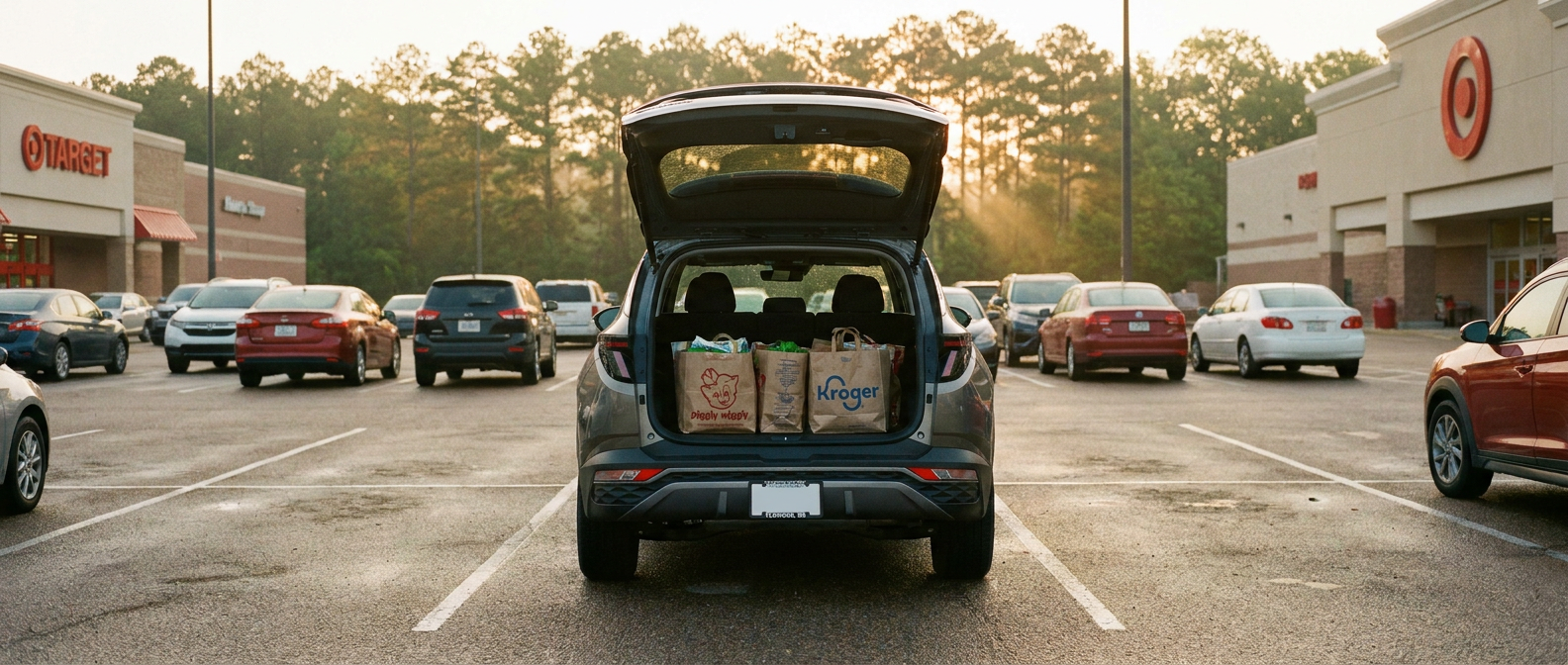
The Venue is the right answer for some Rankin County households. The Tucson is right for others. Which one fits your week comes down to two concrete questions. How much cargo do you load, and how many people need real legroom in the back?
The 2026 Hyundai Venue earns its place if you're running tight routes through Flowood's retail corridor with one or two people on board. The 2026 Tucson is the move the moment a second child, a stroller, or a recurring sports bag becomes part of the routine.
The short version
- Both seat five and carry Hyundai's Forward Collision-Avoidance Assist standard on every trim.
- The EPA rates the 2026 Venue at 31 mpg combined; the 2026 Tucson FWD at 28 mpg combined. Three mpg sounds small until it's your daily Lakeland Drive.
- Here's what most buyers get backwards: the Tucson carries more cargo behind its rear seats (41.2 cu ft) than the Venue does (31.9 cu ft). Bigger vehicle, bigger everyday load floor.
- The Venue is front-wheel drive only. The Tucson adds available AWD.
- Need more than five seats regularly? Neither of these is your answer. That's the Palisade's conversation.
What's the Real Difference Between These Two?
One of these is a compact SUV and the other is a subcompact, and that gap shows up in a number you can measure rather than in styling, because the Tucson runs roughly 18 inches longer than the Venue and nearly all of that length feeds the cargo floor and the rear seat. Styling gets very little of it.
| Spec | 2026 Hyundai Venue | 2026 Hyundai Tucson FWD |
|---|---|---|
| Cargo behind rear seats | 31.9 cu ft | 41.2 cu ft |
| Rear passenger legroom | 34.3 in | 41.3 in |
| EPA combined MPG | 31 mpg | 28 mpg |
| EPA city MPG | 29 mpg | 25 mpg |
| Horsepower | 121 hp | 187 hp |
| AWD available | No | Yes |
| NHTSA overall safety | 4 stars | 5 stars |
The cargo number is the easy one to misjudge. Because the Venue looks compact, it's natural to assume the load floor is 'plenty for errands,' and a standard grocery run does fit. But the Tucson's 9-plus-cubic-foot advantage is real. You'll feel it as the difference between sliding a stroller in alongside two full grocery bags or rearranging everything at the tailgate before the hatch will close.
The 2026 Tucson carries 41.2 cubic feet of cargo behind its rear seats; the 2026 Venue carries 31.9. The bigger vehicle wins the everyday load-space comparison.
Does the Fuel Economy Gap Matter on Lakeland Drive?
The gap matters most if your Rankin County week is heavy on stop-and-go, and it fades close to nothing if you mostly run open highway, so the answer depends on how you drive. Lakeland Drive carries roughly 45,000 vehicles per day through the Flowood corridor, classified by the state as a Principal Arterial, which is a careful way of saying it backs up at signals. Stop-and-go is exactly where a fuel economy gap shows up in real life, not on open highway.
The EPA rates the 2026 Venue at 29 mpg city and 31 combined. The 2026 Tucson FWD earns 25 mpg city and 28 combined. A 4-mpg city gap accumulates over a year of signalized errand driving, and that's worth knowing.
The Tucson Hybrid reshapes the math entirely. The Hybrid Blue SE is EPA-estimated at 38 mpg combined (that beats both gas versions). The reason it gains in stop-and-go is regenerative braking. Every time you lift off for a red light, the system recaptures kinetic energy as electricity. Lakeland Drive hands you plenty of those moments.
Team note: Highway MPG for both gas versions is identical. The EPA rates both the 2026 Venue and the 2026 Tucson FWD at 33 mpg on the highway. If your typical week is mostly open-road miles between Pearl and Brandon with few signalized segments, the city gap tightens considerably and fuel economy stops being the tiebreaker between these two.
Parking, Footprint, and the Flowood Retail Run
Footprint favors the Venue in a tight lot, though the Tucson is far from unwieldy, and the spread between them comes to about 18 inches end to end. The 2026 Venue measures approximately 159 inches, and the Tucson runs about 177. Those inches show up when you're pulling into a packed lot along the I-20 Pearl interchange or threading the tighter rows along the Lakeland Drive commercial strip. The Venue noses in and out quickly. Its lighter curb weight, around 2,600 lbs against the Tucson's roughly 3,400 lbs, also gives it a more agile feel on routes that ask for frequent direction changes.
Don't let parking anxiety push you into a vehicle with less cargo and less rear legroom than your family's week calls for. The Tucson isn't a large vehicle, and its footprint is easy to settle into within the first week. The Venue's compact size is a genuine advantage for the right buyer, and it won't be an argument that works for everyone.
Our service team at Hallmark Hyundai Flowood can walk you through both models on the lot if you'd like to open both hatches and sit in the rear before you commit to anything.
So Which Should You Pick?
Which one you should pick depends on the size of your household and the shape of your weekly load, and the split falls cleanly along those two lines, with a smaller household and lighter cargo pointing you toward the Venue and kids in the back pointing you toward the Tucson. Read it by buyer profile.
Pick the Venue if you're a one- or two-person household, your errand list doesn't regularly include bulky cargo, and you want the simplest, most fuel-efficient option at the most accessible entry point. A well-built, well-equipped subcompact, it won't ask you to manage more vehicle than your life needs.
Pick the Tucson if you carry kids who need real rear legroom, where 41.3 inches against 34.3 is a concrete gap on a 30-minute drive from Brandon, you routinely load a stroller or a week's worth of groceries plus sports equipment, or the NHTSA 5-star overall safety rating is something that matters to your household's decision. And if you're doing heavy Lakeland Drive stop-and-go and want the larger vehicle, the Tucson Hybrid at 38 mpg combined is worth a conversation before you finalize a gas model.
Pick neither if you regularly seat six or seven. Six or seven seats on a regular basis is a job for the Palisade.
One thing we'll say out loud. The Venue costs less to get into. If your budget is genuinely constrained and the extra cargo space isn't something your week requires, don't let anyone push you up to the Tucson just to hit a larger transaction. Buy for your routine.
Frequently Asked Questions
Is the Venue or the Tucson better for a family with young children in Flowood?
The Tucson is the stronger fit for most families with young kids. The 2026 Tucson gives rear passengers 41.3 inches of legroom compared to 34.3 inches in the 2026 Venue. That 7-inch gap is noticeable for a child in a car seat or a growing kid on a longer drive from Flowood toward Brandon. The cargo area also accommodates a full-size stroller alongside groceries more easily at 41.2 cubic feet than the Venue manages at 31.9 cubic feet.
Does the 2026 Hyundai Venue offer all-wheel drive?
No. The 2026 Venue is front-wheel drive only, across every trim. The 2026 Tucson adds available AWD. For paved retail corridors around Flowood and Pearl, front-wheel drive handles the driving conditions without issue. If you occasionally take unpaved Rankin County roads or simply want added traction confidence in wet weather, the Tucson's AWD availability is a real and meaningful distinction between these two vehicles.
Which model wins for stop-and-go errand driving?
The 2026 Venue edges ahead at 29 mpg city, while the 2026 Tucson FWD rates 25 mpg city. That 4-mpg gap adds up over a year of signalized driving on Lakeland Drive. However, if you want the larger vehicle's cargo and legroom, the Tucson Hybrid delivers 38 mpg combined and recaptures energy at every red light through regenerative braking, making it the strongest choice for the daily Flowood errand run with extra capacity.
Categories:
Social


