


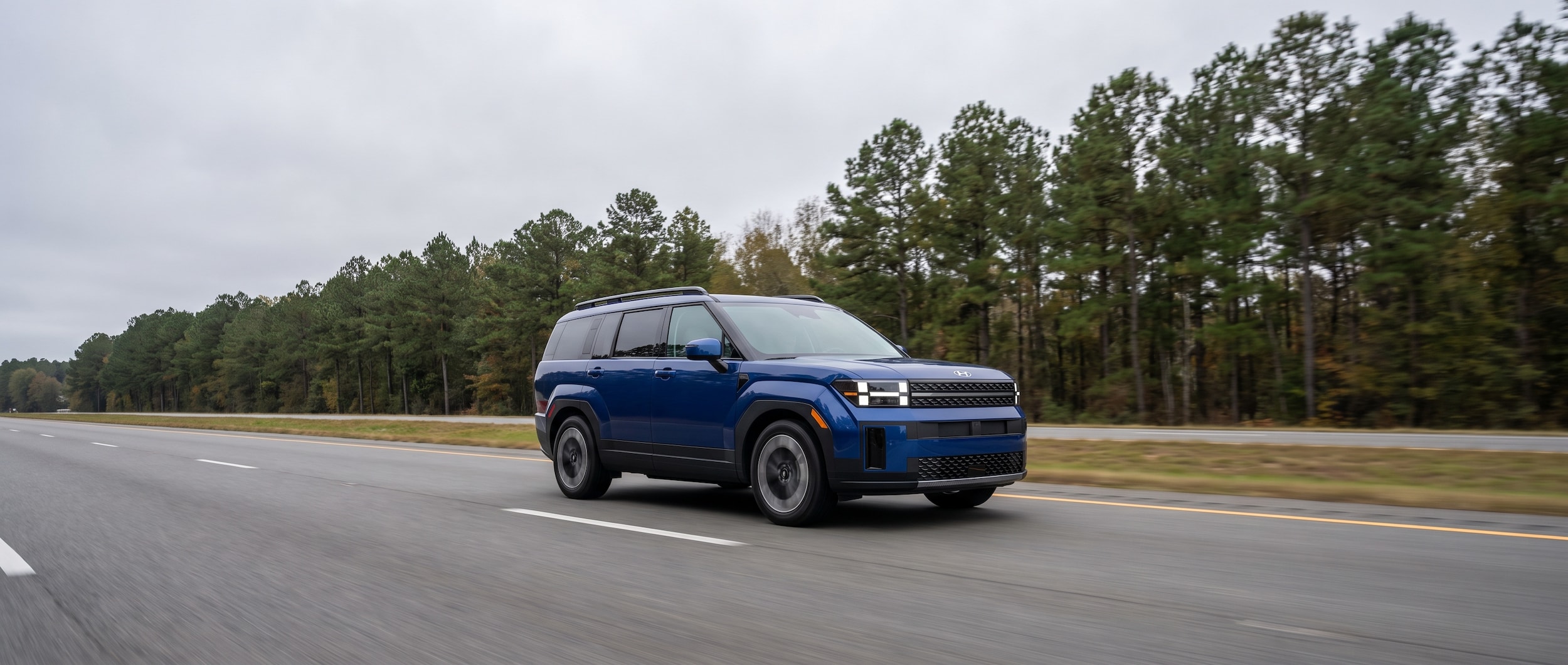
Most pre-trip checklists treat a long drive like any other long drive. Fill the tank, check the tire pressure, grab some snacks. I-59 breaks that pattern if you're driving a Hyundai out of the Flowood area, and it comes down to one fact. The Mississippi section of this corridor runs 171 miles of mostly rural interstate, with significant gaps between exits that have any fuel at all.
Those gaps change the calculation on a few checklist items, and they change it differently depending on whether you're driving a gas-only model or one of the hybrids on our lot. We'll walk through how we think about it.
On I-59's rural Mississippi stretches, your Hyundai's EPA highway range and the tire pressure you start with matter more than they would on any urban highway. Get those two right and you'll find the rest of the prep straightforward.
The 2026 Santa Fe Hybrid fits this kind of trip well for families from Brandon and Pearl, and the hybrid math works in its favor here even though the common assumption is that hybrid efficiency disappears on the highway.
How Does the I-59 Fuel Gap Actually Work?
The fuel gap works in stretches where services disappear for miles at a time, and it catches drivers off guard because each individual distance looks modest on its own, right up until you're already running low. Between Purvis (Exit 51) and Hattiesburg (Exit 60), there's a nine-mile gap with no services. Between Hattiesburg and Moselle, exits 69, 73, and 76 show no fuel. Between Moselle (Exit 80, one Chevron) and the Laurel exits, the stretch runs roughly 15 to 17 miles with nothing. None of those numbers looks dramatic alone, but they compound when you're already running low and there's no next exit to count on.
The corridor connects Meridian to the Louisiana state line through Picayune, Hattiesburg, Laurel, and the largely rural towns in between, and there's not much filling the gaps.
| Segment | Notable Fuel Exits | Gap to Watch |
|---|---|---|
| Purvis south (Exit 51) | One Chevron | Closest stop before Hattiesburg |
| Hattiesburg (Exits 60, 65, 67) | Multiple stations | Refuel here if below half-tank |
| Moselle (Exit 80) | One Chevron | Only stop between Hattiesburg and Laurel area |
| Laurel area (Exits 97, 104) | Shell, Love's | Refuel before pushing south or north |
| Between Laurel and Meridian | Sparse | Confirm before leaving Laurel |
Our service team keeps one rule for this corridor. Never leave Hattiesburg in either direction with less than half a tank, and if you're driving an unfamiliar Hyundai, check your highway range before you hit the ramp.
The 2026 Sonata with FWD carries an EPA-estimated 36 mpg highway. On a 14.5-gallon tank, that's theoretical range approaching 520 miles under ideal conditions. You won't need to stress about the Sonata on this drive. For sedan drivers, the bigger attention item is tire condition, which we'll cover next.
Which Hyundai Specs Actually Matter for This Corridor?
Both the hybrid and the gas model handle this corridor fine, so the spec that actually matters is less about which one survives the drive and more about how much fueling buffer you want between those rural exits where the next pump might be miles away. A fair question before this drive is whether to take the hybrid or the gas model for the long haul. The tradeoff is real, though.
The Sonata Hybrid is rated by the EPA at 47 city / 56 highway / 51 combined mpg. That 56 highway figure genuinely helps on I-59, where the driving is steady-speed rural interstate for long stretches. You'll see something close to the sticker on this drive. The non-hybrid Sonata earns 25 city / 36 highway / 29 combined. Both handle 172 miles of Mississippi interstate. The hybrid gives you a meaningful fueling buffer in a scenario where the next exit might not have a pump.
SUV families face a similar choice.
| Model | EPA Highway MPG | Relevant for I-59 |
|---|---|---|
| 2026 Tucson (FWD) | 33 mpg | Solid for the corridor; comfortable range |
| 2026 Tucson Hybrid (FWD) | Up to 38 mpg combined | Efficiency holds well at steady highway speeds |
| 2026 Santa Fe Hybrid (FWD) | 36 mpg combined | Three-row-ish space with hybrid efficiency |
| 2026 Palisade Hybrid (FWD Blue/SEL Premium) | 35 mpg highway / 34 combined | Best efficiency in the three-row class |
| 2026 Palisade Hybrid (AWD) | 30 mpg highway / 29 combined | Efficiency drops but still strong for the size |
The honest tradeoff on hybrids is this. Their efficiency advantage shows up most in stop-and-go, where regenerative braking feeds energy back into the battery. On a sustained 70 mph cruise down I-59, the electric motor does less work and the gap between hybrid and gas narrows. You'll still come out ahead on a trip this length, but don't expect city-driving numbers.
The 2026 Palisade Hybrid in FWD Blue SEL trim hits the best efficiency of any three-row option we carry, according to EPA ratings. For a family that's running this route loaded with gear and passengers, that matters.
Road Trip Terms Worth Knowing
| Term | What It Means |
|---|---|
| EPA highway estimate | Fuel economy measured under standardized test conditions at steady highway speeds; your real-world number will vary with load, speed, and AC use |
| Regenerative braking | The process where braking energy is captured and stored as electricity; works best in stop-and-go, less so at sustained highway speed |
| Cold tire pressure | Tire pressure measured before the car has been driven; the reading you want to use for your pre-trip check because heat from driving inflates the reading |
| Range buffer | The miles remaining on a full tank beyond what the route requires; critical on rural interstates where exit spacing is wide |
What to Actually Check Before You Leave Flowood
Before a long I-59 run, our service team treats six items as non-negotiable, and each one earns its spot because a rural interstate leaves far less room to recover from a small oversight than the short errands around Flowood ever do. These are the checks we'd want done before any Hyundai heads for the ramp, and here's why each one holds its place.
Tire pressure (cold reading, done at home before you drive to the ramp). Underinflation builds heat through sidewall flex at highway speeds, which speeds up wear and drags down fuel economy right when you can least afford the waste. Check the driver's door jamb sticker for your Hyundai's specific target. Don't use the number molded into the tire sidewall, since that's the maximum, not the target. Do this the morning of the drive, before the car has moved.
Coolant level. Mississippi in October still runs warm. We're past the worst of summer, but afternoon temperatures along I-59 still climb, and a long highway run puts sustained thermal load on the cooling system. Coolant sits in a translucent reservoir under the hood, so check it when the engine's cold.
Washer fluid. Washer fluid sounds minor, and on a rural Mississippi highway in fall it isn't, because bugs pile up fast at interstate speeds across the piney-woods stretch between Hattiesburg and Laurel. A dry reservoir turns into a real visibility problem on a long straight.
Brake condition. If you've noticed any softness in the pedal or heard any noise during normal driving, don't carry that into a long highway run. On I-59's rural stretches, roadside assistance can mean a real wait.
Battery health (if your Hyundai has over 50,000 miles). A battery that's borderline fine for short Flowood errands may not start reliably after a long highway run with every electrical system drawing power. A load test takes a few minutes during a service visit.
Fuel level at departure. Leave Flowood with a full tank. Flowood and Pearl have plenty of stations before you reach I-59's rural sections. Use them.
Schedule a Pre-Trip Service Check
What This Means When You're Choosing Your Next Vehicle
If you drive I-59 regularly for work, family, or anything that pulls you south toward Hattiesburg or north toward Meridian and Alabama, the fueling geography deserves real weight in your next Hyundai choice, more weight than it would ever get from Lakeland Drive errands alone. The math shifts the moment your miles leave town.
The 2026 Tucson Hybrid earns an EPA-estimated 38 mpg combined at the Blue SE trim level, with an EPA-estimated range of approximately 521 miles. Range like that isn't only a commuter spec. On a corridor where refueling options thin out quickly, range changes the decision from "should I stop now?" to "I'll stop when I want to."
The gas-only models aren't bad choices. They just ask for more tank discipline, and the fuel stops you have to plan are fewer and farther apart. For drivers who make this run once in a while, a well-maintained Sonata or Tucson handles it without drama. For drivers who run it often, the hybrid math over thousands of miles shows up at the pump.
Our team on Lakeland Drive is happy to walk through the specific range and efficiency figures for any Hyundai model you're considering. We know this route well enough that the conversation usually gets pretty specific, mileage figures and all.
Frequently Asked Questions
How far is the I-59 corridor in Mississippi?
I-59 runs approximately 172 miles through Mississippi, from the Louisiana state line south of Nicholson to the Alabama state line northeast of Meridian. The route passes through Picayune, Hattiesburg, Laurel, and Meridian, with long rural stretches in between that don't offer much in the way of exit services.
Which 2026 Hyundai gets the best highway fuel economy for an I-59 road trip?
Among the models we carry, the 2026 Sonata Hybrid leads at an EPA-estimated 56 mpg highway. In the SUV class, the 2026 Palisade Hybrid FWD Blue SEL and SEL Premium trims earn 35 mpg highway per EPA ratings, and the Tucson Hybrid reaches up to 38 mpg combined. Real-world highway numbers will vary with speed, load, and temperature, so you'll want to treat the sticker as a ceiling.
Categories:
Social


